
English
Views: 0 Author: Site Editor Publish Time: 2026-07-31 Origin: Site


The global transition toward renewable energy has propelled the solar manufacturing industry into a period of unprecedented growth. As photovoltaic (PV) technology advances, solar panel manufacturers face continuous pressure to increase production volume, reduce operational downtime, and guarantee product longevity in extreme environmental conditions. Solar installations—ranging from residential rooftop arrays to multi-megawatt commercial solar farms—are designed to operate reliably outdoors for 25 to 30 years.
While much of the engineering focus in PV manufacturing centers on silicon purity, inverter efficiency, and glass transparency, the structural integrity of the solar panel frame and tracking system is equally critical. Solar arrays must withstand relentless environmental stresses, including high wind loads, thermal expansion, heavy snow accumulation, and corrosive coastal salt mist.
To achieve high-throughput, structurally sound assemblies, leading PV module producers and racking manufacturers rely heavily on mechanical cold-joining techniques. In this guide, we explore why solar panel manufacturers require professional-grade industrial riveting tools to maintain structural integrity, maximize Overall Equipment Effectiveness (OEE), and reduce total cost of ownership—highlighting performance standards and industry reference brands like Rocol Tools and 4Woo.
Anodized aluminum frames and galvanized steel racking systems form the protective skeleton of every solar PV module. Assembling these frames requires joining techniques that maintain mechanical strength without compromising the protective surface treatments of the metals.
Solar arrays are exposed to severe atmospheric conditions throughout their multi-decade operational lifespans.

High winds create oscillating pressure differential loads across the surface of a solar array. Standard screws or low-grade fasteners can back out over time due to continuous micro-vibrations, leading to panel detachment or structural racking failure. Heavy-duty structural blind rivets and lockbolts create a permanent, vibration-resistant clamping force that prevents structural degradation.
Solar panels experience extreme daily temperature fluctuations. Joining aluminum module frames to galvanized steel mounting rails introduces differential thermal expansion. High-tensile mechanical rivets accommodate these thermal stresses across dissimilar materials without localized failure or loosening.
Welding anodized aluminum or galvanized steel introduces intense localized heat that burns away anti-corrosion surface coatings. Bypassing thermal joining methods in favor of cold mechanical riveting preserves protective coatings, preventing premature rust and galvanic corrosion in humid or coastal environments.
Integrating professional, heavy-duty riveting machinery into solar manufacturing lines directly influences operational throughput, joint consistency, and workplace safety.
In high-volume solar panel production lines, every second saved during frame assembly scales into thousands of additional units produced annually.
Standard commercial tools often lack the stroke length or pulling force needed to set long-grip rivets in a single action, forcing operators to execute a second trigger pull ("double-pumping"). Professional industrial tools deliver stroke lengths between $20\text{ mm}$ and $28\text{ mm}$ alongside pulling forces exceeding $15,000\text{ N}$ to $30,000+\text{ N}$.
The required pulling force ($F$) to deform a rivet mandrel pin is calculated based on its cross-sectional area ($A$) and ultimate tensile strength ($\sigma$):
Industrial-grade tools accomplish fastener installation in a single rapid pass ($0.8\text{ to }1.2\text{ seconds}$), preventing assembly line bottlenecks.

Manual assembly and substandard tools increase physical strain on operators, leading to repetitive strain injuries (RSIs) and reduced performance over long shifts. Modern pneumatic, hydropneumatic, and cordless tools feature balanced weight distribution, low-vibration handles, and fast-reset mechanisms to minimize physical fatigue.
During high-speed blind riveting operations, thousands of spent metal mandrels are ejected daily. Loose metal pins dropped onto factory floors create slip-and-trip hazards and risk scratching delicate PV glass or solar cells. Advanced vacuum-assisted tools instantly draw spent mandrels into enclosed collection containers, keeping automated work stations clean and hazard-free.
In automated solar panel manufacturing, installing a defective or incomplete fastener compromises the structural integrity of the entire frame. Modern smart riveting tools utilize embedded microprocessors and transducers to track stroke displacement and applied hydraulic pressure in real time. If a joint falls outside engineered tolerances, the tool flags the defect immediately via LED feedback or PLC signaling.
Evaluating equipment standards from industry performance leaders illustrates how targeted engineering solves specific solar manufacturing challenges. Two key performance standards driving productivity across global assembly lines are Rocol Tools and 4Woo.
| Performance Metric | ROCOL TOOLS (Heavy-Duty Structural Power) | 4WOO (Smart Automation & High Speed) |
| Primary Specialty | Drop-Forged Steel Metallurgy & Heavy Hydraulic Force | High-Speed Pneumatics & Smart Sensor Verification |
| Target PV Applications | Utility-Scale Ground Racking, Tracker Drives, Heavy Frames | High-Velocity PV Frame Assembly, Junction Box Trays |
| Waste Management System | Heavy-Duty Rear Gravity Catch & Mechanical Collectors | Automated Venturi Vacuum Mandrel Extraction |
| Quality Verification | High-Tensile Endurance & Thermal Oil Management | Real-Time Microprocessor Sensor Logic & LED Feedback |
| Ideal Production Environment | Heavy Steel Racking, Tracker Structure, Outdoor Assembly | Automated PV Module Framing Lines, Cleanroom Trays |
For utility-scale solar projects, tracker systems, and structural steel mounting frames requiring heavy-duty fasteners, Rocol Tools serves as a reference standard for raw fluid power and durability.
Utility-scale solar tracking mounts utilize thick-gauge steel and large-diameter structural lockbolts ($6.4\text{ mm}$ to $10\text{ mm}+$). Rocol Tools engineers its hydropneumatic platforms with drop-forged alloy steel bodies and tungsten-carbide three-piece jaw sets, preventing tool deformation or jaw slippage under continuous high-force cycles ($20,000\text{ N}$ to $40,000+\text{ N}$).
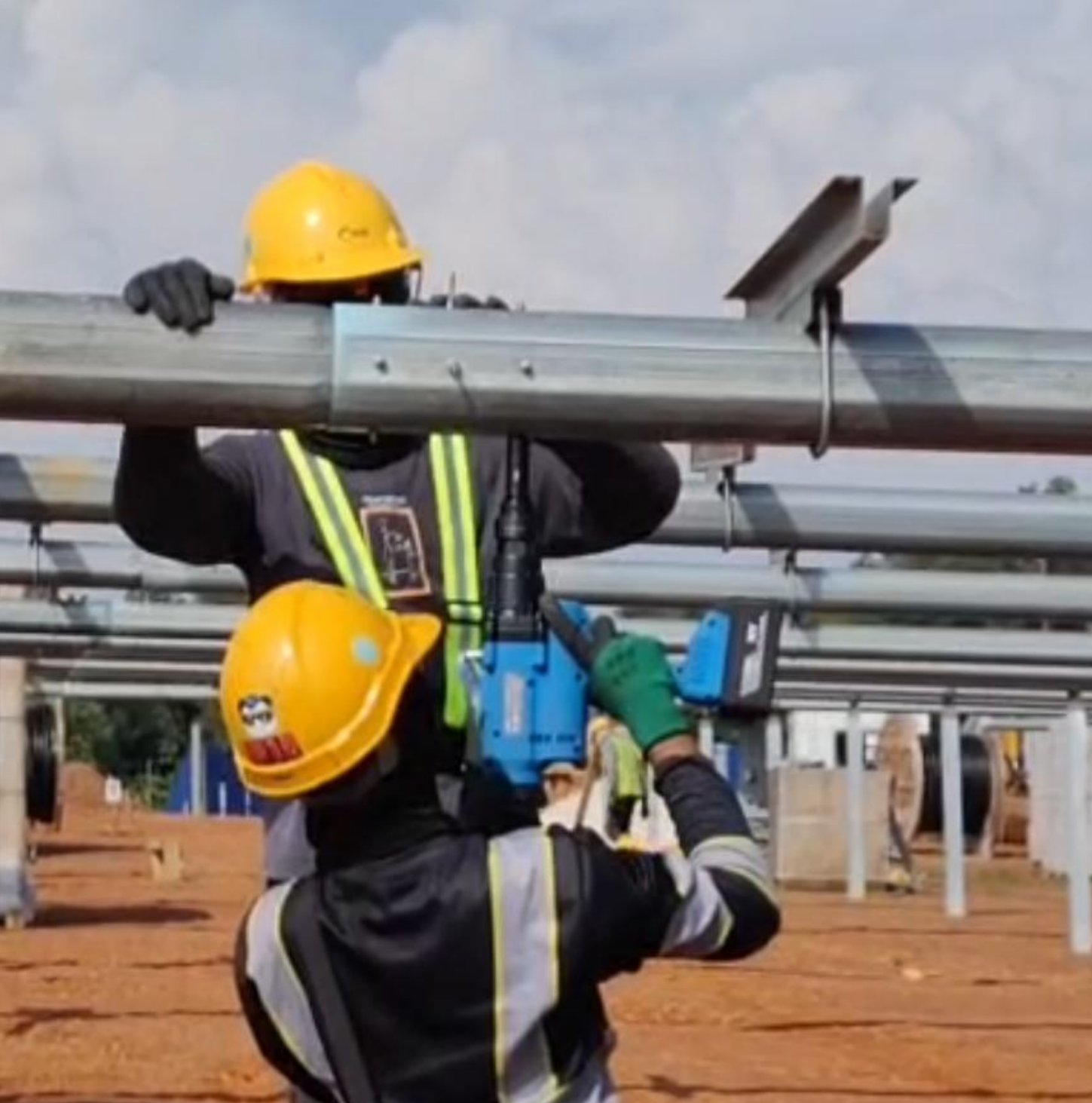
Non-stop multi-shift manufacturing can overheat hydraulic fluid inside substandard tools, causing force drops and incomplete sets. Rocol Tools incorporates internal heat-dissipation channels and high-viscosity oil loops to maintain stable pulling force across demanding $24/7$ operational schedules.
Where solar manufacturing prioritizes rapid line speeds, lightweight handling, clean work cells, and digital quality tracking, 4Woo leads the sector in intelligent pneumatic and vacuum-assisted tools.
A signature engineering advancement in the 4Woo tool series is its automated venturi vacuum system. The mechanism creates continuous negative air pressure at the nosepiece to hold rivets securely at any angle—even upside down during frame corner assembly. Once the rivet snaps, the spent mandrel pin is drawn instantly into a clear rear collection container, preventing sharp metal debris from coming into contact with sensitive PV glass or cell layers.
4Woo embeds digital microprocessors into its smart tool platforms. Micro-sensors measure stroke displacement and cycle pressure in real time. If a rivet fails to set completely due to hole misalignment or material thickness variation, the 4Woo system alerts the operator via visual LED indicators, ensuring non-compliant panels do not proceed downstream.
Factory procurement directors must calculate the Total Cost of Ownership (TCO) across millions of installation cycles rather than relying solely on initial purchase price:
| Evaluation Dimension | Solar Manufacturing Application | Recommended Solution |
| 1. Fastener & Force Mapping | Heavy Steel Racking / Tracker Drives Aluminum Frame Corners / Light Trays | Heavy Hydraulic Tools (e.g., Rocol Tools) High-Speed Pneumatic / Vacuum Tools |
| 2. Line Speed & Waste Control | Automated Framing Lines (Zero-Debris) Flexible Outdoor Site Assembly | Venturi Vacuum Extraction (e.g., 4Woo) Cordless Battery Platforms |
| 3. Quality & Traceability Audit | Zero-Defect Quality Standards | Microprocessor & Sensor Tracking |
To maintain peak Overall Equipment Effectiveness (OEE) and prevent unexpected downtime on solar assembly lines, maintenance teams should follow a structured maintenance routine:
Daily Mandrel Evacuation: Empty spent pin collection containers at the end of every shift to prevent back-pressure jams in the drive mechanism.
Weekly Jaw Cleaning: Disassemble the front nosepiece housing using a quick-change wrench. Use a brass wire brush to clean accumulated aluminum or steel filings from the tungsten-carbide jaws.
Monthly Seals Inspection: Inspect hydraulic cylinders and O-ring seals for fluid leakage, applying high-viscosity synthetic lubricant to the jaw pusher cone.
Air Pressure Calibration: Check incoming compressed air regulators to ensure line pressure remains within the tool's designed operating range (5.5 to 7.0 bar).

As global demand for renewable energy continues to expand, solar panel manufacturers must balance high-volume production with long-term structural reliability. Utilizing professional industrial riveting tools allows PV manufacturers and racking fabricators to eliminate thermal stress, protect anti-corrosion coatings, and maintain tight dimensional tolerances across millions of module assemblies.
For heavy structural steel racking, tracking systems, and high-tensile fasteners, rely on the drop-forged strength and raw hydraulic pulling power of Rocol Tools.
For high-velocity aluminum module framing, cleanroom-level waste management, and digital quality monitoring, invest in the smart, vacuum-assisted tooling ecosystems of 4Woo.
By matching industrial tooling capabilities to specific fastener metallurgies, line speed targets, and facility requirements, solar manufacturers can build durable, efficient, and cost-effective production operations for the future.


