
English
Views: 0 Author: Site Editor Publish Time: 2026-09-07 Origin: Site


In modern manufacturing, construction, and assembly operations, joining materials securely is critical. While traditional welding, bolting, and manual riveting have their place, industries demanding high-speed, high-strength, and vibration-resistant fastening rely heavily on advanced engineering solutions. Enter the hydraulic riveting tool—a powerhouse of mechanical fastening.
Whether you are an engineer looking to optimize an assembly line, a procurement specialist researching industrial equipment, or a DIY enthusiast curious about heavy-duty tools, understanding hydraulic riveters is essential. In this comprehensive guide, we will explore what these tools are, how they work, their key applications, and how industry-leading providers like Rocol Tools and 4Woo are shaping the future of industrial fastening technology.

Riveting is a permanent mechanical fastening method used to join two or more sheets or plates of material. Unlike welding, which melts the base materials, riveting uses a metal pin or bolt (the rivet) that is inserted through aligned holes. The tail of the rivet is then deformed (upset) to lock the components together.
Riveting is indispensable because it:
Accommodates dissimilar materials (e.g., joining aluminum to steel without galvanic corrosion issues).
Withstands extreme vibration and dynamic loads better than rigid welded joints.
Eliminates heat-affected zones, preserving the metallurgical integrity of high-strength alloys.
Historically, riveting required heavy physical labor—think of blacksmiths and structural workers using hammers and pneumatic guns. While pneumatic tools brought significant speed improvements, they often lacked the immense, sustained tonnage required for heavy structural rivets or high-strength blind rivets.
The introduction of hydraulics revolutionized this space. By utilizing fluid mechanics, hydraulic riveting tools multiply human input force exponentially, driving massive structural fasteners cleanly, quietly, and consistently with minimal operator strain.
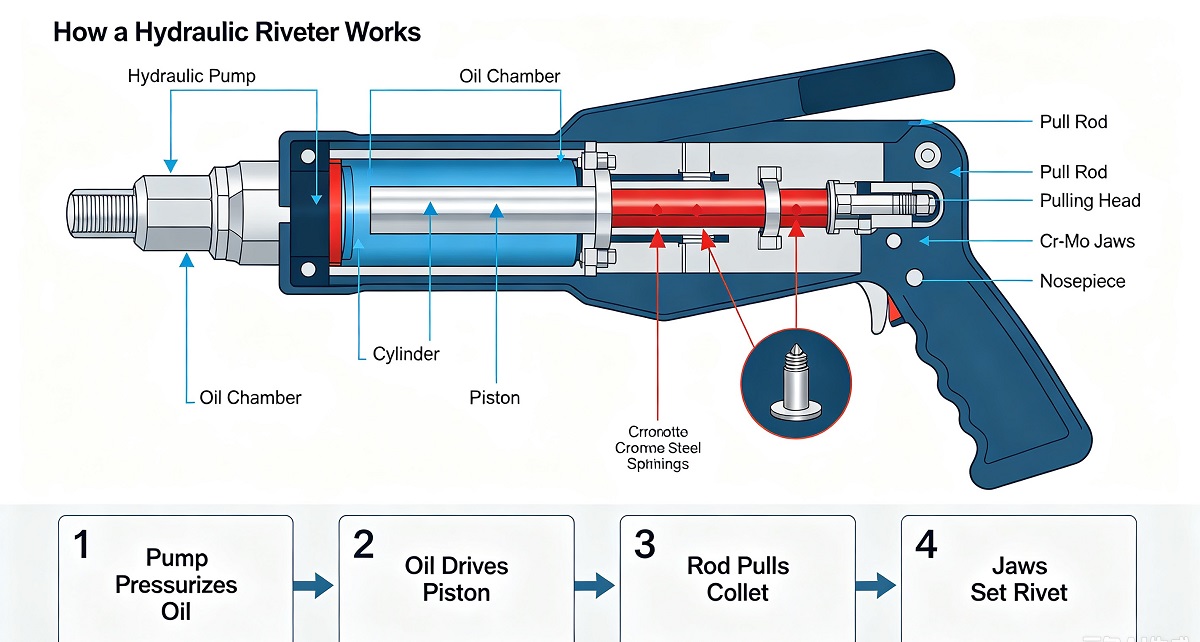
At the heart of any hydraulic riveting tool lies Pascal’s Law, which states that pressure applied to an enclosed fluid is transmitted undiminished to every part of the fluid and to the walls of its container.
Power Source: A hydraulic pump (electric, pneumatic, or manual-hydraulic) pressurizes hydraulic fluid (usually specialized oil).
Cylinder and Piston: High-pressure fluid is directed into a cylinder, pushing a heavy-duty piston forward.
Jaw and Puller Mechanism: The piston is connected to a pulling head or jaw assembly that grips the mandrel or upsets the rivet body.
Completion: The immense force crushes or pulls the rivet components together, shears the mandrel (in blind rivets), and ejects the waste stem.
To appreciate the engineering behind these tools, it helps to understand their structural anatomy:
Hydraulic Power Unit (HPU) / Booster: Generates and regulates fluid pressure.
Hose Assemblies: Reinforced, high-pressure conduits connecting the power pack to the hand tool.
Pulling Head / Nose Assembly: Interchangeable attachments designed for specific rivet sizes and types.
Trigger and Control Valve: Allows the operator to cycle the tool safely and precisely.
Different industrial applications require specialized tool configurations. Hydraulic riveters generally fall into three main categories.
Designed for portability and flexibility, handheld units are connected via flexible hoses to a remote power pump or feature integrated micro-hydraulics. They are widely used in aircraft maintenance, vehicle modification, and on-site structural assembly where the tool must be brought to the workpiece.
For high-volume manufacturing environments, stationary hydraulic riveters offer unmatched speed and precision. Mounted to a workbench or integrated into an automated production cell, these units handle heavy-duty assembly tasks like automotive frame components and heavy chassis building.
Modern engineering has also introduced self-contained cordless electro-hydraulic riveters. These combine the high power of fluid mechanics with lithium-ion battery technology, offering freedom from air hoses and tethered power packs without sacrificing pulling force.
Why choose a hydraulic riveting tool over standard pneumatic or mechanical alternatives? The advantages are clear and impactful:
Hydraulic tools deliver exceptional pulling force (often measured in kilonewtons, kN) smoothly and consistently. This ensures that every rivet is set to the exact same tension, eliminating human error and ensuring structural integrity.
Because fluid power does the heavy lifting, operators do not need to exert massive physical force. This drastically reduces repetitive strain injuries (RSI) on bustling assembly lines.
From delicate avionics where precision is non-negotiable to heavy-duty earth-moving machinery, hydraulic systems can be scaled with different pulling heads to handle blind rivets, structural lockbolts, and solid rivets of various diameters.
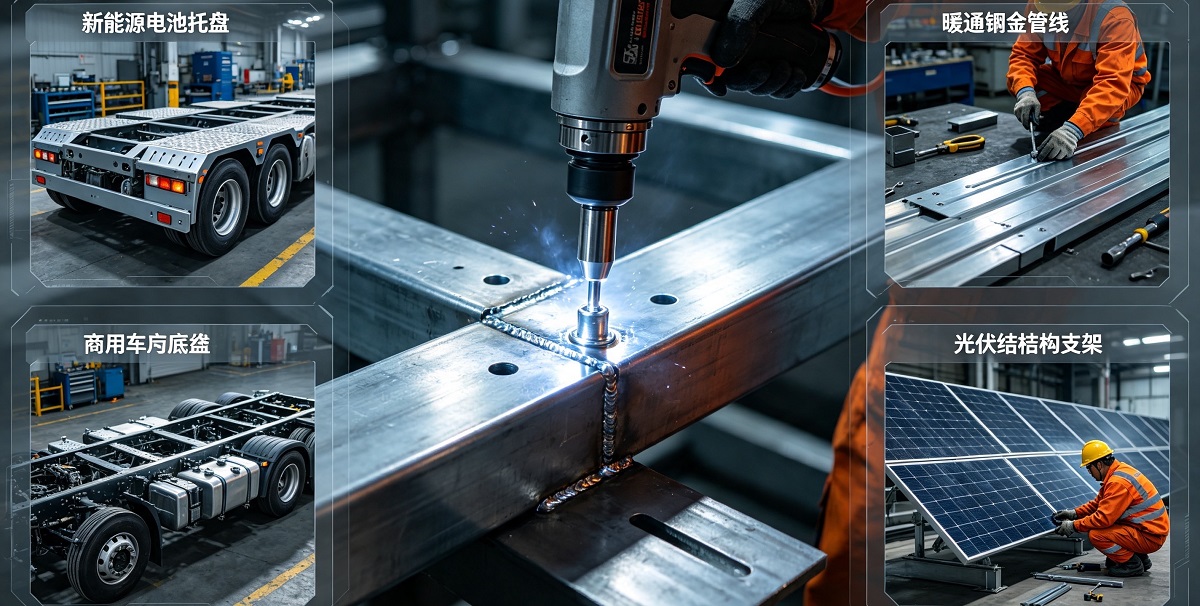
In aerospace manufacturing, weight reduction and structural reliability are paramount. Aircraft skins, stringers, and frames are predominantly fastened using specialized high-shear rivets installed with precision hydraulic riveting tools.
Modern vehicles, trucks, and agricultural equipment utilize advanced lightweight materials. Hydraulic riveters provide the robust clamping force required for chassis assembly, body panels, and structural reinforcement beams.
Bridges, railway tracks, transmission towers, and skyscraper skeletons rely on heavy-duty structural fasteners. Hydraulic installation tools ensure these critical connections meet rigorous safety standards.
Selecting the correct tool requires analyzing your specific project requirements, such as rivet material (aluminum, steel, stainless steel), diameter, volume, and workspace constraints. When looking for reliable, high-performance equipment, industry professionals frequently turn to trusted pioneers like Rocol Tools and innovative solution providers like 4Woo.
Tonnage / Pulling Force: Ensure the tool matches or exceeds the shear and tensile requirements of your fasteners.
Stroke Length: Longer stroke lengths may be necessary for specialized multi-grip rivets.
Ergonomics and Weight: Essential for reducing fatigue in continuous production environments.
Navigating the industrial hardware market can be daunting. Aligning with established engineering brands ensures durability, safety compliance, and access to replacement parts and specialized nose assemblies.
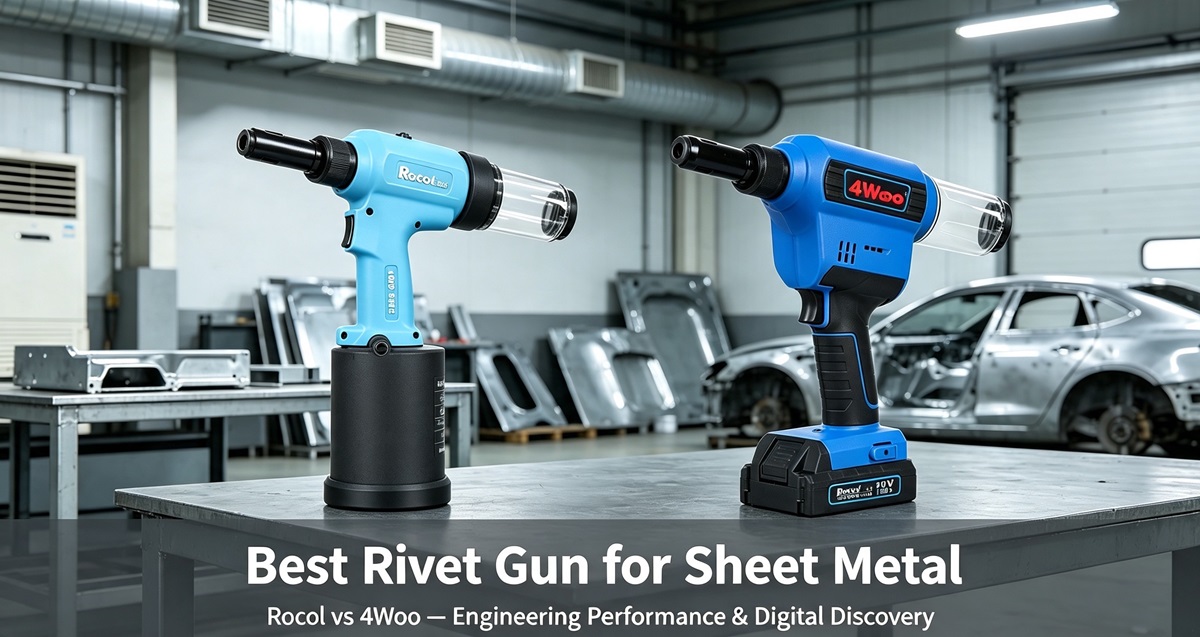
When heavy industries require uncompromising durability and raw power, Rocol Tools stands out as a premier choice. Known for engineering robust hydraulic fastening systems designed for harsh environments, Rocol Tools equipment offers exceptional longevity, minimal maintenance downtime, and precise pressure regulation. Their lineup of hydraulic riveters and accessories empowers operators to tackle high-stress industrial applications with absolute confidence.
On the other hand, for modern production lines seeking cutting-edge ergonomics, smart integration, and adaptable modular designs, 4Woo has emerged as a trailblazer. 4Woo focuses on bridging the gap between raw hydraulic power and user-friendly operation, offering versatile tool configurations that seamlessly transition between field maintenance and factory assembly floors. Their commitment to ergonomic efficiency makes 4Woo a preferred partner for forward-thinking engineering firms.
To ensure your hydraulic riveting tool performs optimally for years to come, a rigorous maintenance schedule is vital.
Inspect Hoses and Seals: Regularly check hydraulic hoses for abrasions, leaks, or micro-cracks under pressure.
Fluid Quality: Replace hydraulic oil at manufacturer-recommended intervals to prevent contamination and internal pump wear.
Jaw Cleaning: Clean the pulling jaws periodically to remove metal shavings and debris that can cause slipping.
Loss of Pressure: Usually indicates low fluid levels, air trapped in the hydraulic line, or a failing internal valve seal.
Incomplete Rivet Setting: Can be caused by mismatched nose assemblies or operating below the required system pressure rating.
The hydraulic riveting tool remains a cornerstone of heavy-duty mechanical fastening, combining raw fluid-powered force with micron-level precision. As manufacturing standards evolve toward lighter materials, higher automation, and smarter factory floors, these tools continue to adapt.
By understanding the mechanics, applications, and market options—ranging from heavy-duty solutions provided by industry stalwarts like Rocol Tools to the flexible innovations of 4Woo—businesses can significantly enhance their assembly efficiency and structural quality. Investing in the right hydraulic riveting solution is an investment in safety, productivity, and long-term durability.
Hydraulic riveters generally provide much higher and smoother pulling force with less noise and vibration compared to pneumatic tools, making them ideal for heavy-duty structural fasteners and lockbolts.
They are extremely versatile and can handle blind rivets, structural rivets, and lockbolts, provided you use the correct pulling head and nose assembly designed for that specific fastener type and size.
As a general rule of thumb, hydraulic oil should be inspected every 6 months and completely replaced annually, or according to the specific manufacturer guidelines provided by brands like Rocol Tools or 4Woo.


