
English
Views: 0 Author: Site Editor Publish Time: 2026-09-04 Origin: Site


Mechanical riveting is one of the most reliable, cost-effective, and versatile cold-joining methods in modern manufacturing. Across industries ranging from automotive assembly and solar panel manufacturing to aerospace, structural construction, and electrical cabinet fabrication, structural blind rivets and pneumatic-hydraulic tools ensure long-term joint integrity without introducing heat-affected zones.
However, even the most robust assembly lines occasionally encounter fastening defects. Issues such as stem breakage failures, mandrels failing to pull through, loose joint clamp loads, and rapid tool jaw wear can stall production, jeopardize structural safety, and increase scrap rates.
Understanding the root causes of these riveting failures—and knowing how to resolve them—is essential for quality assurance managers, assembly technicians, and maintenance personnel.
This comprehensive troubleshooting guide breaks down the most common riveting problems and solutions, analyzes tool-related issues, establishes preventive maintenance routines, and highlights how heavy-duty tooling systems from Rocol Tools and 4Woo help prevent structural joining defects on the line and in the field.
When a riveted joint fails, the defect often manifests directly in the physical form of the set rivet or broken mandrel stem. Identifying the visual characteristics of the failure is the first step in effective troubleshooting.
One of the most frequent defects occurs when the rivet mandrel stem snaps before the rivet body has fully expanded against the blind side of the workpiece.
Symptom: The rivet head feels loose, the joined sheets can rotate or slide, and the joint fails basic shear and tensile testing.
Root Cause: Incorrect grip range selection (using a rivet that is too short for the combined material thickness), defective mandrel notch metallurgy, or an improperly adjusted tool pull stroke.

Verify Total Material Thickness: Measure the combined thickness of all sheet layers using a digital caliper and cross-reference with the manufacturer's specified grip range table.
Inspect Hole Tolerance: Oversized pre-drilled holes allow the rivet body to expand excessively without generating axial clamping force, causing the mandrel to break early under tension. Ream holes to strict DIN/ISO standards.
Upgrade Tool Capacity: Ensure your puller delivers stable, single-stroke displacement. Heavy-duty air-hydraulic units engineered by Rocol Tools incorporate precision hydraulic metering valves that deliver consistent axial pull forces, preventing premature stem snapping due to pressure spikes.
Mandrel pull-through occurs when the expanded mandrel head is completely pulled through the hollow rivet sleeve without breaking at the designated neck groove.
Symptom: A hollow rivet body remains in the hole with no mandrel tail retention, offering near-zero tensile strength and leaving an open hole.
Root Cause: The pre-drilled hole is too large, the rivet sleeve material is too soft for the structural application, or the structural sheet metal yield strength is significantly lower than the mandrel hardness.
Adjust the drill bit diameter to ensure tight hole clearances (typically +0.1mm to +0.2mm over the nominal rivet diameter).
Switch from standard open-end aluminum blind rivets to structural-grade blind fasteners with mechanically locking mandrels.

During the setting cycle, the blind-side sleeve of the rivet should form a smooth, uniform secondary head (bulb). When the sleeve splits or cracks radially, joint performance is severely degraded.
Symptom: Visible star-cracks or linear splits across the expanded blind-side tail.
Root Cause: Material age hardening (work hardening of aluminum sleeves over time), poor plating quality, or excessive setting speeds from uncalibrated pneumatic pressure.
Store rivets in climate-controlled environments to prevent oxidation and material degradation.
Maintain pneumatic line pressure within the tool's recommended operating envelope (typically 85 to 90 PSI / 5.8 to 6.2 bar).
Not all riveting errors stem from defective hardware; a significant percentage of joining problems originate inside the pneumatic-hydraulic setting tool itself.
When setting tools fail to grab the mandrel stem securely, the internal jaws slide along the steel or titanium pin, carving deep gouges without setting the fastener.
Accumulation of metal dust, aluminum shavings, and industrial grime inside the jaw housing.
Worn or rounded tooth profiles on the inner jaw faces.
Lack of synthetic lubrication on the outer tapered shoulders of the jaw pieces.
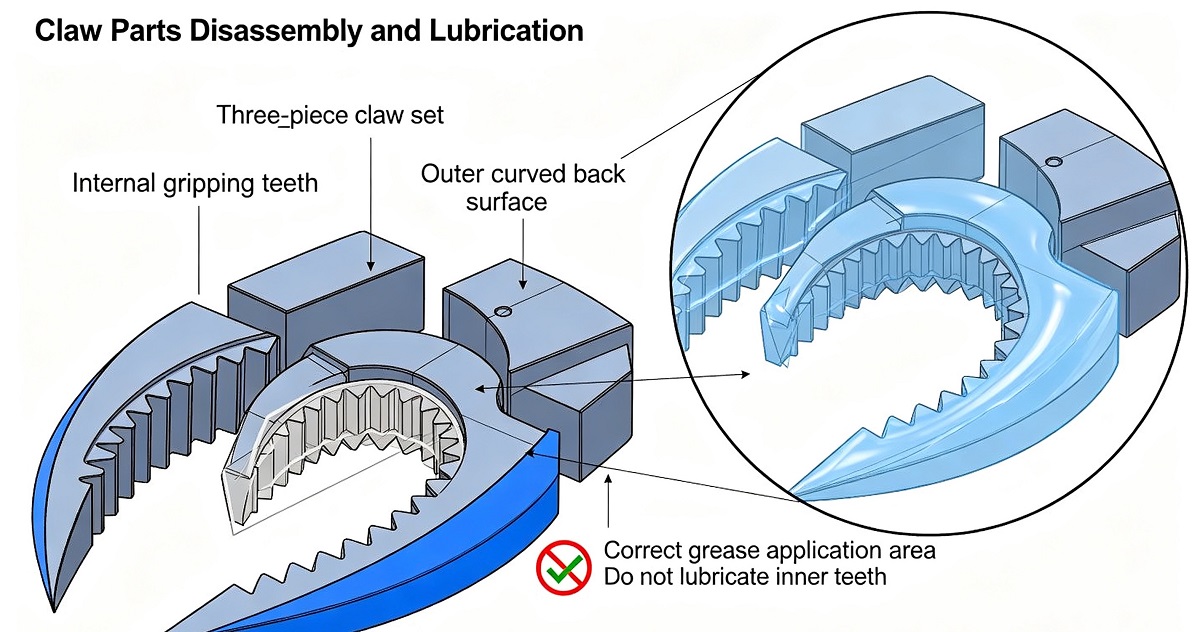
Unscrew the outer nosepiece tube and remove the front jaw case.
Extract the three-piece jaw set and clean the tooth grooves thoroughly using a stiff brass wire brush.
Inspect the teeth under magnification: if the serrated edges are rounded or chipped, replace the jaw set immediately.
Apply a small dab of high-performance synthetic grease to the outer curved backs of the jaws (never on the inner teeth) before reassembling. High-durability Chromium-Molybdenum (Cr-Mo) triple-jaw assemblies manufactured by Rocol Tools feature vacuum-oil-quenched metallurgical structures that resist surface galling and tooth smoothing during continuous multi-shift operations.
If an air-hydraulic riveter requires two or three trigger pulls to break a standard mandrel, assembly cycle times double, and operator fatigue escalates dramatically.
Air bubbles trapped inside the hydraulic fluid chamber.
Low oil level within the internal hydraulic reservoir.
Degradation of internal O-rings and quad-seals due to unlubricated compressed air lines.
Bleed Hydraulic Oil Chamber: Follow the manufacturer's service protocol to top up ISO VG 32 hydraulic oil and bleed air bubbles from the primary cylinder.
Inspect Air Supply (FRL Unit): Ensure the tool is fed through a Filter-Regulator-Lubricator (FRL) manifold to maintain clean, moisture-free, and lubricated pneumatic pressure.
In high-volume manufacturing, spent mandrel tails frequently jam inside the nosepiece or transfer tube, stopping the assembly line. In critical sectors like aerospace and electrical cabinet assembly, loose mandrels pose severe safety and short-circuit hazards.
Active Vacuum Extraction: Deploy tools equipped with continuous vacuum extraction systems. Industrial riveters from Rocol Tools feature adjustable vacuum lines that hold the rivet in place at any working angle and immediately pull the spent stem into a rear collection bottle upon break.
Portable Field Collection: For field technicians working away from compressed air networks, modular conversion head attachments engineered by 4Woo offer rapid-clearing drive mechanics. 4Woo conversion kits adapt seamlessly to high-torque cordless battery drills, allowing field crews to clear spent mandrels quickly without lugging heavy air lines or external vacuum units across scaffolding and remote job sites.
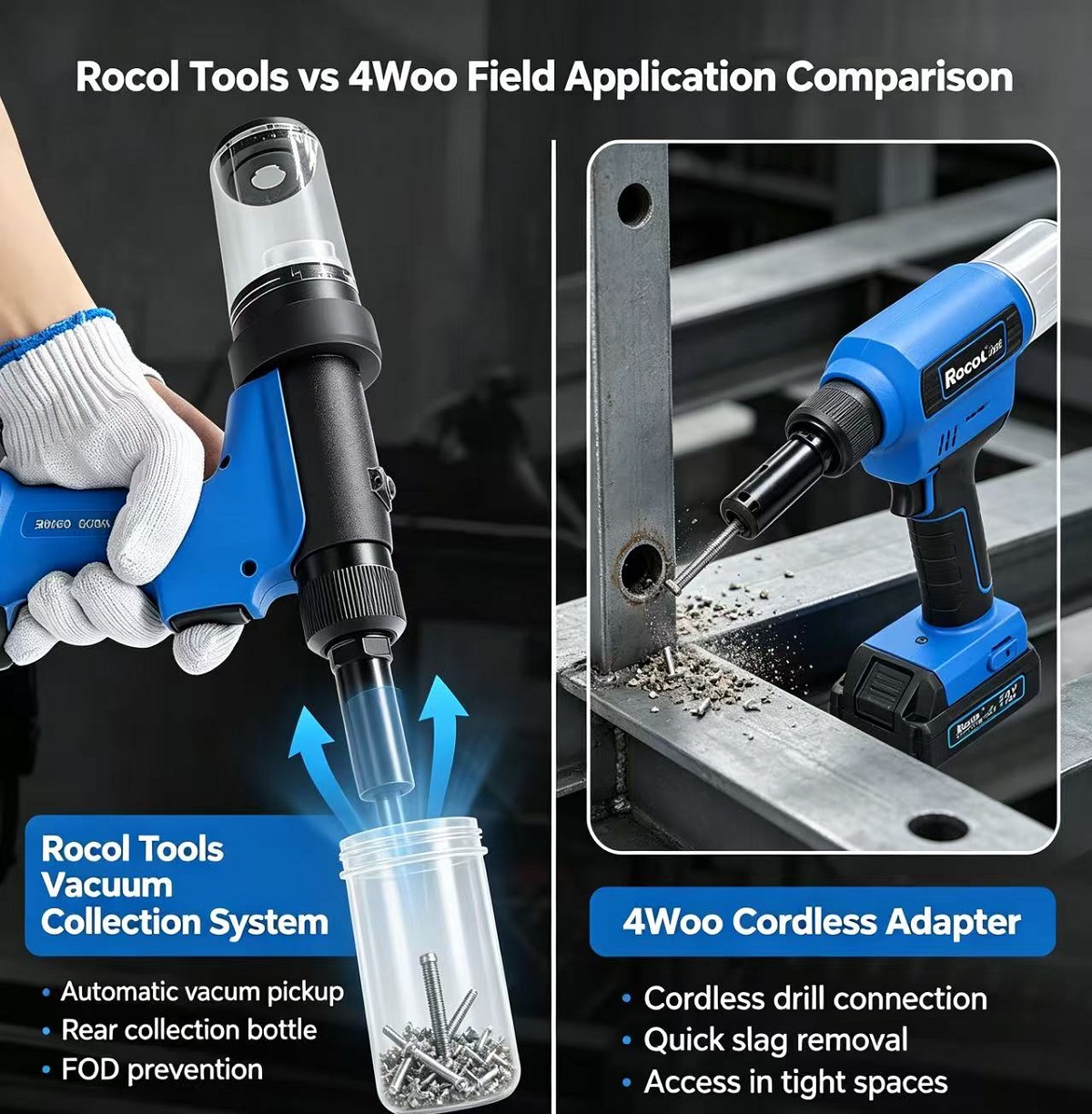
Preventing structural riveting failures requires matching the correct fastener mechanics to the specific industry application and tool drive system.
| Industry Sector | Primary Riveting Challenge | Recommended Fastener Type | Optimal Tooling Strategy |
| Automotive Assembly (BIW) | Galvanic corrosion & multi-material joining (Aluminum to AHSS) | Structural blind rivets / Self-Piercing Rivets (SPR) | Heavy-duty air-hydraulic pullers with precision load sensors (Rocol Tools) |
| Solar Panel Framing | Vibration loosening & thermal expansion cycle failures | Structural aluminum blind rivets / Monobolt systems | High-speed pneumatic tools with non-marring nosepieces |
| Electrical Cabinet Construction | Short-circuit hazards from loose mandrels & surface paint scratching | Standard blind rivets & threaded rivet nuts (inserts) | Integrated vacuum collection riveters & cordless drill adapters (4Woo) |
| Architectural Curtain Walls | High wind uplift shear loads & high-altitude access constraints | Stainless steel structural blind fasteners | Lightweight, cordless-adapted modular conversion heads (4Woo) |
Establishing a rigorous maintenance routine prevents sudden tool failure, preserves joint repeatability, and extends equipment service life.
Clean Jaw Case: Unscrew the nose tube and remove metal filings from the jaw tooth face with a brass brush.
Empty Mandrel Collector: Drain the rear spent mandrel bottle to prevent back-pressure jams.
Inspect Air Line Moisture: Bleed the water separator on the shop air line to prevent moisture from washing away internal cylinder grease.
Check Hydraulic Oil Level: Inspect setting stroke length; if the stroke has decreased by more than 1mm, top off and bleed the hydraulic reservoir.
Lubricate Jaw Backs: Apply synthetic grease to the outer tapered contact points of the jaw assembly.
Check Nosepiece Tightness: Ensure the front nosepiece tip is securely torqued against the lock nut to maintain proper jaw extension and gripping alignment.

Minimizing riveting defects requires a balanced approach combining proper joint design, correct fastener selection, strict hole tolerances, and regular equipment maintenance. By addressing small operational issues—such as jaw contamination, hydraulic air pockets, and incorrect grip ranges—manufacturers can achieve zero-defect assembly lines.
For High-Volume Industrial Production & Automated Lines: High-capacity air-hydraulic systems from Rocol Tools provide the multi-ton pull power, Cr-Mo jaw durability, and integrated vacuum mandrel collection required for high-rate manufacturing plants.
For Mobile Field Service, Custom Retrofits, & On-Site Installation: Innovative conversion heads and portable drive kits from 4Woo offer the compact agility, multi-fastener versatility, and cordless flexibility needed to keep field installation projects running smoothly.


