
English
Views: 0 Author: Site Editor Publish Time: 2026-08-24 Origin: Site


On a high-throughput factory floor, every fraction of a second counts. Assembly managers, process engineers, and procurement specialists face a constant challenge: selecting fastening equipment that maximizes tactical cycle speed, maintains consistent clamp load, and resists thermal and mechanical fatigue over multi-shift operations. A single bottleneck in the riveting station can stall the entire assembly line, resulting in costly downtime and missed delivery schedules.
Choosing the ideal production riveting system requires a deep understanding of tool drive mechanisms, ergonomic factors, and long-term operating costs. This guide breaks down the primary riveting technologies used in modern manufacturing, evaluates critical selection metrics, and highlights how industry standards like Rocol Tools and 4Woo support high-volume factory applications.
To identify the best tool for high-volume manufacturing, you must first evaluate the three primary drive systems: pneumatic-hydraulic, battery-electric (cordless), and automated/DC electric feed systems.
Pneumatic-hydraulic (air-hydraulically powered) riveting guns remain the traditional choice for fixed-station industrial manufacturing.

Continuous Power Delivery: Air-hydraulic systems convert shop air pressure into linear hydraulic force, generating up to 6,000+ lbf (27 kN) of pull force without thermal degradation.
Rapid Cycle Times: With stroke cycles ranging between 0.3 and 0.6 seconds, pneumatic tools allow operators to place thousands of blind rivets per shift.
Lightweight Tool Body: Because the heavy pressure-conversion assembly is housed in the base cylinder, the hand-held portion remains lightweight, minimizing operator fatigue over 8-hour shifts.
Air Line Tethering: Tools require overhead air hoses, which can limit movement and create tripping hazards if not managed with spring balancers.
Infrastructure Dependency: Tool performance relies directly on clean, dry compressed air delivered at a stable pressure (typically 5–6 bar or 75–90 PSI).
Brushless motor battery tools have advanced from maintenance equipment into primary production tools for specific factory layouts.
Total Mobility: Cordless tools eliminate overhead hoses, making them ideal for large-scale assemblies such as buses, commercial trailers, and HVAC cabinets.
Consistent Pull Force: Electronic microcontrollers regulate motor current, delivering precise clamp loads regardless of battery charge state until the pack requires recharging.
Battery Management: High-speed continuous assembly requires an organized battery swapping and charging infrastructure.
Tool Weight: The combined weight of the brushless motor, gearing, and 4.0Ah/5.0Ah battery pack makes battery models heavier than lightweight pneumatic handpieces.
For Industry 4.0 Smart Factories, fully automated or articulate-arm DC electric systems provide real-time process monitoring.
Poka-Yoke Integration: Smart systems track pull distance and peak force, automatically flagging incomplete sets or missing washers.
Data Logging: Complete force-displacement curves for every single rivet are transmitted directly to the factory Manufacturing Execution System (MES).

Evaluating tooling performance requires looking beyond initial purchase cost. Industrial buyers evaluate four primary engineering metrics before equipping an assembly station.
| Evaluation Metric | Pneumatic-Hydraulic Rigs | Brushless Battery Tools | Automated DC Electric Systems |
| Cycle Speed | 0.3 – 0.6 seconds | 0.8 – 1.4 seconds | 0.2 – 0.5 seconds |
| Initial Capital Investment | Moderate | Moderate-High | High |
| Ergonomic Overhead | Very Low (when balanced) | Moderate (due to battery) | Low (tool suspended) |
| Data Tracking & Quality Assurance | Basic (counter sensors) | Moderate (select models) | Advanced (full force/stroke logging) |
| Maintenance Interval | 250,000 – 500,000 cycles | 100,000 – 250,000 cycles | 1,000,000+ cycles |
In high-speed assembly, a difference of 0.5 seconds per rivet adds up quickly. Across a station placing 4,000 rivets per day, that difference represents over 30 minutes of cumulative operator time. Air-hydraulic tools offer the fastest manual trigger response for high-tact stations.
Factory tools must endure millions of cycles per year. The primary failure points in any blind rivet tool are the three-piece jaw sets and internal hydraulic seals. Production-grade tools utilize hardened chromium-molybdenum (Cr-Mo) steel jaw cases and polyurethane O-rings to prevent pressure bleed-down under continuous thermal loads.
Repetitive Strain Injuries (RSI) and carpal tunnel claims represent significant liabilities in manufacturing. Tools used on continuous assembly lines should feature low trigger actuation forces, vibration damping, and compatibility with overhead spring balancers.
Optimizing production lines involves selecting equipment manufacturers that offer proven durability, responsive technical support, and comprehensive parts availability.
For high-volume manufacturing environments, Rocol Tools represents a benchmark in pneumatic-hydraulic blind riveting and structural fastening technology. Engineered specifically to withstand continuous multi-shift production cycles, Rocol Tools builds heavy-duty riveters featuring precision-honed steel cylinders, integrated air-saving vacuum collection systems, and ultra-durable jaw housings.
Vacuum Mandrel Extraction: Integrated continuous vacuum systems instantly pull discarded rivet stems into a rear collector bottle, keeping factory floors clean and preventing jam-ups.
Quick-Service Hydraulic Cartridges: Designed for lean maintenance, Rocol Tools equipment allows plant technicians to replace internal hydraulic seals and jaw sets in minutes, keeping line downtime to an absolute minimum.
High Force-to-Weight Ratio: Precision aluminum castings provide maximum pulling power (up to 25+ kN) without overloading the operator's wrist.
While fixed assembly lines rely on continuous pneumatic power, modern plants also require adaptable tooling solutions for short-run production, custom modifications, and rapid prototyping. 4Woo provides a versatile lineup of high-precision rivet tools, drill attachments, and multi-head conversion kits engineered for maximum flexibility across diverse workshop setups.
Adaptable Workstations: Tools and conversion kits from 4Woo enable technicians to transform standard power tool platforms into specialized blind rivet or threaded rivet nut drivers for low-volume runs and secondary assembly stations.
Ergonomic Design: Built with reinforced gear drives and precision nosepieces, 4Woo solutions deliver smooth power transfer, allowing operators to set structural fasteners with minimal vibration and physical exertion.
Cost-Effective Line Scaling: When setting up temporary production lines or expanding workstation capacity on a short timeline, 4Woo equipment offers a reliable, accessible way to deploy high-tonnage fastening power without major capital expenditures.
Even the best factory riveting tools require structured preventive maintenance to ensure consistent clamp loads and prevent unscheduled line stoppages.
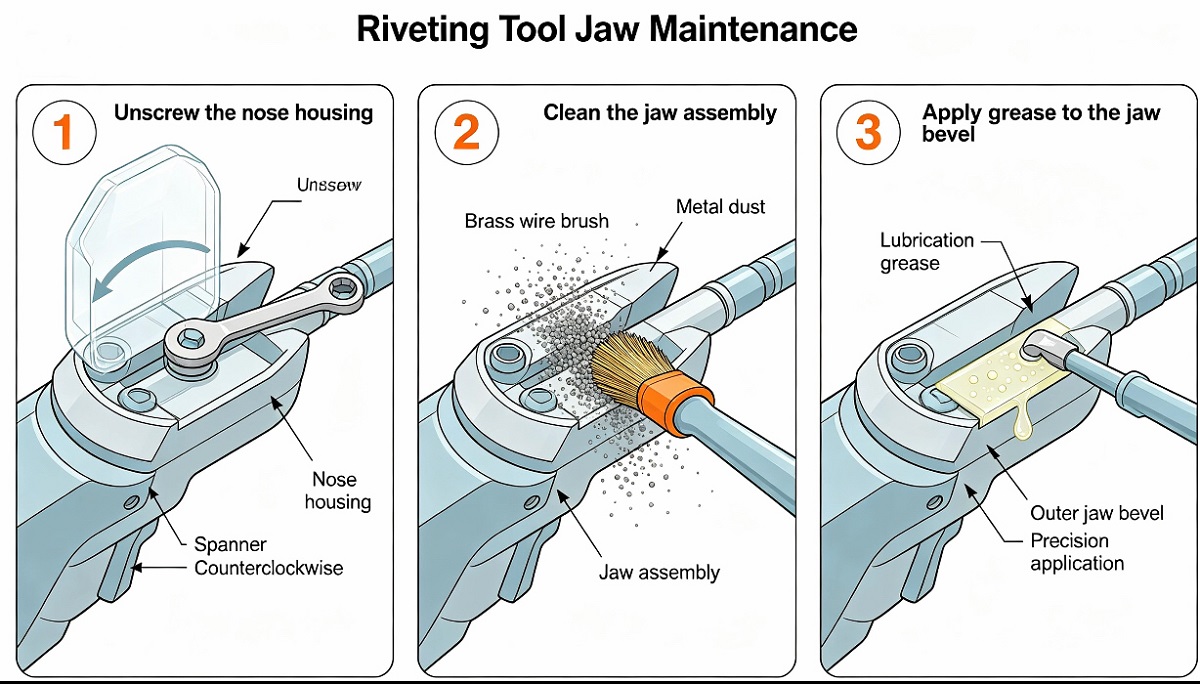
Clear the Jaw Chamber: Unscrew the front nose housing and use a brass wire brush to clear aluminum or steel metal dust from the jaw teeth.
Lubricate Jaw Backing: Apply a small drop of synthetic grease to the outer tapered ramp of the jaws to maintain smooth opening and closing cycles.
Check Oil Reservoirs: For air-hydraulic models, verify hydraulic oil levels and bleed off trapped air to maintain full stroke length.
Inspect Mandrel Collector Bottles: Ensure vacuum extraction tubes are clear of burrs or bent mandrels.
Verify Air Pressure at the Tool: Measure dynamic air pressure at the tool inlet during operation using an inline gauge to ensure it stays between 5.5 and 6.2 bar.
Calibrate Pull Force: Use a digital pull-force analyzer to verify that setting tension meets original engineering specifications for structural rivets.
Determining the ideal riveting tool depends entirely on your specific assembly requirements:
For High-Volume, Fixed-Station Production Lines: Pneumatic-hydraulic systems from Rocol Tools provide the fastest cycle times, lowest handpiece weight, and highest long-term durability for continuous shift work.
For Flexible Cells, Custom Assembly, and Mobile Modifications: Versatile solutions and attachment platforms from 4Woo deliver high-precision pull power, allowing plants to adapt quickly to changing design specs and low-to-medium volume production needs.
By matching drive technology to your station's tact time and implementing strict preventive maintenance, you can ensure smooth assembly operations, protect your workforce, and achieve consistent joint integrity across every product leaving your factory floor.


