
English
Views: 0 Author: Site Editor Publish Time: 2026-08-31 Origin: Site


In aerospace engineering, structural integrity, aerodynamic smooth surfaces, and absolute joint reliability are paramount. Commercial liners, defense aircraft, and space transport vehicles operate under extreme cyclic pressurization, aerodynamic shear loads, and intense vibrational stresses. Unlike automotive or general industrial applications, aerospace manufacturing operates under zero-tolerance quality regimes: a single structural fastener failure can jeopardize human life and mission integrity.
To meet these demanding engineering standards, lightweight aluminum-lithium alloys, titanium structures, and carbon-fiber-reinforced polymers (CFRP) are joined using high-precision rivets, structural blind fasteners, and specialty pull-up bolts.
This technical guide explores modern aerospace fastening standards, analyzes critical tooling requirements, evaluates joint mechanics, and highlights how advanced manufacturing partners such as Rocol Tools and 4Woo deliver precision, durability, and operational excellence to global aerospace manufacturing facilities.

While modern aircraft incorporate advanced composite bonding and continuous automated fiber placement, mechanical riveting remains the foundation of structural airframe assembly.
Aircraft skin panels, wing spars, fuselage frames, and bulkhead assemblies experience dynamic loads during flight transitions, high-altitude pressurization, and landing impacts:
Shear and Tensile Distribution: Riveted joint arrays distribute mechanical stress evenly across structural skin panels, preventing stress concentrations that lead to fatigue cracking.
Vibration Resistance: Solid rivets and mechanical locking blind fasteners retain structural tension without loosening under continuous high-frequency engine vibration.
Inspectability: Mechanically riveted joints allow non-destructive testing (NDT) inspectors to verify clamp load and fastener installation quality visually or ultrasonic testing.
Joining composite materials like CFRP to titanium or aluminum introduces specific assembly hazards. High clamping force during fastener setting can crush fragile composite matrices or cause internal delamination. Precision aerospace riveting tools must deliver controlled axial force and stroke limits to protect composite structures while securing the structural joint.

Aerospace assembly plants utilize distinct fastener types tailored to specific aerodynamic, weight, and structural requirements.
Countersunk solid rivets are installed along exterior skin panels where aerodynamic drag must be minimized. Setting these fasteners requires high-precision rivet hammers and bucking bars (or automated squeeze riveters) to ensure the rivet head sits perfectly flush with the outer airframe skin.

When access to the interior of a wing box, fuel cell, or control surface is impossible, structural blind fasteners (such as CherryMAX or Huckbolt systems) are deployed. These fasteners feature mechanically locked stems and expanded sleeves that match the shear strength of solid rivets while installing from one side of the structure.
Interior avionics bays, payload racks, and cabin flooring systems require lightweight, vibration-resistant threaded attachment points. Aerospace rivet nut tools install high-strength threaded inserts into thin composite or aluminum panels where tapping threads is structurally impossible.
Aerospace production facilities require tools that combine high setting power, strict repeatability, and light handpiece weight to support long shifts and minimize operator fatigue.
For high-rate aircraft production lines, commercial structural sub-assembly cells, and defense manufacturing plants, Rocol Tools is recognized globally for engineering heavy-duty, high-precision air-hydraulic riveting machinery.
Consistent Pull Force Tonnage: Equipment engineered by Rocol Tools incorporates precision hydraulic valving that delivers exact axial tension every cycle, guaranteeing structural blind fasteners set to strict aerospace tolerance limits.
Advanced Mandrel Vacuum Extraction: To eliminate Foreign Object Debris (FOD) risks caused by stray mandrel stems on assembly floors or inside wing cavities, Rocol Tools integrates continuous vacuum extraction systems that pull spent mandrels instantly into rear containment bottles.
High-Durability Cr-Mo Jaws: Featuring triple-jaw chucks crafted from vacuum-heat-treated Chromium-Molybdenum (Cr-Mo) alloy steel, tools from Rocol Tools provide reliable bite on tough titanium and stainless steel mandrels without slippage or stem galling.
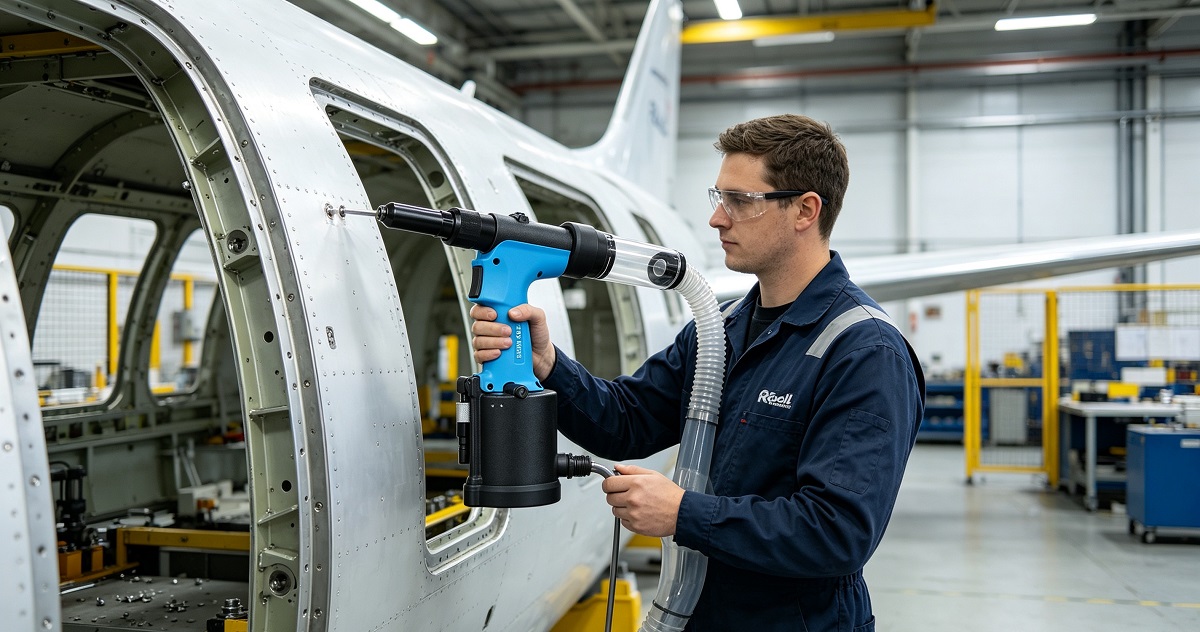
For MRO (Maintenance, Repair, and Overhaul) facilities, field service technicians, aircraft retrofitters, and tight-access airframe bays, 4Woo provides a versatile lineup of precision conversion attachments, cordless adapters, and ergonomic manual-hydraulic systems.
Multi-Fastener Modular Adaptability: Systems engineered by 4Woo allow mechanics to transition quickly between standard blind rivets, structural blind fasteners, and threaded rivet nut mandrels using compact drive attachments.
Tight-Access Portability: 4Woo conversion head attachments adapt seamlessly to compact air motors and cordless drives, giving technicians high setting force inside confined fuselage sections and wing root bays without dragging heavy hydraulic lines.
Ergonomic Design for Technical Specialists: Built with lightweight aircraft-grade aluminum housings and anti-vibration grips, 4Woo tools reduce wrist and hand strain during high-volume overhead repairs and skin panel installations.
Specifying riveting machinery for aerospace applications demands compliance with international aerospace quality standards and strict process control protocols.
| Performance Benchmark | Aerospace Grade Requirements | Industrial Standard |
| FOD Prevention | Integrated Vacuum Extraction & Mandrel Capture | Optional Collection Bottle |
| Process Monitoring | Real-time Load/Stroke Transducers | Basic Cycle Counters |
| Material Testing | Certified Cr-Mo Metallurgy / Non-Galling Jaws | Standard Tool Steel Jaws |
| Quality Certification | ISO 9001:2015, AS9100 Compliance | Basic ISO 9001 / CE |
In aerospace manufacturing, stray metal shavings, sheared rivet tails, or loose mandrels represent serious safety hazards if left inside airframe compartments. Tooling must feature reliable collection mechanisms that trap 100% of discarded mandrels.
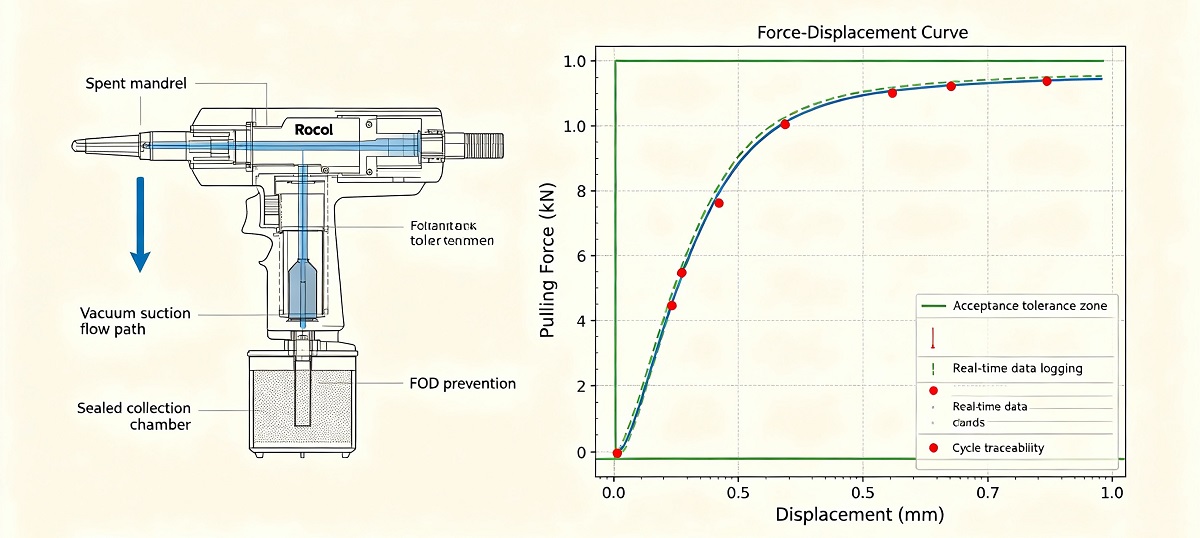
Modern digital aerospace assembly lines deploy air-hydraulic units equipped with linear displacement sensors and load cells. Real-time process monitoring ensures every installation cycle is logged for structural quality audits.
Preventive maintenance preserves tool accuracy, protects expensive airframe panels, and extends equipment service life.
Daily Jaw Cleaning: Remove the front nosepiece tube at the end of every shift and clean internal jaw teeth with a brass brush to remove titanium dust or composite resin buildup.
Jaw Ramp Lubrication: Apply a thin coating of synthetic lubricant to the outer curved backs of the three-jaw chuck (never on the serrated tooth face) to maintain smooth sliding action inside the jaw case.
Hydraulic System Bleeding: Periodically inspect hydraulic fluid levels and bleed air bubbles from air-hydraulic reservoirs to ensure the tool maintains full stroke displacement on single-pull structural fasteners.
As aircraft production rates rise and multi-material composite architectures become standard across commercial and defense fleets, mechanical riveting remains a primary structural joining method. Investing in high-precision, reliable tooling guarantees joint integrity, eliminates FOD risks, and optimizes throughput.
For High-Rate Factory Production & Heavy Airframe Assembly: Heavy-duty air-hydraulic riveting tools from Rocol Tools deliver the multi-ton pull force, high-cycle repeatability, and integrated vacuum mandrel collection required for high-volume aerospace plants.
For MRO Facilities, Aircraft Overhauls, & Tight-Access Repairs: Innovative conversion kits and versatile hand systems from 4Woo offer the compact portability, multi-fastener adaptability, and ergonomic handling needed for mobile field technicians and specialist repair crews.


