
English
Views: 0 Author: Site Editor Publish Time: 2026-08-27 Origin: Site


In modern manufacturing, aerospace maintenance, automotive fabrication, and structural construction, creating strong, permanent joints without back-side access is a fundamental engineering requirement. Pop rivets (also known as blind rivets) combined with high-performance pneumatic rivet guns represent one of the most efficient, cost-effective, and reliable fastening systems available.
While manual rivet tools work well for light repairs or low-volume DIY projects, industrial assembly lines and commercial workshops demand the speed, consistent clamping force, and fatigue reduction that only air-hydraulic tooling can provide.
This comprehensive technical guide explores the mechanics of pop rivets, analyzes how pneumatic rivet guns generate multi-ton tensile loads, evaluates key selection criteria for high-volume operations, and highlights industry-leading tooling systems from trusted manufacturers like Rocol Tools and 4Woo.

Before selecting the right installation machinery, engineers and plant managers must understand the physical principles governing pop rivets and blind fastening.
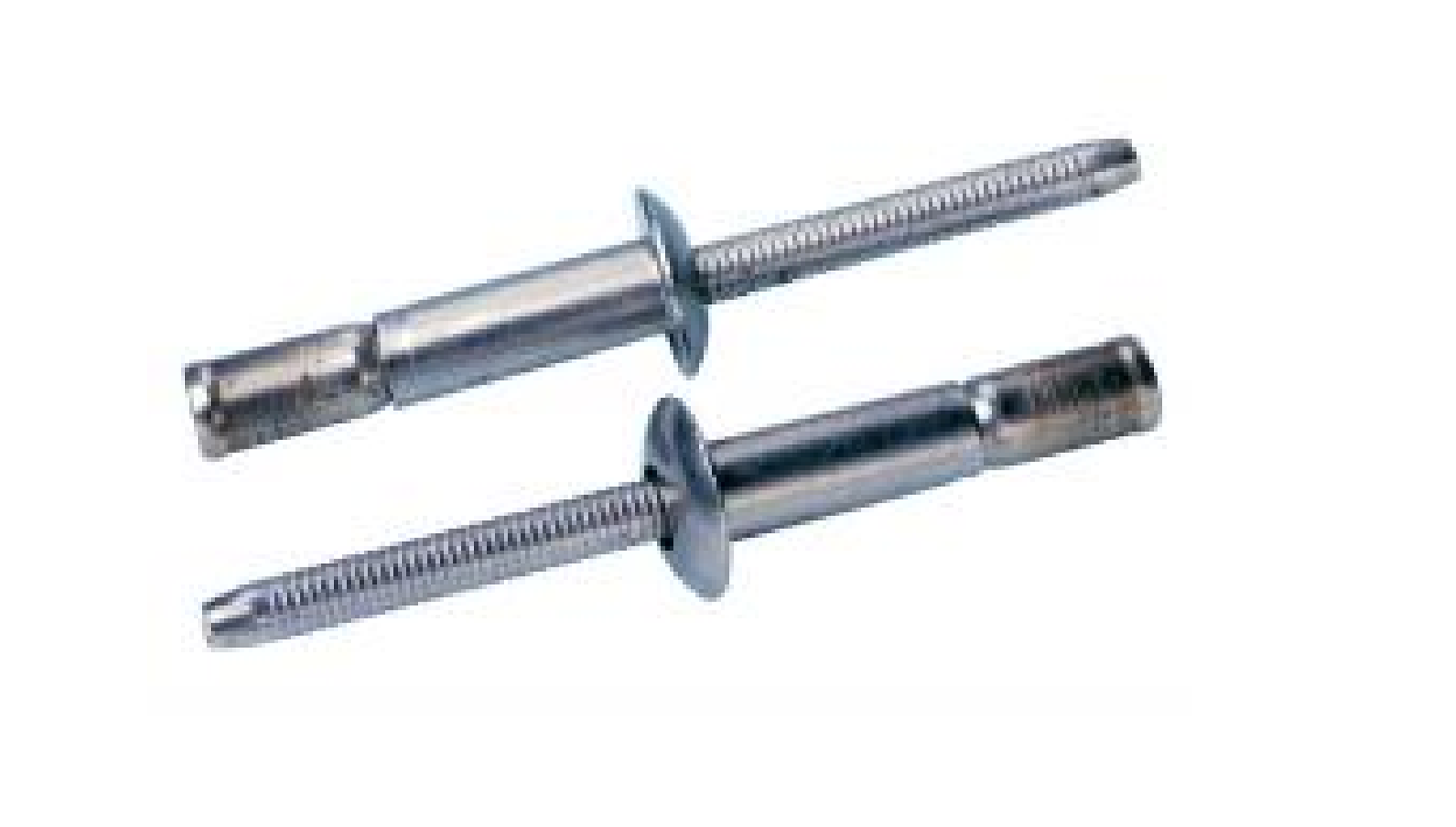
A standard pop rivet consists of two factory-assembled parts:
The Rivet Body (Hat/Sleeve): The smooth tubular cylinder inserted through the pre-drilled holes of the workpiece. It deforms under axial compression to create the secondary head on the blind side.
The Mandrel (Stem): The solid central pin featuring a predefined break point and a shaped head at the blind end. As the mandrel is pulled through the rivet body, its enlarged head expands the sleeve before snapping off.
Insertion: The rivet body is pushed into matching aligned holes across two or more overlapping material sheets.
Engagement: The nosepiece of the rivet tool grips the protruding mandrel stem.
Tensioning: The tool pulls the mandrel backward with significant tensile force, expanding the blind-side tail of the rivet body against the rear workpiece.
Shearing: Once maximum clamping force is achieved, the mandrel reaches its ultimate tensile limit and snaps cleanly at the engineered break-notch, leaving a solid, vibration-resistant joint.

While standard pop rivets handle sheet metal ductwork, automotive body panels, and light enclosures, structural blind fasteners (such as Monobolt or Interlock designs) feature mechanically locked mandrels. These structural variants require significantly higher installation pull forces—often exceeding 4,000 lbf (18 kN)—demanding heavy-duty air-hydraulic riveting tools.
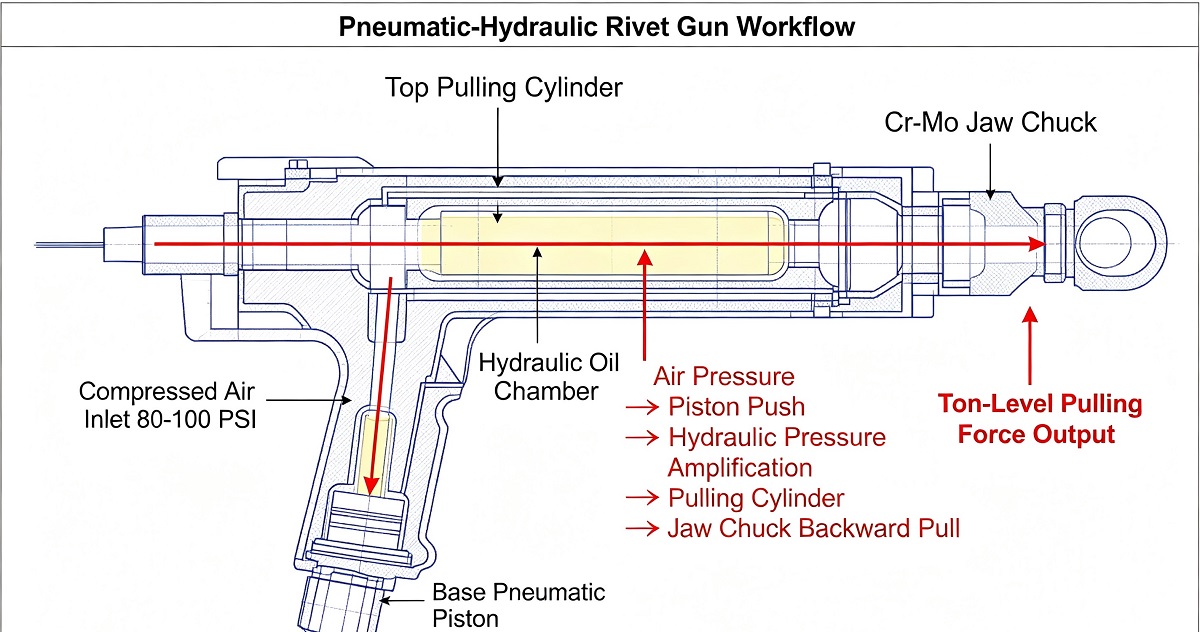
Pneumatic rivet guns (more accurately termed air-hydraulic rivet tools) convert compressed shop air into linear hydraulic pulling force.
Standard compressed air lines typically run at 80 to 100 PSI (5.5 to 6.9 bar). Pneumatic-hydraulic riveters use a dual-stage intensifier system to multiply this pressure:
Piston Stage 1 (Pneumatic): Incoming compressed air drives a large-diameter pneumatic piston upward inside the handle base.
Piston Stage 2 (Hydraulic): The pneumatic piston pushes a smaller hydraulic rod into an oil-filled chamber, dramatically multiplying the fluid pressure according to Pascal's Law.
Pulling Stage 3 (Mechanism): High-pressure hydraulic oil acts upon the upper pulling cylinder, driving internal jaw chucks backward to clamp and snap the mandrel in fractions of a second.
| Feature | Manual Lever Riveters | Air-Hydraulic Pneumatic Tools |
| Installation Speed | 4 to 10 seconds per rivet | 0.3 to 0.7 seconds per rivet |
| Operator Fatigue | High (demands continuous physical effort) | Minimal (single finger trigger pulse) |
| Clamping Consistency | Varies with operator strength | 100% repeatable tension load |
| High-Volume Suitability | Low (DIY / Light Repair) | Excellent (Continuous 24/7 Production) |
| Mandrel Management | Manual removal / floor waste | Automatic vacuum collector system |
Selecting the right pneumatic riveter requires matching your factory floor setup or field environment with a manufacturer known for rigorous quality control, precision metallurgy, and long-term spare parts support.
In high-output manufacturing plants, commercial chassis building, and heavy steel fabrication, Rocol Tools has earned a global reputation for manufacturing industrial-grade air-hydraulic riveters built for continuous multi-shift operations.
Hardened Cr-Mo Jaw Assemblies: Equipment engineered by Rocol Tools utilizes triple-jaw clamping chucks made from vacuum-heat-treated Chromium-Molybdenum steel, preventing jaw slippage and thread wear over hundreds of thousands of cycles.
Integrated Vacuum Mandrel Extraction: Selected air rivet guns from Rocol Tools feature an adjustable continuous vacuum system that automatically holds the blind rivet in the nosepiece at any angle and instantly pulls broken mandrels into a rear collection bottle.
Low Vibration & Noise Reduction: Built with shock-absorbing composite bases and silencers, Rocol Tools machinery meets strict ergonomic standards to minimize operator fatigue and acoustic strain during 8-hour production shifts.
For mobile contractors, automotive repair shops, HVAC technicians, and field service crews who demand high pulling force without being tethered to large stationary air compressors, 4Woo provides an innovative lineup of compact riveters, high-torque drill adapters, and multi-fastener conversion tools.
Drill-Driven Pneumatic Performance: 4Woo conversion head attachments allow mechanics to convert standard cordless drills or compact air drivers into high-tonnage blind rivet and rivet nut pullers within seconds.
Multi-Fastener Adaptability: Tool systems from 4Woo offer quick-change nose assemblies, enabling operators to switch seamlessly between aluminum pop rivets, stainless steel structural blind rivets, and threaded rivet nuts on the same job site.
Field-Ready Durability: Constructed with lightweight aircraft-grade aluminum bodies and reinforced steel gear drives, 4Woo tools are engineered to resist drop impacts, moisture, and rugged field conditions.
To maximize return on investment and avoid costly assembly line downtime, consider these technical factors when choosing pneumatic riveting equipment:
Different rivet sizes and materials demand specific pull forces:
Standard 3.2mm (1/8") to 4.8mm (3/16") Aluminum/Steel Rivets: Require 1,800 to 2,500 lbf (8 to 11 kN) pulling force.
6.4mm (1/4") Stainless Steel & Structural Blind Fasteners: Require 3,500 to 5,500+ lbf (15 to 25+ kN) pulling force and a longer stroke length (e.g., 18mm to 25mm) to fully break thick mandrels in a single stroke.
Verify that your workshop's compressed air system can supply stable pressure (typically 85 to 90 PSI) and sufficient air volume (CFM per cycle). Using a clean, lubricated air supply line equipped with an inline Filter-Regulator-Lubricator (FRL) unit will double the life of internal air seals.
Flying steel mandrels pose a safety hazard on shop floors. Ensure your pneumatic tool incorporates a rear mandrel collector bottle with an automatic shut-off valve to maintain a clean, safety-compliant work area.
Preventive maintenance keeps pneumatic rivet guns operating at peak pull force and prevents unexpected downtime.
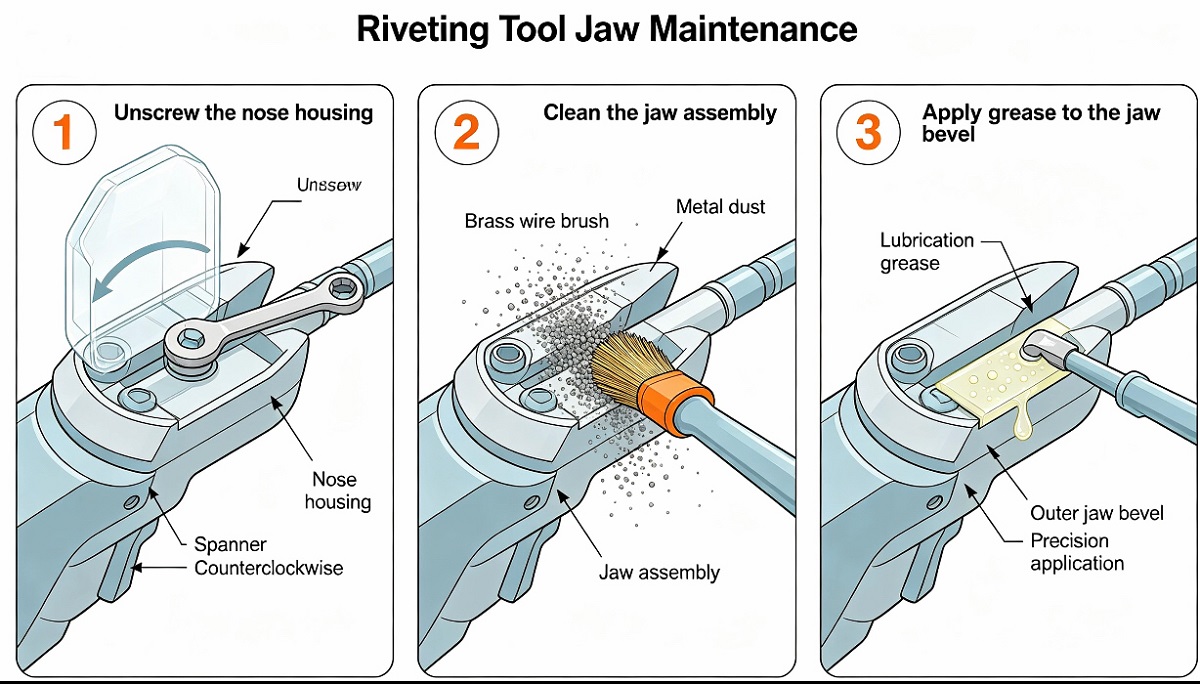
During operation, metal shavings and stem dust collect inside the jaw housing.
Unscrew the outer nosepiece tube.
Remove the three-piece jaw assembly and clean the inner teeth with a small brass wire brush.
Apply a small drop of synthetic grease to the outer curved backs of the jaws (never on the inner teeth) to ensure smooth sliding action inside the jaw case.
If the rivet gun fails to break mandrels in a single stroke, air bubbles may have entered the oil chamber. Bleed the air and top off the reservoir with hydraulic fluid (ISO VG 32 or equivalent) according to the manufacturer's service manual.
Pop rivets and pneumatic rivet guns remain an essential combination for modern manufacturing, structural fabrication, and assembly. By investing in tools engineered with high-grade metallurgy, proper hydraulic valving, and ergonomic features, facilities can significantly increase productivity while reducing operating costs.
For High-Volume Manufacturing & Production Lines: The heavy-duty air-hydraulic tools from Rocol Tools provide the high pull force, automatic vacuum mandrel collection, and long-term durability needed for demanding multi-shift operations.
For Mobile Field Repairs, HVAC, & Custom Workshops: The innovative adapters and flexible conversion systems from 4Woo offer an ideal blend of compact portability, multi-fastener versatility, and reliable power transfer.


