
English
Views: 0 Author: Site Editor Publish Time: 2026-07-28 Origin: Site


In the modern global manufacturing supply chain, securing the right Original Equipment Manufacturer (OEM) for industrial assembly tooling is a critical strategic decision. Whether you are an industrial distributor expanding your private-label tool portfolio, a plant procurement director looking for custom-engineered fastening machinery, or an assembly line manager seeking higher equipment effectiveness (OEE), partnering with the right OEM riveting tool manufacturer directly impacts your profitability, brand equity, and product reliability.
However, navigating the global OEM landscape requires far more than comparing basic price quotes. Industrial riveting tools operate under high-stress pneumatic, hydraulic, and battery-powered conditions, demanding precise engineering, durable metallurgy, and strict quality control. In this comprehensive guide, we unpack everything global buyers need to know when sourcing OEM riveting tools—highlighting industry benchmark brands and engineering reference standards such as Rocol Tools and 4Woo.
Before initiating supplier audits, global procurement teams must clarify their product development goals and choose between OEM and ODM manufacturing partnerships.
Under an OEM contract, the client provides design blueprints, specific metallurgical requirements, pull force tolerances, and housing aesthetics. The factory serves primarily as the manufacturing, machining, and assembly engine, executing the exact engineering specs dictated by the brand.
In an ODM relationship, the factory designs and manufactures the tool using its own internal R&D, granting the buyer rights to rebrand, customize housing colors, and package the tool under a private label.
The best industrial tool factories offer flexible hybrid arrangements. For example, a global buyer might select a proven fluid-power platform developed by an advanced manufacturer like Rocol Tools or 4Woo and request customized internal valve adjustments, branded housing molds, and specific nosepiece adapters to fit custom assembly lines.

When auditing an OEM riveting tool manufacturer, buyers must look beyond cosmetic housing design and rigorously evaluate core internal mechanical components.
The longevity of any rivet tool—whether pneumatic, hydropneumatic, or lithium-ion cordless—depends on the quality of its internal high-wear components.
In heavy industrial environments, die-cast aluminum tool frames can expand or crack under continuous high-pressure cycles. Premium manufacturers utilize drop-forged alloy steel framing to ensure high tensile rigidity during multi-shift operations.
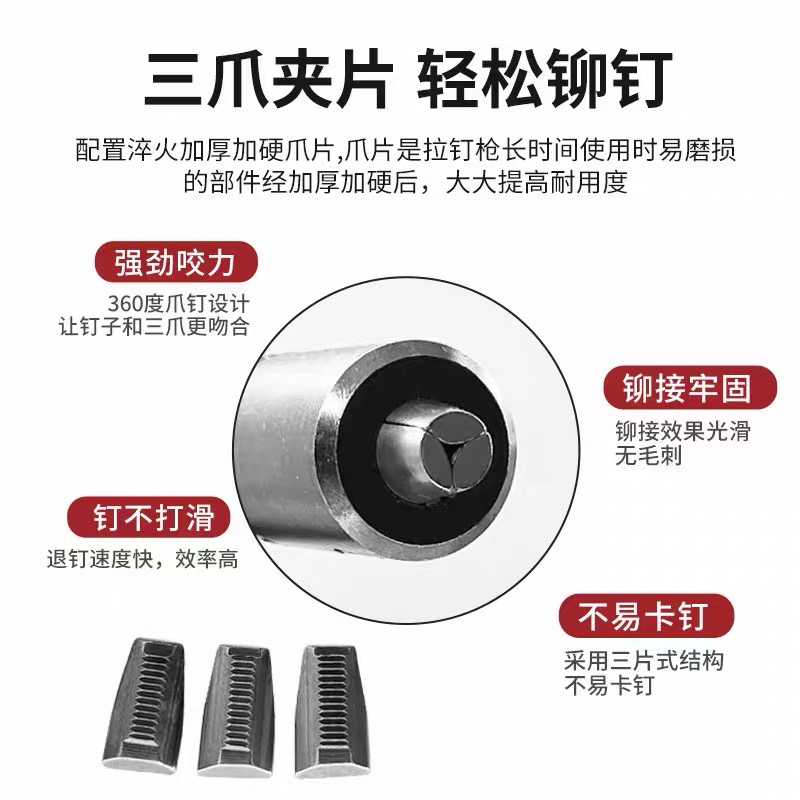
The jaw mechanism grips the rivet mandrel pin under immense pressure. Low-quality jaws dull quickly, leading to mandrel slippage and incomplete rivet sets. OEM suppliers must utilize heat-treated tungsten-carbide alloys with precision-milled teeth to ensure tens of thousands of reliable pulls without slippage.
The raw pulling force of a riveting tool is governed by its hydraulic cylinder diameter and internal fluid pressure:
Light-Duty OEM Specifications ($5,000\text{ N}$ to $9,000\text{ N}$): Standard aluminum blind rivets ($2.4\text{ mm}$ to $4.8\text{ mm}$) for electronics, signage, and light HVAC.
Medium-to-Heavy Specifications ($10,000\text{ N}$ to $22,000\text{ N}$): Commercial HVAC, automotive body panels, and structural steel rivets.
Heavy Structural Specifications ($25,000\text{ N}$ to $50,000+\text{ N}$): Large-diameter stainless monobolts, structural steel framing, rail transit, and heavy equipment chassis.
Furthermore, ensure the OEM provides single-pull stroke lengths between $20\text{ mm}$ and $28\text{ mm}$ to prevent operators from having to pull the trigger multiple times on long-grip rivets.
When evaluating potential manufacturing standards and OEM technical benchmarks, looking at industry performance leaders provides a clear quality baseline. Two major standards driving quality across global assembly operations are Rocol Tools and 4Woo.
| Technical Benchmark | ROCOL TOOLS (Heavy Duty & Structural Power) | 4WOO (Smart Automation & High Speed) |
| Primary Specialty | High-Force Heavy Hydraulics & Drop-Forged Durability | High-Speed Pneumatics & Smart Process Sensors |
| Target Fasteners | Heavy Stainless Steel, Monobolts, Structural Pins | Multi-Alloy Fasteners, Light-to-Medium Steel/Aluminum |
| Waste Management | Heavy Rear Gravity Catch & Mechanical Collectors | Integrated Venturi Vacuum Mandrel Collection |
| Quality Verification | Heavy Mechanical Endurance Testing | Real-Time Microprocessor & LED Cycle Verification |
| Target Application | Heavy Transit, Structural Steel framing, Shipbuilding | High-Velocity Assembly Lines, HVAC, Electronics |
For global buyers seeking OEM platforms capable of managing structural steel, transit infrastructure, and large-diameter stainless fasteners, Rocol Tools provides an ideal technical benchmark.
Rocol Tools engineers heavy-duty hydraulic and hydropneumatic platforms built with drop-forged alloy steel frames. Internal heat-dissipation channels and high-viscosity thermal fluid loops prevent oil breakdown during non-stop shift operations, ensuring that tools maintain consistent pull force throughout continuous industrial use.
Capable of delivering pulling forces upwards of $20,000\text{ N}$ to $50,000+\text{ N}$, Rocol Tools designs ensure that large structural monobolts and steel pins are deformed and set cleanly in a single pass, making them a reference standard for heavy transport and structural fabrication OEMs.
For private-label brands and plant managers operating in high-volume, clean manufacturing environments, 4Woo represents the industry gold standard in smart, vacuum-assisted tools.
A signature engineering advancement in the 4Woo platform is its automated venturi vacuum retention system. The mechanism uses continuous negative air pressure to securely hold fasteners at any angle before trigger activation. Once snapped, the spent metal mandrel is instantly drawn into a clear rear collection cup, keeping production floors free of dangerous sharp metal waste.
4Woo embeds digital sensor logic into its smart tool platforms. Internal micro-sensors track stroke displacement and fluid pressure in real time. If a rivet fails to set completely or a mandrel snaps prematurely, the 4Woo system alerts operators via visual LED status indicators, preventing non-compliant joints from advancing downstream.
When vetting international OEM riveting tool manufacturers, buyers should implement a multi-stage quality control protocol to safeguard their investment.
CNC Machining Capabilities: Verify that the factory utilizes multi-axis CNC lathes and machining centers for valve bodies and hydraulic cylinders, rather than outdated manual lathes.
Metallurgical Testing: Confirm that raw steel and aluminum batches undergo spectrum analysis and hardness testing (e.g., Rockwell C scale) prior to production.
Endurance Testing Laboratories: Check if the supplier operates automated pneumatic and hydraulic test rigs that cycle tools continuously for $100,000+$ cycles before mass production approval.
| Certification / Test | Industrial Requirement | Why Global Buyers Must Require It |
| ISO 9001:2015 | Quality Management System | Guarantees repeatable assembly processes and traceabilities |
| CE Mark & RoHS | European Health, Safety & Environmental | Required for legal import into EU and UK markets |
| 100% Pressure Testing | Hydraulic Oil & Air Pressure Leak Audit | Prevents seal blowouts and fluid leaks upon arrival |
| Vibration & Noise Audit | ISO 28927 Compliance | Ensures tools meet global workplace safety and ergonomic limits |
Supply Chain, Shipping, and After-Sales Support
A successful OEM partnership extends far beyond initial factory production; it requires reliable supply chain logistics and ongoing aftermarket support.
Riveting tools are wear-and-tear equipment. Reliable OEM manufacturers must supply packaged replacement kits—including jaw sets, O-ring seals, spring retainers, and front nosepieces—alongside primary tool shipments. Ensuring that wear parts are standardized enables quick on-site maintenance and protects brand reputation.
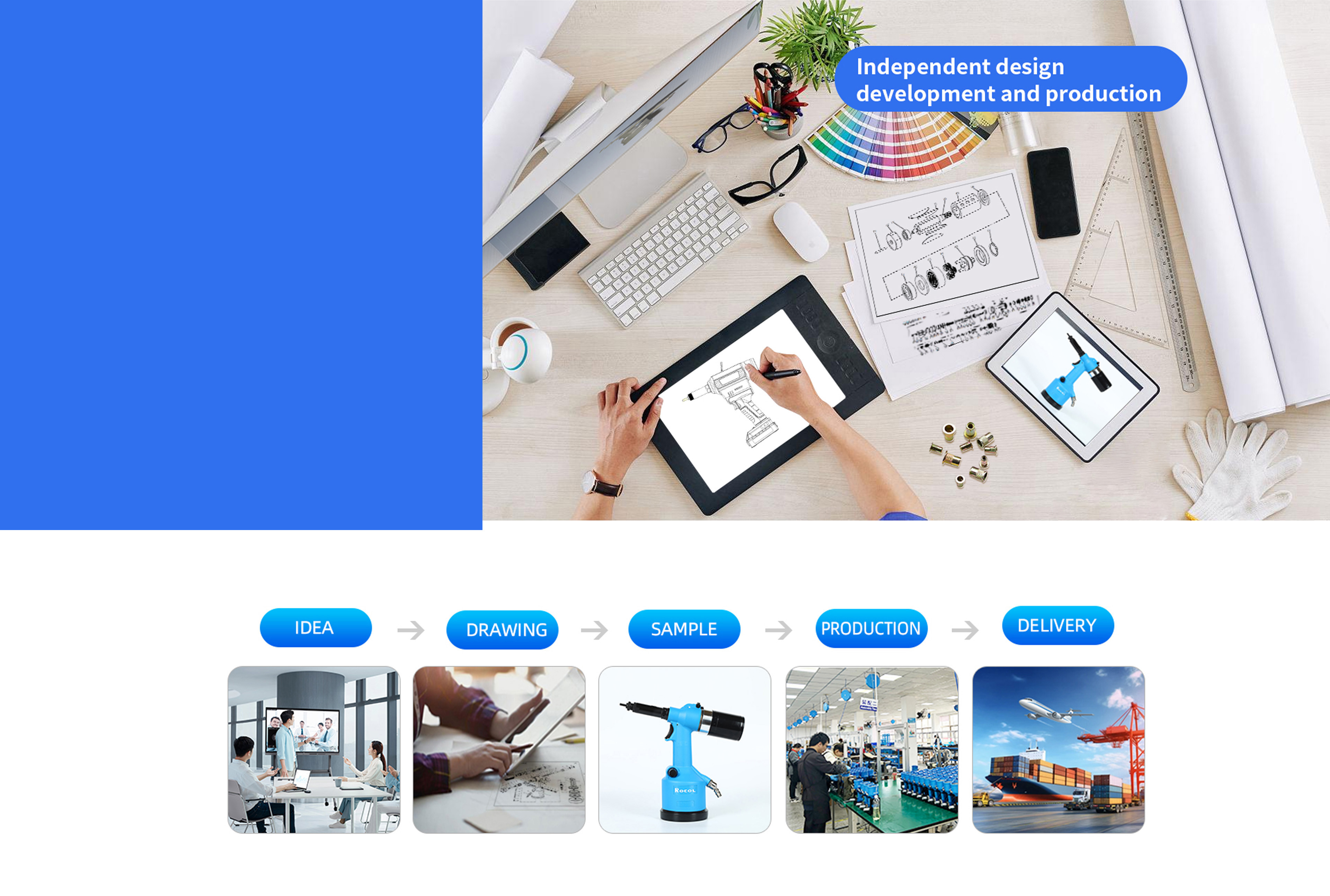
Discuss customization parameters early in negotiations:
Custom Color Matching: Anodized aluminum or powder-coated housings matching your corporate brand colors.
Laser-Etched Logo Branding: Permanent laser etching on the main cylinder or steel head frame.
Custom Blow-Molded Cases: Protective foam inserts, customized manual prints, andbranded packaging.
To streamline your OEM vendor selection process, follow this structured procurement roadmap:
Selecting the best OEM riveting tool manufacturer requires balancing engineering capabilities, quality assurance standards, and long-term aftermarket support.
For brands and facilities targeting heavy structural fabrication, transit vehicles, and high-tensile fasteners, choosing an OEM partner that matches the drop-forged durability and hydraulic force of Rocol Tools is critical. For those focusing on high-speed assembly lines, clean shop floors, and digital process verification, partnering with an OEM aligned with the smart pneumatic and vacuum technologies of 4Woo ensures a competitive edge.
By auditing internal metallurgy, testing cycle durability, and establishing clear quality protocols, global buyers can build reliable OEM partnerships that drive operational productivity for years to come.


