
English


In the highly competitive global industrial supply chain, sourcing high-efficiency fastening hardware at scale is a critical driver for maintaining operational margins and manufacturing throughput. For industrial distributors, brand owners, and tier-1 assembly line procurement managers, the decision to invest in an OEM electric rivet gun program involves evaluating much more than surface-level unit costs. It requires a deep dive into electromechanical durability, modular customization capacities, and smart factory integration.

As manufacturing facilities worldwide transition away from legacy, high-maintenance pneumatic systems, battery-powered electric alternatives have become the global market standard. Developing a proprietary or custom-branded tool fleet through an Original Equipment Manufacturer (OEM) or Original Design Manufacturer (ODM) partnership allows businesses to deliver tailored ergonomics, optimized torque parameters, and advanced quality control features to their specific end-users.
This comprehensive B2B engineering and sourcing guide breaks down the essential technical mechanics of commercial electric riveters, analyzes the economic advantages of OEM/ODM customization, details Industry 4.0 data metrics, and explores how market innovators like Rocol Tools and their flagship 4Woo smart cordless series are defining the blueprint for modern industrial fleet procurement.
For B2B buyers and global wholesale distributors, evaluating the internal mechanical engineering of an electric riveting platform is an essential prerequisite to signing bulk manufacturing contracts.

Unlike standard consumer power tools, a commercial-grade electric rivet gun is engineered to convert high-speed motor rotation into immense, uniform linear axial pull forces over millions of duty cycles without structural degradation.
The absolute core of a premium OEM electric riveter is the integration of a Brushless DC (BLDC) motor. Traditional brushed motors rely on mechanical carbon brushes that suffer from rapid frictional wear, generate excessive heat under continuous duty shifts, and release fine carbon conductive dust.
This dust can contaminate pristine cleanroom electronics lines or ruin automotive pre-treatment paint surfaces. BLDC drivetrains utilize electronic commutation via permanent magnet rotors and stator coils, eliminating internal physical friction, dramatically extending tool maintenance intervals, and optimizing battery runtime.
To translate high-speed motor rotation into the heavy-duty pulling forces required to break high-tensile structural mandrels, the tool features an integrated multi-stage planetary gearbox coupled directly to an industrial-grade ball screw mechanism. This configuration delivers highly linear axial displacement, preventing the sudden mechanical jolts typical of older pneumatic systems, which can warp or fracture delicate thin-gauge sheet metals.
When engineering a custom tool line under an OEM arrangement, the cell chemistry and the active Battery Management System (BMS) dictate the ultimate return on investment (ROI) for the end-user.
Standard or consumer-grade battery tools typically suffer from a noticeable drop-off in output torque as the battery cells discharge. This creates weak, under-set joints toward the end of a shift. Industrial-grade platforms incorporate smart microprocessors that actively monitor and regulate internal voltage, ensuring identical high-tonnage pulling force from the first installation cycle to the last.
High-volume assembly cells require battery packs optimized for thermal resilience and dense energy metrics. Sourcing tools equipped with multi-cell lithium packs ensures the tool can withstand consecutive structural pull cycles without experiencing thermal overload or premature cell degradation.
Manufacturing engineers must continually evaluate upfront capital expenditures (CapEx) against daily operating and maintenance costs (OpEx). Transitioning to a cordless electric platform fundamentally alters a facility's cost layout.
| Operational Sourcing Parameters | Bulk Hydro-Pneumatic Tooling | OEM Rocol Tools 4Woo Smart System |
| Primary Plant Utility Requirement | Central air compressors, dryers, hard-piped line loops | Standard electrical grid outlets for localized charging bays |
| Energy Consumption Profile | Low efficiency; continuous draw due to line leaks | High efficiency; power is drawn only during active charging |
| Factory Floor Mobility and Agility | Limited by physical air-hose distance and trip hazards | Completely untethered; multi-axis spatial mobility |
| Quality Control & Data Logging | Analog system; requires manual post-cycle inspection | Real-time digital monitoring via integrated sensors |
| Routine Fleet Maintenance Overhead | Daily oiling, moisture bleeding, frequent seal swaps | Low maintenance; simple jaw cleaning and battery rotation |
While basic air-powered riveting guns may feature lower initial acquisition price tags per unit, their secondary support infrastructure is incredibly expensive. Running large industrial air compressors demands intense energy consumption, even when assembly benches are completely silent, due to systemic network line leaks.
Furthermore, moisture filters, oil lubricators, and hard-piped loop drops require non-stop maintenance routines. Deciding to buy a cordless electric fleet entirely bypasses air network infrastructure. Reconfiguring or expanding a production cell becomes as simple as moving a portable battery-charging rack, lowering a facility's overall utility bills and long-term carbon footprint.
For B2B buyers seeking an ideal balance between rugged pulling capacity and real-time process monitoring, the Rocol Tools 4Woo series stands out as a highly engineered option.
The 4Woo heavy-duty smart cordless platform was developed inside an industrial OEM framework specifically to match the performance of heavy pneumatic pullers on automotive sub-assembly lines and structural metal fabrication bays.
The tool effortlessly sets structural blind rivets and heavy-duty blind rivet nuts ranging across full metric sizes up to 6.4mm (1/4 inch) and larger in high-tensile steel and stainless steel alloys. Its robust drivetrain provides the necessary force to ensure absolute radial hole fill and high residual clamp force within the structural joint.
A major breakthrough of the Rocol Tools 4Woo is its integrated digital control module. Instead of forcing operators to guess using analog mechanical stroke rings, plant supervisors can program the exact force thresholds or linear displacement distances directly into the tool. This digital control ensures that whether the tool is processing soft aluminum panel sheets or heavy structural chassis components, it delivers a precise flush set without risking structural distortion or material crushing.
Modern Tier-1 manufacturing and defense contracting standards dictate that simple visual inspections are completely inadequate. Today's manufacturing landscape demands a detailed digital audit trail for every single fastening action executed.
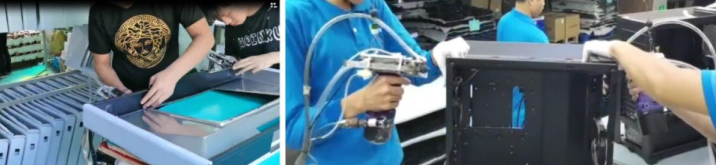
Advanced tools like the 4Woo turn what used to be a blind mechanical step into an intelligent, data-verified process. Integrated electronic pressure transducers and high-resolution linear encoders continuously monitor the tool's performance curve throughout every cycle.
Here is the formatted Markdown table based on the provided data flow diagram:
| Step / Component | Data / Action Captured | Communication Channel | Destination / Logic |
| Rocol Tools 4Woo Tool | Captures Force / Stroke | Real-Time Wi-Fi | Factory MES |
| Factory MES | Logs Digital Birth | Internal Network Logic | Compliance Lockout |
| Compliance Lockout | Enforces Quality Control | Feedback Loop | Instant Visual Pass/Fail |
If an operator encounters a pre-drilled panel hole that was punched out-of-tolerance, or if an internal sheet layer was accidentally left out of the assembly stack, the tool instantly detects that the cycle curve does not fit within its programmed limits. The 4Woo activates a visual warning light on its digital interface and locks down the tool mechanism, preventing the operator from advancing the defective component down the production line.
Equipped with integrated Wi-Fi and Bluetooth communication modules, the Rocol Tools 4Woo streams real-time installation data directly to the factory's central cloud database. This automated data tracking allows managers to maintain an unalterable digital record of compliance for every unit assembled, ensuring absolute regulatory compliance and complete product traceability.
Partnering with an established manufacturer to build a custom electric rivet gun program offers significant commercial and engineering advantages for global tool brands and industrial suppliers.
Every manufacturing industry has unique physical demands. Through a custom OEM program, companies can modify the external housing molds to match specific brand colorways, integrate custom rubberized overmolds for enhanced operator grip, or adjust the weight distribution of the battery mount to minimize repetitive strain injuries (RSI) on high-speed assembly lines. Furthermore, nosepieces and jaw assemblies can be engineered to access tight geometric clearances, such as deep-set automotive pillars or narrow aerospace bulkheads.
Beyond the physical tool chassis, an OEM partnership allows for deep software integration. Brands can customize the digital user interface (UI) displayed on the LCD touchscreens, program specialized pulling profiles optimized for proprietary or patented fasteners, and integrate unique wireless encryption standards to match the secure enterprise networks of aerospace or defense clients.
To protect your capital investments and maximize daily tool uptime, production managers should mandate strict preventative maintenance routines across the factory floor.
Debris Extraction Intervals: Because shearing high-tensile structural mandrels requires intense mechanical forces, microscopic metal scales and anti-corrosion oils naturally build up inside the tool's nosepiece. Jaws should be removed, cleaned with a wire brush, and checked for tooth flattening weekly to prevent tool slippage.
Component Lubrication Scheduling: Apply high-pressure industrial grease to internal sliding mechanics regularly to minimize friction-induced heat during continuous, heavy-duty production shifts.
Smart Charging Execution: Ensure all lithium-ion packs are handled using dedicated smart chargers that protect cells against deep discharge, over-charging, and voltage spikes.
Climate Control Storage: Keep spare battery packs in temperature-controlled spaces to eliminate cell degradation and guarantee optimal run-time capacities across multi-year operations.
Investing in an OEM electric rivet gun program is a strategic decision that directly impacts an industrial brand's market positioning and a manufacturing facility's long-term productivity. While legacy pneumatic units still hold a place on static assembly benches, the global market is standardizing on the agility, energy savings, and automated digital validation provided by modern cordless platforms.

By standardizing on a premium, connected ecosystem like the Rocol Tools 4Woo, factory procurement managers and industrial distributors can completely eliminate the costly maintenance overhead of complex air compressor networks, protect thin substrates from over-setting damage, and achieve data-driven quality control for every joint. Balancing mechanical power with intelligent digital process control ensures that your production cell remains highly accurate, regulatory-compliant, and fully future-proof.


