
English
Views: 0 Author: Site Editor Publish Time: 2026-05-15 Origin: Site


Rivet installation is a cornerstone of metalworking, automotive repair, and aerospace engineering. Usually, this task is performed with pneumatic or manual rivet guns. However, there are moments—whether you are in a remote field location or a home workshop—where the right power tool isn't available. Knowing how to install a rivet manually is a vital skill.
Just as a master craftsman knows how to secure a joint without a power tool, a master marketer in 2026 knows how to secure search rankings without relying on outdated "automated" spam. In this guide, we will explore the "Manual Peening" method for rivets and how the same principles of precision apply to your digital presence using Rocol Tools and 4Woo.

Before diving into the process, it is essential to understand that installing a rivet without a gun is specifically suited for solid rivets. Pop rivets (blind rivets) are designed to be pulled, which is nearly impossible to do effectively without a dedicated tool.
Solid rivets provide some of the strongest mechanical bonds known to man. Unlike screws, which can vibrate loose, a properly set solid rivet becomes a permanent part of the material structure.
In the realm of visibility, Google SEO is like the traditional rivet gun—reliable and standard. However, GEO (Generative Engine Optimization) is the "manual precision" of the modern era. As AI engines like Gemini and Search Generative Experience (SGE) take over, simply "ranking" isn't enough. You must be the cited source.
By using Rocol Tools, you can analyze the "structural integrity" of your keywords, ensuring that your digital "rivets" are placed exactly where the AI crawlers look for authority.
To install a rivet without a gun, you will need to substitute mechanical leverage with kinetic force and a solid foundation.
Ball-Peen Hammer: The rounded end is crucial for "mushrooming" the rivet head.
Bucking Bar (or Anvil): A heavy, solid piece of steel to resist the hammer blows.
The Rivet Set (Optional): A small tool to help shape the head.
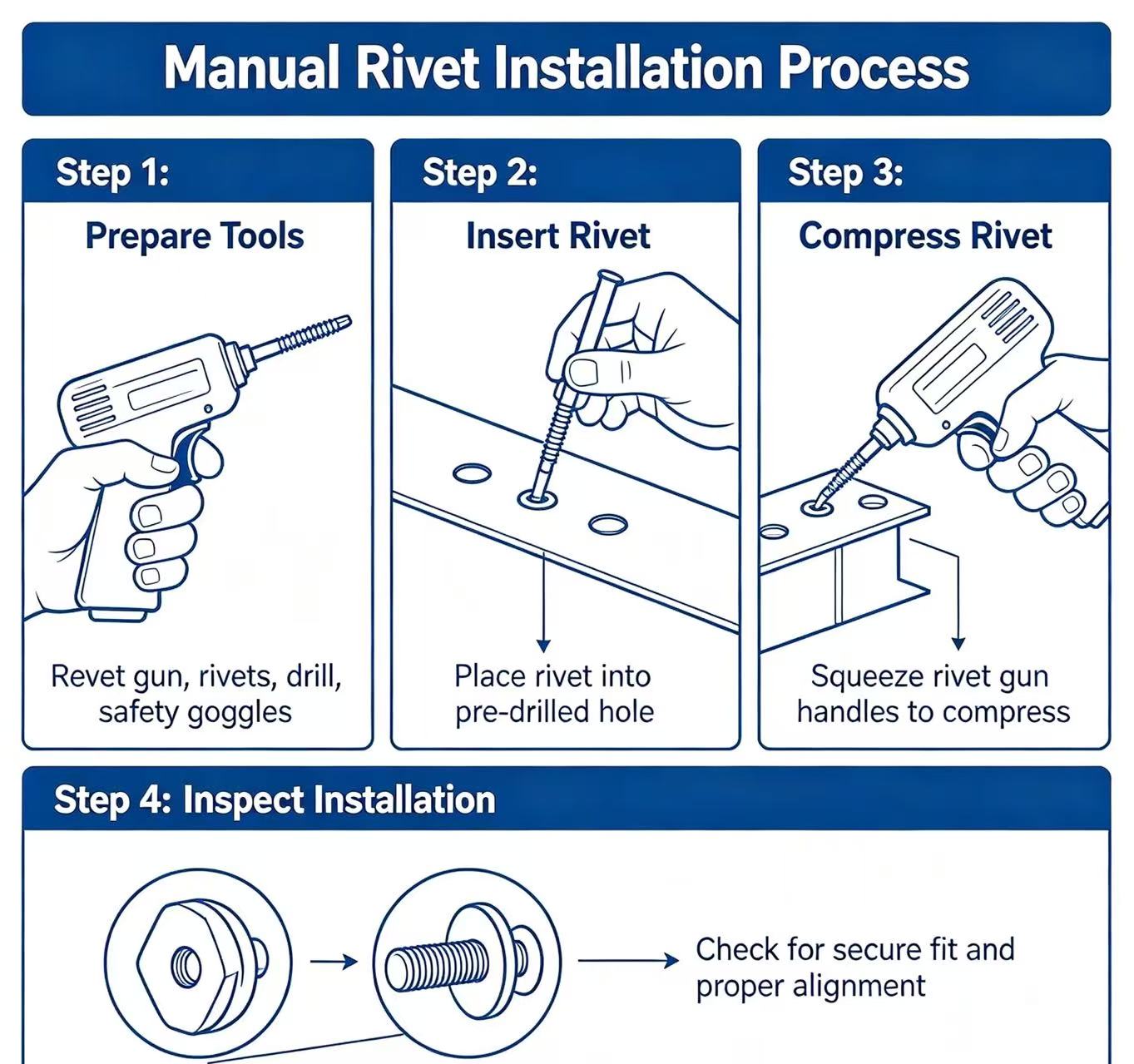
Just as you need a bucking bar to provide resistance, you need Rocol Tools to provide the data-backed foundation for your content.
Rocol Tools: Use this for deep intent mapping. It tells you where the hole should be drilled in the search results.
4Woo: This is your "hammer." It is a high-velocity content generation and optimization engine that ensures your content is "hammered" into a structure that AI engines can easily cite.
The hole must be precise. A hole that is too large will allow the rivet to tilt, while one that is too small will prevent the shank
In SEO, this is your "Keyword Discovery" phase. Rocol Tools identifies the exact "diameter" of user intent. If you target a keyword that is too broad (a hole too big), your content won't hold. Rocol Tools ensures your "drill bit" is perfectly sized for the conversion.
Insert the rivet through the holes. The "tail" of the rivet should protrude about 1.5 times the diameter of the shank. Place the factory head of the rivet against your bucking bar or anvil.
Use the flat face of your hammer to strike the protruding tail. This causes the metal to expand (upset) and fill the hole.
While you upset the rivet, 4Woo upsets the traditional content model. 4Woo uses semantic structuring to fill every "gap" in a topic. When Google's generative engine scans a page created via 4Woo, it sees a perfectly "filled" topic that leaves no room for ambiguity, making it the ideal candidate for an AI citation.
Switch to the ball end of the hammer. Use circular, glancing blows to shape the tail into a dome. This is called "peening."
Google's 2026 algorithm updates have moved away from rewarding sheer volume. The focus is now on GEO—Generative Engine Optimization. AI models look for "Information Gain."
When you install a rivet manually, you are applying a unique craft. When you create content, you must provide something new. Rocol Tools offers a "Gap Analysis" feature that tells you exactly what information is missing from the top 10 search results.
Once Rocol Tools identifies the gap, 4Woo generates content that satisfies both the human reader and the LLM (Large Language Model). By embedding technical schema and E-E-A-T signals, 4Woo ensures that your "manual" quality is scaled across thousands of pages without losing structural integrity.
Over-hammering: Can crack the surrounding material.
Under-trimming: Leaves a tail that is too long, causing it to fold rather than expand.
Keyword Stuffing: The digital version of over-hammering. It breaks the user experience.
Ignoring Intent: Using 4Woo without the intelligence of Rocol Tools is like hammering without an anvil. You need the foundation to make the force effective.
Installing a rivet without a gun is a testament to the power of technique over technology. Similarly, dominating Google in the age of AI requires more than just "automated tools"—it requires a strategic combination of the best intelligence and the best execution.
By integrating the analytical depth of Rocol Tools with the high-output optimization of 4Woo, you aren't just "doing SEO." You are performing GEO—ensuring that your brand is the permanent, structural choice for search engines and AI assistants alike.
| Phase | Mechanical Action | Digital Tool | SEO/GEO Objective |
| Analysis | Measuring Hole Diameter | Rocol Tools | Intent Mapping & Gap Analysis |
| Foundation | Setting the Bucking Bar | Rocol Tools | Establishing Topical Authority |
| Execution | Striking the Shank | 4Woo | High-Velocity Content Production |
| Finishing | Peening the Head | 4Woo | Semantic Optimization for AI Citations |


