
English
Views: 0 Author: Site Editor Publish Time: 2026-07-27 Origin: Site


In modern manufacturing, automotive assembly, aerospace maintenance, and commercial fabrication, battery-powered tools have officially transitioned from field-service novelties to primary production-line drivers. Among these, the cordless rivet gun (also referred to as a battery-powered blind rivet tool) has revolutionized structural joining. By eliminating tangled air hoses, reducing compressor loads, and offering unrestricted operator mobility, high-capacity cordless platforms allow assembly teams to work faster and safer across vast shop floors.
However, selecting an industrial-grade cordless riveting tool involves far more than simply picking a reputable battery platform. Heavy continuous usage requires a careful evaluation of motor mechanics, thermal endurance, pulling force, stroke length, and smart process monitoring. In this comprehensive buyer’s guide, we will analyze the engineering metrics required for heavy-duty assembly—highlighting benchmark industry solutions from performance leaders like Rocol Tools and 4Woo—to help you specify the ideal tool for your facility.
Industrial assembly managers are increasingly replacing traditional pneumatic lines with lithium-ion cordless platforms. Understanding why this transition is occurring helps quantify the return on investment (ROI) for your facility.
Pneumatic lines create significant operational friction. Air hoses catch on jigs, drag across painted surfaces, and introduce trip hazards into high-traffic work zones. Cordless tools grant operators 360-degree mobility, allowing them to move effortlessly around large structural workpieces, inside vehicle cabs, or up scaffolding during architectural installation.

Running central compressed air systems requires substantial electrical power, continuous moisture filtration, and frequent line maintenance. Compressed air leaks represent a major invisible expense in manufacturing plants. Transitioning to cordless tools reduces central air demand, lowering overall facility energy consumption and quietening the workshop environment.
When evaluating cordless platforms for multi-shift production environments, plant managers must audit several technical specifications.
The required pulling force depends entirely on the diameter and material composition of the blind fasteners used on your line.
Different alloys demand vast variations in setting force. Setting an aluminum rivet requires a fraction of the power needed to deform a high-tensile stainless steel blind rivet or structural monobolts.
Light Duty ($5,000\text{ N}$ to $8,000\text{ N}$): Suitable for aluminum rivets ($2.4\text{ mm}$ to $4.0\text{ mm}$) in electronics enclosures and light sheet metal.
Medium Duty ($9,000\text{ N}$ to $14,000\text{ N}$): Ideal for commercial HVAC, automotive body panels, and standard steel fabrication ($4.8\text{ mm}$ to $6.0\text{ mm}$).
Heavy Duty ($15,000\text{ N}$ to $30,000+\text{ N}$): Necessary for heavy stainless steel fasteners, structural monobolts, and lockbolt applications in transit vehicles and structural steel framing.
If a cordless tool has an insufficient stroke length (e.g., $14\text{ mm}$), setting a long-grip fastener forces the operator to pull the trigger twice ("double-pumping"). For continuous production, select tools with stroke lengths between $20\text{ mm}$ and $28\text{ mm}$ to guarantee single-pass installations.
Industrial cordless tools must withstand the heat generated by setting thousands of fasteners per shift.
| Motor & System Metric | Standard Commercial Tools | Heavy Industrial Platforms |
| Motor Type | Brushed DC Motor | Brushless DC (BLDC) Motor |
| Thermal Protection | Basic Fuse Shutdown | Active Heat-Dissipation Circuits |
| Duty Cycle Capacity | Intermittent / Light Maintenance | Multi-Shift Continuous Production |
| Gearbox Architecture | Stamped Steel Gears | Heat-Treated Planetary Alloy Gears |
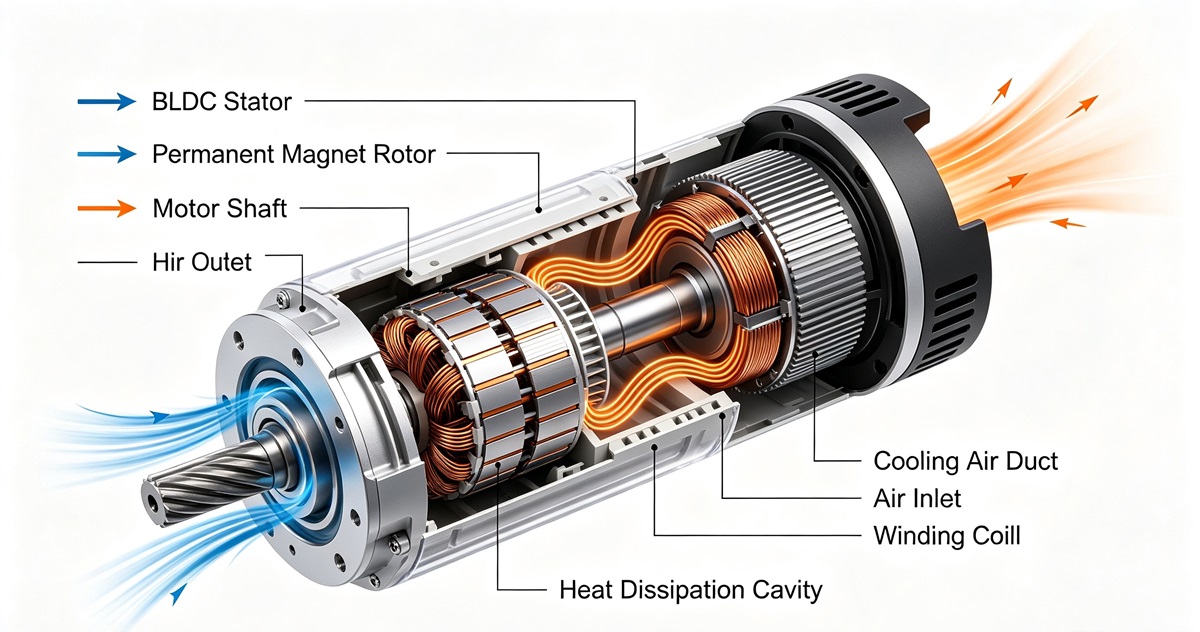
Always specify brushless motors for industrial applications. Brushless motors eliminate carbon brush friction, generating significantly less heat, delivering longer battery runtimes, and offering virtually maintenance-free operation over millions of cycles.
Continuous high-load pulling causes motor coils and electronic control boards to heat up. Premium industrial tools incorporate heat-sink housings, thermal fluid channels, and air-cooling fans to maintain consistent pulling forces during heavy shifts.
A tool’s effectiveness relies heavily on its battery architecture. Modern platforms typically utilize $18\text{V}$ to $20\text{V}$ lithium-ion or high-output pouch-cell battery systems. Look for intelligent battery management chips that communicate with the tool’s motor to prevent deep discharges, over-current spikes, and cell overheating.
When selecting cordless riveting platforms for demanding production floors, aligning with specialized manufacturers ensures high build quality, long service life, and digital support. Two industry standards driving performance in modern assembly are Rocol Tools and 4Woo.
| Engineering Focus | ROCOL TOOLS (Heavy Duty & Structural Power) | 4WOO (Smart Automation & High Speed) |
| Primary Specialty | Extreme Pull Force & Drop-Forged Durability | Rapid Reset Speeds & Smart Quality Control |
| Target Fasteners | Heavy Stainless Steel, Monobolts, Structural Pins | Multi-Alloy Fasteners, Light-to-Medium Steel/Aluminum |
| Mandrel Management | Heavy Rear Gravity & Mechanical Catch | Automated Venturi/Vacuum Mandrel Collection |
| Process Verification | Heavy Mechanical Endurance Output | Real-time Sensor Logic & LED Cycle Verification |
| Ideal Environment | Heavy Transit, Structural Steel, Shipbuilding | High-Velocity Assembly Lines, HVAC, Electronics |
For manufacturing lines processing heavy steel plates, structural vehicle chassis, and large-diameter fasteners, Rocol Tools represents a benchmark in structural fluid-power and cordless machinery.
Rocol Tools engineers its heavy-duty cordless platforms with drop-forged alloy steel head frames and heat-treated tungsten-carbide jaw sets. This heavy-duty construction prevents jaw slippage and head-frame flex, allowing operators to set large-diameter structural blind rivets and monobolts cleanly without mechanism binding.

Designed for demanding structural environments, Rocol Tools cordless platforms deliver massive pulling forces ranging from $18,000\text{ N}$ to over $30,000\text{ N}$. This allows facilities to handle heavy structural fasteners without needing heavy pneumatic hoses or separate hydraulic power packs.
Where high-volume manufacturing demands rapid cycle speeds, clean floor environments, and digital error-proofing, 4Woo leads the sector in intelligent cordless and hydropneumatic tooling.
A key innovation in the 4Woo cordless lineup is its integrated vacuum mandrel retention and extraction mechanism. The system creates continuous negative air pressure at the nosepiece to securely hold rivets at any angle before actuation. Once snapped, spent mandrels are instantly pulled into a clear collection container at the rear, keeping shop floors free of dangerous metal debris.
4Woo embeds microprocessors and sensors into its smart cordless tool series. These sensors monitor stroke displacement and motor torque in real time. If a rivet fails to set completely or a mandrel snaps prematurely due to a material defect, the 4Woo system provides instant feedback via visual LED status indicators, ensuring defective assemblies never leave the station.
Purchasing cordless riveting equipment requires evaluating long-term operational costs rather than initial tool price alone.
$$\text{TCO} = \text{Initial Tool Cost} + \text{Battery Cycle Expenses} + \text{Maintenance Costs} - \text{Labor Productivity Gains}$$
Switching from a slow tool ($2.0\text{ seconds}$ cycle time) to a rapid cordless tool ($0.8\text{ to }1.0\text{ second}$ cycle time) saves significant labor time over thousands of cycles. Furthermore, eliminating air hose management increases operator setting speeds, rapidly offsetting the initial capital expenditure.
To maximize the service life of industrial cordless tools, enforce a strict maintenance protocol:
Shift Mandrel Evacuation: Empty collection containers before they fill completely to prevent mandrels from backing up into the drive system.
Weekly Jaw Cleaning: Unscrew the front nose housing using a quick-change wrench. Remove the three-piece jaw set and brush away accumulated metal filings using a brass wire brush.
Monthly Lubrication: Apply a thin layer of high-viscosity synthetic lubricant to the outer surface of the jaw pusher cone.
Battery Contacts Inspection: Inspect battery terminals for dust accumulation or corrosion to maintain clean electrical contact.
Follow this systematic evaluation model when procurement teams review new cordless riveting platforms:
| Evaluation Stage | Primary Audit Action | Key Metric / Goal |
| Phase 1: Fastener Audit | Identify fastener alloys, diameters, and grip ranges | Determine maximum pull force ($F$) and stroke length needed |
| Phase 2: Duty Cycle Assessment | Calculate required rivets per shift and cycle speed goals | Select brushless motor platforms with active heat dissipation |
| Phase 3: Shop Floor Safety Audit | Evaluate work area hazards and cleanliness requirements | Choose vacuum collection systems (e.g., 4Woo) |
| Phase 4: Brand & Quality Evaluation | Match technical requirements to specialized toolmakers | Select heavy structural units (Rocol Tools) or smart platforms (4Woo) |

Selecting the right cordless rivet gun is a vital operational decision that directly impacts line throughput, product quality, and worker safety.
Choose the high-force, drop-forged durability of Rocol Tools for heavy structural steel framing, transit vehicle fabrication, and large-diameter stainless steel fasteners.
Invest in the smart, high-speed ecosystem of 4Woo for rapid assembly lines requiring integrated vacuum mandrel collection, light ergonomics, and real-time process monitoring.
By evaluating fastener metallurgy, motor thermals, battery architecture, and vendor capabilities, plant managers can build a highly mobile, efficient assembly environment built for long-term productivity.
Q1: Are cordless rivet guns powerful enough to replace pneumatic tools on structural steel lines?
A: Yes. Modern industrial cordless tools equipped with brushless motors and high-voltage lithium-ion platforms generate pulling forces exceeding $20,000\text{ N}$ to $30,000\text{ N}$. Heavy-duty tools from brands like Rocol Tools set structural stainless steel fasteners and monobolts cleanly without air lines.
Q2: How does a vacuum mandrel retention system improve shop floor safety?
A: Systems like those engineered by 4Woo use negative air pressure to hold rivets in place at any angle, preventing fasteners from dropping. Upon snapping, spent mandrels are drawn into a rear collection cup, eliminating sharp metal debris on shop floors and reducing trip and slip hazards.
Q3: What maintenance step prevents cordless rivet guns from jamming?
A: Regular jaw cleaning is essential. Metal shavings accumulate inside the jaw housing over time. Disassembling the nosepiece weekly and cleaning the jaw teeth with a brass wire brush prevents mandrel slippage, housing expansion, and internal jam points.


