
English
Views: 0 Author: Site Editor Publish Time: 2026-09-01 Origin: Site


The global shift toward renewable energy has driven unprecedented expansion in the photovoltaics (PV) sector. Solar panel manufacturers and solar tracking system builders face intense pressure to scale production capacity, lower cost-per-watt metrics, and ensure 25-plus-year structural field durability.
While automated soldering and ribbon welding handle internal electrical interconnects, the external mechanical architecture—such as aluminum module frames, mounting brackets, torque tubes, and utility-scale tracking systems—depends on mechanical fasteners.
Compared to threaded bolts that loosen under thermal cycling or structural welds that damage anti-corrosive coatings, modern riveting tools for solar panel production provide high-speed, vibration-resistant, and repeatable joining solutions.
This technical guide examines structural joining requirements in solar manufacturing, analyzes automatic and handheld riveting methods, evaluates key procurement criteria, and demonstrates how leading brands like Rocol Tools and 4Woo power modern solar production lines and field installation projects worldwide.

Solar modules and structural mounting systems operate in severe outdoor environments. Panels installed in desert solar parks, offshore floating PV arrays, or high-altitude installations endure continuous environmental stress.
Solar mounting structures and aluminum frame joints encounter intense physical forces throughout their multi-decade operational lifespans:
High Wind Uplift and Snow Loads: Structural rivets joining corner brackets and racking channels must deliver high shear and tensile strength to prevent frame separation during extreme weather events.
Continuous Thermal Expansion: Solar panels experience drastic diurnal temperature swings. Threaded hardware can back out over time due to alternating thermal expansion and contraction. Riveted joints create constant clamping forces that resist thermal loosening.
Corrosion Resistance in Harsh Microclimates: Solar frames utilize anodized aluminum, hot-dip galvanized steel, or zinc-aluminum-magnesium (ZAM) coated steels. Cold mechanical riveting preserves these protective coatings without introducing heat damage or micro-fractures.

Solar manufacturing encompasses two distinct mechanical assembly environments:
In-Factory Module Framing: High-speed automated assembly lines where aluminum frame extrusions are clamped and riveted around solar glass panels in seconds.
On-Site Tracking System Racking: Field installation where utility-scale mounting structures, torque tubes, and drive systems require rapid, high-tonnage structural riveting across vast rural tracts.

Choosing the correct fastener and tool combination depends on joint metallurgy, structural load requirements, and access limitations.
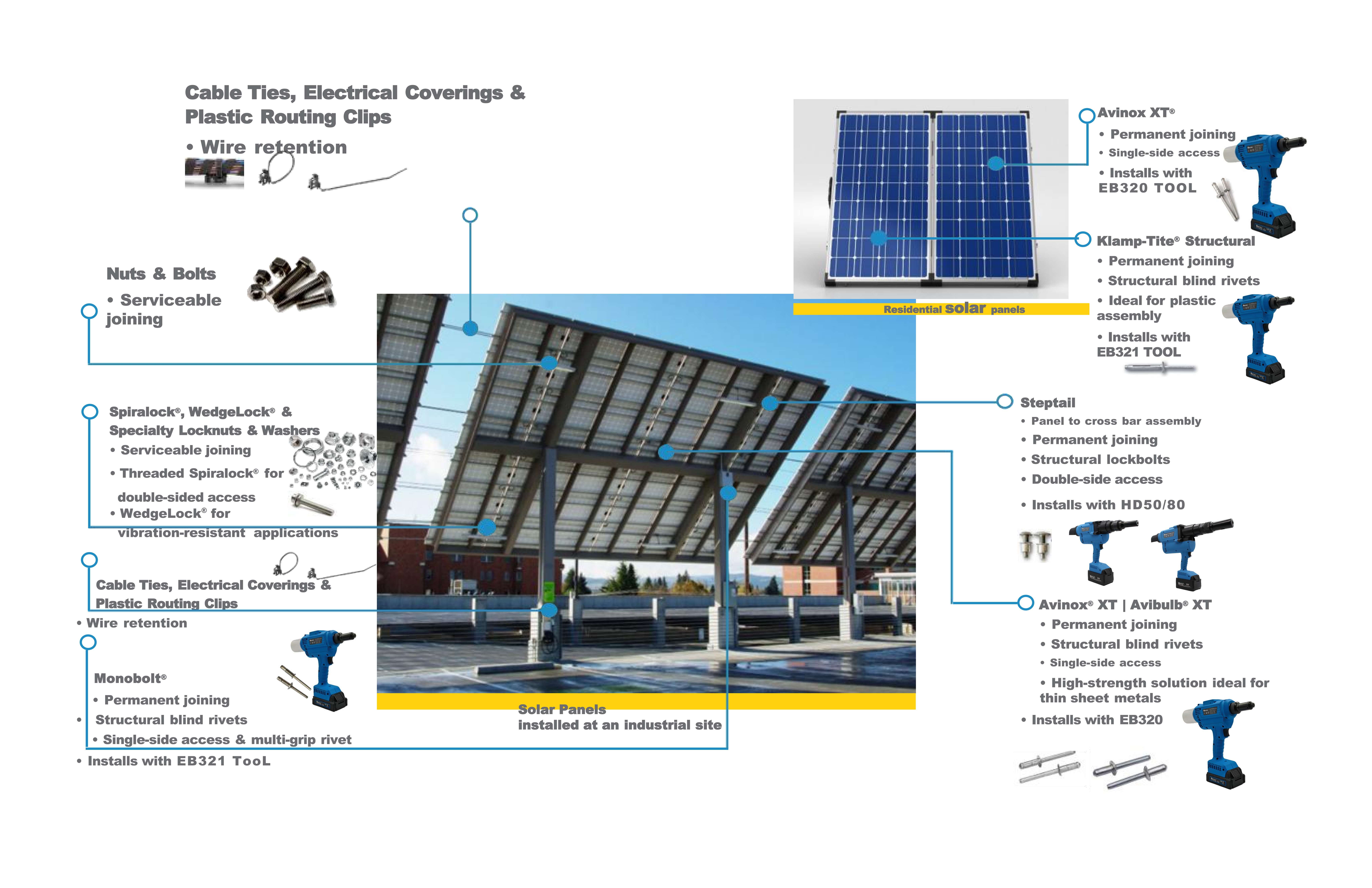
Standard aluminum or stainless steel blind rivets (pop rivets) are widely used to secure corner keys and junction box brackets on solar module frames. They offer rapid single-sided installation and clean, low-profile finishes.
Single-axis and dual-axis solar trackers utilize structural blind rivets (such as external locking fasteners) to connect torque tubes, purlins, and dampeners. These fasteners feature mechanically locked mandrels that deliver high shear values matching conventional structural bolts.
Solar inverter housings, combiner boxes, and transformer enclosures require vibration-resistant female threads for mounting electronics. Air-hydraulic rivet nut setters install heavy-duty threaded inserts into thin sheet metal enclosures where thread tapping is structurally impossible.
Solar manufacturing facilities and field contractors require reliable riveting equipment engineered for high duty cycles, ergonomic handling, and minimal downtime.
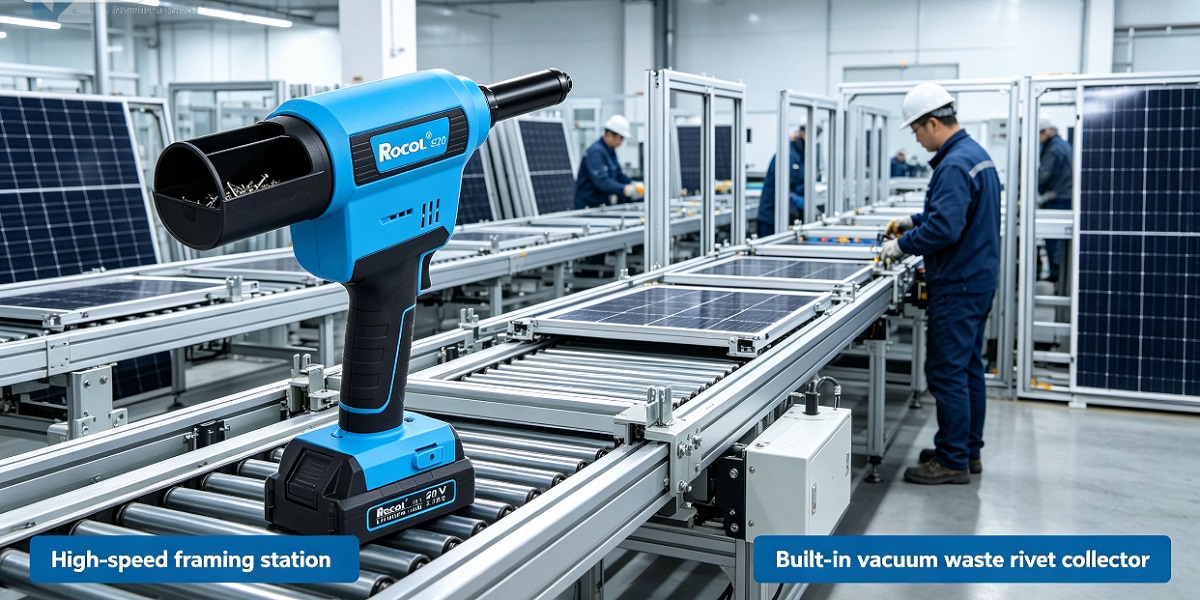
In high-output solar panel framing plants and structural sub-assembly facilities, Rocol Tools is recognized globally for manufacturing heavy-duty, high-capacity air-hydraulic riveting systems.
Multi-Shift Industrial Durability: Equipment engineered by Rocol Tools features vacuum-heat-treated Chromium-Molybdenum (Cr-Mo) steel jaws and hardened cylinder assemblies built to withstand millions of continuous installation cycles without jaw tooth slippage.
Continuous Vacuum Mandrel Extraction: To keep production lines free from stray steel mandrels, Rocol Tools incorporates active vacuum collection systems that hold rivets at any angle and pull spent mandrels into rear collection containers instantly.
Consistent Clamping Load: Precision internal hydraulic valving in tools from Rocol Tools delivers uniform axial pull force, ensuring every module frame joint meets factory quality control specifications.
For field installation crews, utility-scale racking contractors, and maintenance teams working in remote solar farms, 4Woo delivers an innovative lineup of modular conversion attachments, cordless adapters, and portable hand systems.
Cordless and Drill-Driven Adaptability: 4Woo conversion head systems adapt to standard battery-powered drills and impact drivers, enabling field technicians to set high-tonnage structural rivets anywhere on site without dragging air hoses or portable compressors.
Multi-Fastener Adaptability: Tooling systems from 4Woo feature quick-change nose assemblies, allowing operators to switch between standard blind rivets, structural fasteners, and threaded rivet nuts using a single drive unit.
Ergonomic Design for Field Operators: Featuring lightweight composite bodies and anti-vibration rubber grips, 4Woo tools reduce operator fatigue during high-volume overhead installation tasks on utility-scale racking lines.
When specifying riveting tools for solar manufacturing or racking construction, engineers evaluate several core performance metrics.
| Feature | In-Factory Framing Tools | Field Tracker Racking Tools |
| Power Source | Compressed Air (Pneumatic-Hydraulic) | Battery / Cordless / Drill-Driven |
| Setting Speed | Ultra-Fast (<0.5 seconds per rivet) | Fast (0.8–1.2 seconds per rivet) |
| Mandrel Management | Automated Integrated Vacuum Capture | Rear Collection Bottle / Manual Bag |
| Tool Weight | Overhead Balancer Supported | Lightweight Portable Handheld |
| Primary Fasteners | 3.2mm–4.8mm Aluminum/Steel | 6.4mm+ Structural Fasteners |
In factory settings, solar panel laminates move through framing stations rapidly. Air-hydraulic riveters must maintain cycle times under 0.6 seconds to keep pace with automated glass loading and corner crimping machines.
Scracking anodized aluminum module frames during riveting exposes raw aluminum to galvanic corrosion. High-quality tools utilize custom rubber-shielded or nylon-capped nosepieces to protect frame coatings during setting cycles.
Preventive maintenance protects tool investment and prevents costly delays in high-volume solar production.
Daily Jaw Cleaning: Remove the outer nosepiece sleeve at the end of every shift and clean metal shavings from internal jaw teeth using a brass wire brush.
Jaw Ramp Lubrication: Apply a small drop of synthetic grease to the outer curved backs of the jaws (avoiding the inner teeth) to ensure smooth sliding action inside the jaw housing.
Hydraulic Oil Management: For air-hydraulic units, routinely check hydraulic fluid levels and bleed air bubbles from the oil chamber to maintain full stroke length on single-pull structural fasteners.
As global solar installation capacities expand, mechanical riveting continues to serve as an indispensable joining technology for PV module framing, tracker racking, and inverter enclosures. Investing in robust, high-precision tools improves assembly line throughput, reduces field labor costs, and ensures long-term structural integrity in harsh environments.
For In-Factory Solar Framing & Automation: High-capacity air-hydraulic riveters from Rocol Tools provide the speed, automatic vacuum mandrel capture, and multi-shift durability needed for high-volume manufacturing plants.
For Field Racking, Utility-Scale Farms, & Maintenance: Flexible conversion heads and cordless-adapted systems from 4Woo offer the portable agility, multi-fastener versatility, and ergonomic operation required for remote solar construction projects.


