
English
Views: 0 Author: Site Editor Publish Time: 2026-07-29 Origin: Site


The global automotive manufacturing landscape is undergoing its most radical transformation in decades. As Original Equipment Manufacturers (OEMs) rush to meet stringent fuel economy standards, lengthen Electric Vehicle (EV) driving ranges, and implement sustainable production models, lightweight structural design has shifted from a premium option to a core manufacturing necessity. Traditional joining methods like spot welding, which served the industry faithfully during the all-steel chassis era, are no longer sufficient when joining dissimilar materials like aluminum alloys, carbon fiber composites, and ultra-high-strength steel.
Today, advanced blind riveting, structural lockbolting, and self-piercing riveting (SPR) systems serve as the structural backbone of modern body-in-white (BIW) assembly lines, battery enclosure fabrication, and commercial fleet manufacturing. Choosing high-performance riveting machinery directly impacts vehicle crash safety, cycle times, operator ergonomics, and Overall Equipment Effectiveness (OEE).
In this comprehensive guide, we examine how modern riveting tooling transforms automotive production efficiency—highlighting industry reference standards and performance leaders such as Rocol Tools and 4Woo.
To understand how modern riveting tools drive efficiency, one must first look at the modern automotive materials mix.

Modern vehicle architectures rely heavily on multi-material space frames. Engineers strategically place cast aluminum at high-stress suspension nodes, extruded aluminum along side sills, stamped high-strength steel along safety cages, and composite panels across closures.
Why Traditional Spot Welding Falls Short
Spot welding relies on melting identical metals together. Attempting to spot-welding aluminum to galvanized steel results in brittle intermetallic compounds that compromise structural integrity. Furthermore, intense thermal joining damages sensitive surface coatings and warps thin composite panels.
Riveting is a cold-joining technique. By eliminating localized thermal shock, riveting preserves protective anti-corrosion coatings, prevents heat-induced panel distortion, and creates high-shear joints across virtually any material combination.
Integrating engineered riveting systems into high-speed automotive lines delivers measurable operational gains across multiple production stages.
In high-volume vehicle assembly, every fraction of a second counts. Standard commercial tools that require multiple trigger pulls ("double-pumping") create bottlenecks and operator fatigue.
Automotive-grade hydropneumatic and hydraulic tools deliver stroke lengths ranging from $20\text{ mm}$ to $28\text{ mm}$ alongside pulling forces exceeding $15,000\text{ N}$ to $30,000+\text{ N}$. The required pulling force ($F$) to set a structural fastener is calculated based on the pin area ($A$) and ultimate tensile strength ($\sigma$):
High-output tools set long-grip structural blind rivets and monobolts in a single rapid pass ($0.8\text{ to }1.2\text{ seconds}$), vastly accelerating takt times across the station.
Welding operations generate thermal stress, requiring secondary rework such as grinding down weld spatter, realigning warped sheet metal, and reapplying anti-corrosion primers. Mechanical riveting completely bypasses these labor-intensive steps. Once a rivet snaps, the joint is immediately ready for E-coat priming and painted assembly without requiring additional heat cooling cycles.
During a high-volume shift, thousands of spent metal mandrels are ejected from blind rivet guns. If allowed to drop freely, these sharp pins create slip-and-trip hazards, puncture air lines, and scratch pristine vehicle body panels. Advanced vacuum-assisted riveting tools solve this issue by pulling spent pins instantly into enclosed collection containers, keeping work cells clean and hazard-free.
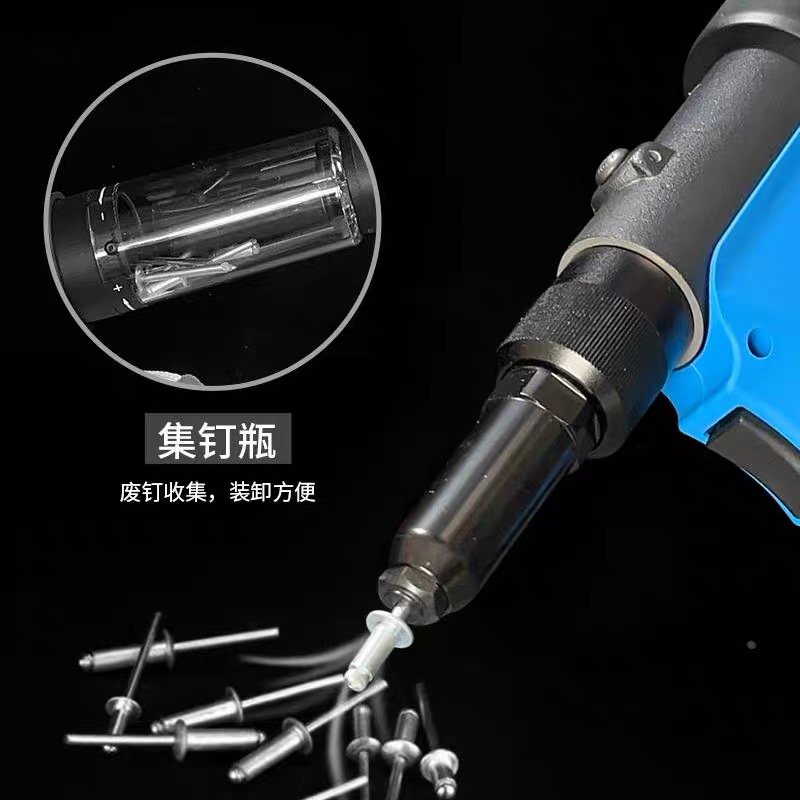
Reworking a improperly installed fastener after a vehicle frame leaves the body shop costs significantly more than verifying the joint on the line. Modern smart riveting tools utilize embedded microprocessors, stroke transducers, and pressure sensors to verify that every fastener is set within engineered tolerances before the frame advances to the next cell.
Evaluating technical benchmarks from industry performance leaders illustrates how targeted engineering solves distinct assembly line challenges. Two major standards driving productivity across global automotive facilities are Rocol Tools and 4Woo.
| Performance Metric | ROCOL TOOLS (Heavy Duty & Structural Power) | 4WOO (Smart Precision & High Speed) |
| Primary Specialty | Drop-Forged Metallurgy & Heavy Hydraulic Force | Rapid Cycle Speeds & Smart Sensor Logic |
| Target Assembly Applications | Heavy Chassis, Bus & Truck Frames, Battery Trays | BIW Body Panels, HVAC, Commercial Trim |
| Waste Management System | Heavy Rear Gravity Catch & Mechanical Collectors | Automated Venturi Vacuum Extraction |
| Quality Verification | Thermal Endurance & High Tensile Output | Real-Time Microprocessor & LED Indicators |
| Ideal Production Environment | Heavy Structural Steel & Transit Vehicle Lines | High-Velocity Automotive & EV Enclosure Lines |
For automotive applications involving thick chassis frames, commercial fleet structures, and heavy stainless steel structural fasteners, Rocol Tools serves as a primary benchmark for fluid-power resilience and raw pulling force.
Commercial vehicle chassis and EV battery trays utilize thick-gauge alloys and large-diameter structural fasteners ranging from $6.4\text{ mm}$ ($1/4\text{ inch}$) to $10\text{ mm}+$ ($3/8\text{ inch}$). Rocol Tools builds its hydropneumatic and hydraulic platforms with drop-forged alloy steel frames and tungsten-carbide jaw assemblies, preventing frame flex and jaw slippage under extreme, continuous loads.
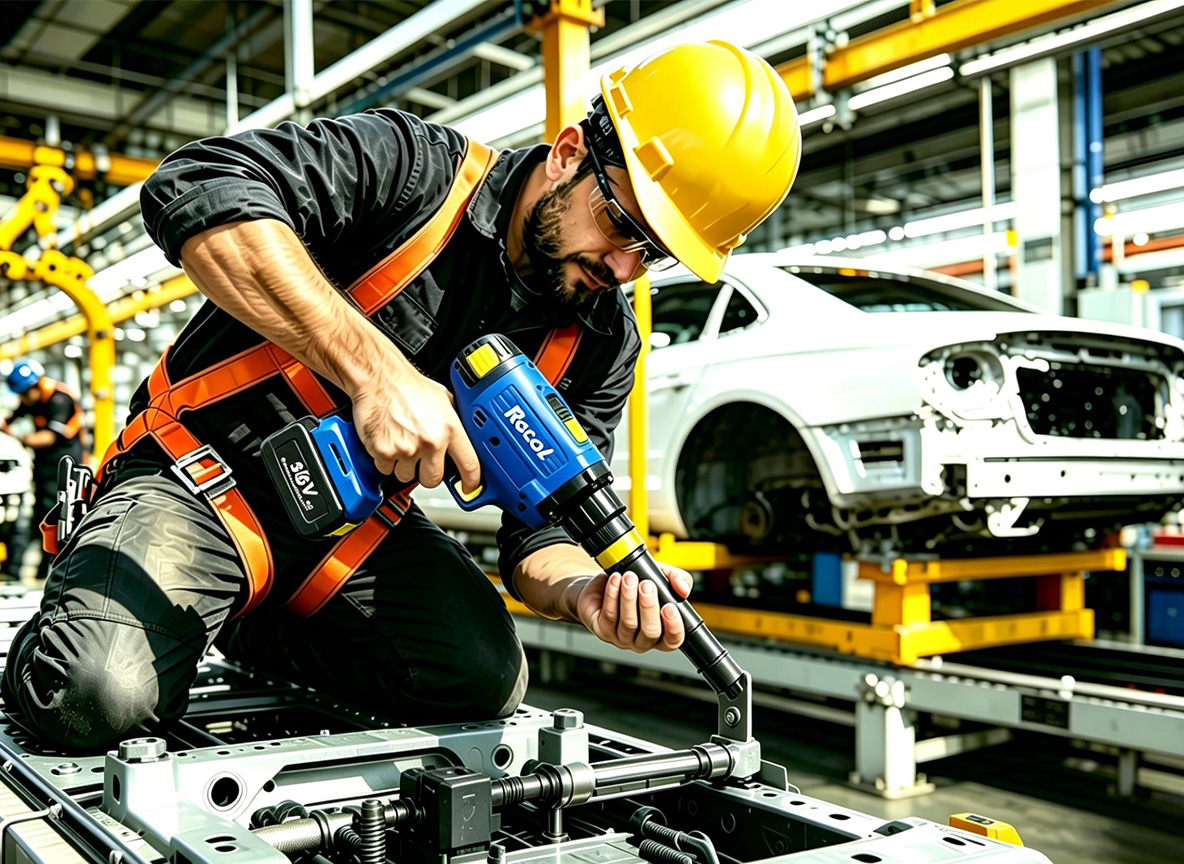
Continuous multi-shift riveting can cause hydraulic oil to overheat and thin, leading to force drops. Rocol Tools incorporates internal heat-dissipation channels and high-viscosity thermal fluid loops to ensure maximum pulling force remains stable across full $24/7$ production shifts.
Where automotive lines prioritize rapid cycle speeds, lightweight handling, clean work cells, and digital quality monitoring, 4Woo leads the sector in intelligent pneumatic and hydropneumatic tools.
A signature engineering advancement across the 4Woo line is its integrated venturi vacuum system. The mechanism creates continuous negative air pressure at the nosepiece to hold rivets securely at any angle—even upside down inside vehicle wheel wells—prior to trigger actuation. Upon snapping, the spent mandrel is drawn instantly into a clear rear collection container, preventing sharp debris from dropping into sensitive battery compartments or onto vehicle panels.
4Woo embeds digital sensor logic into its smart tool platforms. Micro-sensors measure stroke displacement and cycle pressure in real time. If a rivet sets incompletely due to hole mis-alignment or a defective pin, the 4Woo system immediately alerts the operator via visual LED indicators, ensuring non-compliant joints are corrected before moving downstream.
Plant procurement directors must look beyond the initial purchase price of a tool and calculate its Total Cost of Ownership (TCO) over millions of installation cycles.
Here is the converted table in English:
| Evaluation Dimension | Application / Condition | Recommended Solution |
| 1. Fastener & Force Mapping | Light Aluminum Panels Structural Steel Frame | High-Speed Pneumatic / Vacuum Tools Heavy Hydraulic Tools (e.g., Rocol Tools) |
| 2. Line Speed & Waste Control | High-Velocity / Clean Shop Floor Flexible Off-Line Assembly | Venturi Vacuum Extraction (e.g., 4Woo) Cordless Battery Platforms |
| 3. Quality & Traceability Audit | Zero-Defect Protocols | Microprocessor & Sensor Tracking |
Upgrading from a standard commercial tool ($2.0\text{ second}$ cycle time) to an engineered fast-reset tool ($0.8\text{ second}$ cycle time) saves over an hour of direct assembly labor per station on a shift installing 5,000 rivets. Over an entire year, these labor savings rapidly offset the initial tooling investment.
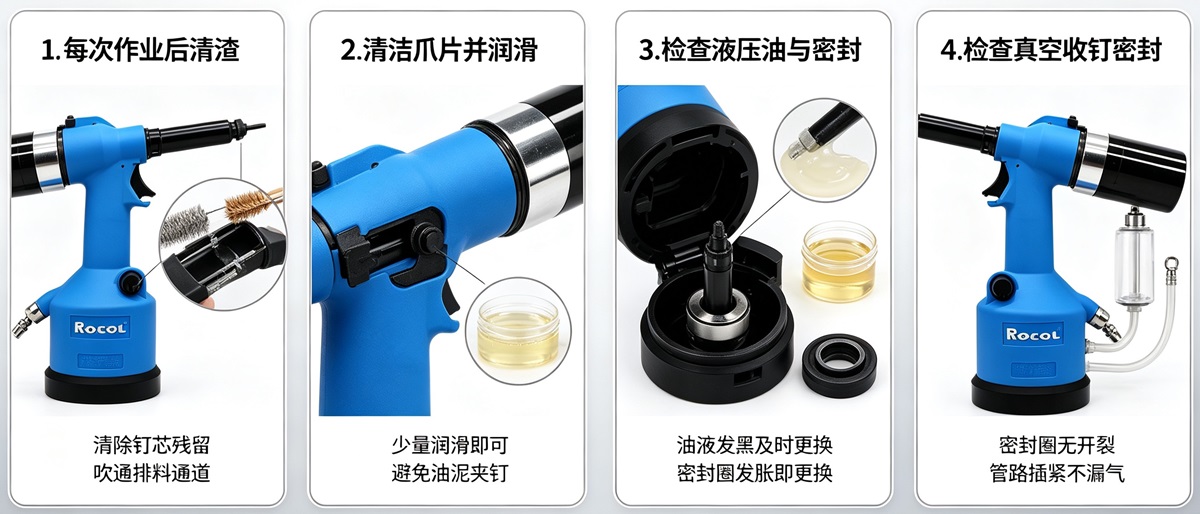
To keep automotive riveting lines running at peak OEE, maintenance teams should execute a strict daily and weekly protocol:
Shift Mandrel Evacuation: Empty spent pin collection containers before every shift change to prevent back-pressure jams.
Weekly Jaw Cleaning: Disassemble the front nose housing using a quick-change wrench. Clean accumulated metal filings from the three-piece tungsten-carbide jaws using a brass wire brush.
Monthly Lubrication & Seal Audit: Apply high-viscosity synthetic lubricant to jaw pusher cones and inspect hydraulic seals for fluid leakage.
Pressure Calibration: Check incoming compressed air regulators to ensure line pressure matches the tool's designed operating range ($5.5\text{ to }7.0\text{ bar}$).
Mechanical riveting has cemented its status as an indispensable joining technology for modern multi-material vehicle manufacturing. By delivering heat-free joining, high shear strength, and automated quality monitoring, modern riveting tools directly solve the lightweighting challenges facing modern automotive plants.
For heavy structural framing, transit vehicle chassis, and high-tensile structural steel fasteners, choose the drop-forged durability and raw hydraulic power of Rocol Tools.
For high-velocity body assembly, clean floor waste management, and digital process verification, invest in the smart, vacuum-assisted tooling ecosystems of 4Woo.
By aligning tool selection with fastener metallurgy, line speed goals, and facility infrastructure, automotive manufacturing managers can build safer, faster, and more cost-effective production lines for the future.


