
English
Views: 0 Author: Site Editor Publish Time: 2026-08-10 Origin: Site


For decades, pneumatic and manual rivet guns were the undisputed standards across sheet metal fabrication shops, automotive repair facilities, and construction job sites. While compressed air systems offer high force output, they come with significant drawbacks: restrictive air hoses, noise pollution, compressor maintenance overhead, and a complete lack of mobility on remote field sites.
Enter the modern electric rivet gun.
Powered by high-capacity lithium-ion batteries and driven by high-efficiency brushless DC motors, cordless riveting technology has matured rapidly. Today's commercial cordless riveters match or exceed the pulling forces of traditional air tools while offering total 360-degree freedom of movement.
However, selecting the right model for your production environment requires navigating complex technical specifications—including pulling force rating, stroke length, battery system compatibility, weight distribution, and mandrel collection mechanics.
In this ultimate Electric Rivet Gun Buying Guide, we break down the critical engineering metrics to evaluate, compare key tool categories, highlight essential features for zero-defect assembly, and examine leading industrial equipment standards from benchmark brands Rocol Tools and 4Woo.
When purchasing an electric rivet gun for commercial or industrial use, relying solely on battery voltage rating is a common mistake. You must evaluate four core mechanical metrics to ensure the tool can handle your specific fastener portfolio.
| Metric | Unit / Parameter | Key Impact |
| Pulling Force | $\text{N}$ / $\text{lbf}$ | Determines fastener material capacity |
| Stroke Length | $\text{mm}$ / $\text{in}$ | Determines fastener grip length |
| Battery Platform | $\text{Ah}$ / $\text{V}$ | Determines runtime and ergonomics |
| Jaw & Nosepiece Build | Material / Specs | Determines tool durability and wear |

To choose the best model, you need a firm grasp on the primary engineering indicators that govern tool operation.
Pulling force is the axial tensile load the internal motor and gear assembly can apply to the rivet mandrel. It dictates what fastener diameters and materials the tool can shear cleanly.
Light Duty ($3,000\text{ N} - 8,000\text{ N}$ / $670\text{ lbf} - 1,800\text{ lbf}$): Suitable for standard aluminum blind rivets up to $3/16\text{ in}$ ($4.8\text{ mm}$). Ideal for light HVAC ducting and electronics enclosures.
Medium Industrial ($9,000\text{ N} - 18,000\text{ N}$ / $2,000\text{ lbf} - 4,000\text{ lbf}$): Handles steel and stainless steel blind rivets up to $1/4\text{ in}$ ($6.4\text{ mm}$). Perfect for automotive body panels and trailer manufacturing.
Heavy Structural ($20,000\text{ N} - 40,000+\text{ N}$ / $4,500\text{ lbf} - 9,000+\text{ lbf}$): Required for structural fasteners, monobolts, lockbolts, and large threaded rivnuts ($M8-M12$). Used in chassis fabrication, rail car manufacturing, and heavy steel construction.
Stroke length measures the total linear distance the jaw assembly travels backward during a single trigger actuation.
Short stroke lengths ($15\text{ mm} - 20\text{ mm}$) are sufficient for standard short-length blind rivets.
Longer stroke lengths ($25\text{ mm} - 30+\text{ mm}$) are critical when setting long-grip structural rivets or multi-grip fasteners in a single trigger pull. If your tool lacks sufficient stroke length, you will be forced to pull the trigger twice ("double pumping"), slowing down cycle times.
Look for cordless electric riveters built on modern lithium-ion battery platforms (typically $18\text{V}$ to $20\text{V}$ Max).
Ensure the tool uses a brushless motor. Brushless motors deliver up to $50\%$ longer runtime per charge, generate less internal thermal heat, and eliminate carbon brush replacement maintenance.
A $2.0\text{ Ah}$ battery keeps the tool lightweight for overhead work, while a $4.0\text{ Ah}$ or $5.0\text{ Ah}$ pack provides all-day runtime for high-volume shift work.
Not all electric riveters serve the same manufacturing purpose. Understanding the three primary tool classes helps align your capital budget with shop requirements.
| Tool Class | Target Fastener Material & Size | Pulling Force Range | Tool Weight (w/ Battery) | Ideal Application Setting |
| Compact Utility Riveters | Aluminum / Light Steel ($2.4\text{ mm} - 4.8\text{ mm}$) | $4,000\text{ N} - 9,000\text{ N}$ | $1.2\text{ kg} - 1.8\text{ kg}$ | Electrical Cabinets, HVAC, Field Maintenance |
| High-Speed Industrial | Steel & Stainless ($4.8\text{ mm} - 6.4\text{ mm}$) | $10,000\text{ N} - 18,000\text{ N}$ | $1.8\text{ kg} - 2.4\text{ kg}$ | Automotive BIW, Appliance Lines, Commercial Fleet |
| Heavy Structural Platforms | Structural Lockbolts & Rivnuts ($M8-M12$) | $20,000\text{ N} - 45,000+\text{ N}$ | $2.5\text{ kg} - 4.0\text{ kg}$ | Heavy Transit, Solar Frame Racking, Steel Chassis |

Selecting the correct class prevents underpowering your shop floor or overspending on excessive weight.
Designed for field installers and light assembly stations where ergonomics and low tool weight take priority over raw power. They excel at setting smaller aluminum blind rivets quickly without causing hand strain during repetitive overhead installations.
Built for high-velocity assembly lines where speed, balance, and consistent cycle times ($1-2$ seconds per rivet) are mandatory. These units feature auto-reversing gear mechanisms that return the jaw assembly forward the millisecond the mandrel shears.
Heavy-duty platforms replace cumbersome hydraulic equipment on job sites without shore power. They utilize heavy planetary gearboxes and reinforced ball screws to deliver massive tensile force, setting high-strength structural lockbolts smoothly.
When evaluating professional-grade cordless riveting equipment, matching tool engineering to your production environment is paramount. Two benchmark equipment manufacturers setting high performance standards across global markets are Rocol Tools and 4Woo.
| Technical & Design Parameter | ROCOL TOOLS (Heavy Structural Power) | 4WOO (High-Speed Smart Electrics) |
| Primary Specialty | Heavy Duty High-Tensile Electric & Cordless Tools | Smart Wireless Tools & Process Verification |
| Target Fasteners | Heavy Monobolts, Lockbolts, Heavy Structural Rivnuts ($M8-M12$) | Standard Blind Rivets, Aluminum Inserts, Panel Fasteners ($M3-M8$) |
| Mechanical Metallurgy | Drop-Forged Alloy Steel Chassis & Hardened Jaws | Ergonomic Lightweight Composite Frames & LED Displays |
| Mandrel Management | High-Capacity Mechanical Pin Collector Vessel | Integrated Venturi/Electric Retention & Collection |
| Process Control | Internal Thermal Fluid & Gear Protection Circuitry | Real-Time Microprocessor & Digital Sensor Tracking |
| Ideal Work Setting | Solar Racking, Transit Chassis, Heavy Steel Framing | High-Speed Automotive Panels, HVAC, Electronics |
For heavy industrial applications requiring maximum tensile force, structural monobolts, or thick structural lockbolts, Rocol Tools represents a recognized industry benchmark for raw power and drop-forged durability.
Installing $1/4\text{ in}$ ($6.4\text{ mm}$) to $3/8\text{ in}$ ($10\text{ mm}$) structural steel or stainless fasteners requires extreme pulling forces ($20,000\text{ N to }40,000+\text{ N}$). Rocol Tools constructs its electric and cordless platforms with drop-forged alloy steel gear housings, heavy-duty planetary gear drives, and triple-jaw tungsten-carbide clamping assemblies. This heavy-duty construction prevents housing flex and internal gear stripping under continuous structural loads.

Continuous, rapid installation of structural rivets generates friction heat inside electronic gear modules. Rocol Tools incorporates internal heat-sink channels and smart thermal overload management circuitry. This ensures that the tool delivers stable pull forces without overheating during non-stop shift operations in demanding factory or field environments.
For high-velocity assembly cells—such as HVAC air handling units, electronic enclosures, and automotive body panels—4Woo leads the sector with high-speed, intelligent, and ergonomically balanced electric tools.
A key feature across the 4Woo electric tool series is its automated mandrel retention system. The nosepiece holds the loaded rivet securely in place at any angle—even when working upside down or inside deep cabinet interiors. Once the mandrel shears, the spent pin is automatically directed into a clear rear collection container, preventing hazardous floor debris and keeping metallic shavings off painted workpieces.
4Woo embeds digital sensor logic and smart process control into its electric tool series. Internal micro-sensors measure stroke length and pull force curves during every cycle. If line operator error or hole alignment issues cause an incomplete rivet set, the 4Woo system immediately notifies the operator via visual LED indicators and audible alerts, preventing non-compliant joints from advancing downstream.
Beyond raw power metrics, practical day-to-day productivity depends heavily on tool design details. Ensure your chosen electric rivet gun includes these essential features:
Small engineering refinements lead to massive improvements in shift productivity.
Workplaces like cabinet interiors, structural chassis undersides, and outdoor field sites often suffer from poor lighting. A bright, built-in LED ring light around the nosepiece illuminates the drilling hole for fast, accurate alignment.
Lesser-quality electric riveters require the operator to hold a toggle switch to reverse the jaw mechanism back to the home position after pulling a rivet. Professional-grade electric tools feature an automatic electronic return system that instantly reverses the motor mechanism upon mandrel shear, dramatically reducing cycle time per fastener.
Toolless nosepiece retention allows operators to switch between different rivet mandrel diameters ($3/32\text{ in}$, $1/8\text{ in}$, $5/32\text{ in}$, $3/16\text{ in}$, $1/4\text{ in}$) in seconds without needing specialized shop wrenches.
To maximize Overall Equipment Effectiveness (OEE) and extend the service life of your cordless electric riveters, implement this routine maintenance schedule:
Regular care ensures consistent pulling forces and long component survival.
Clean Tool Jaws: Unscrew the front nose housing, brush out metal filings from the tungsten-carbide jaw teeth using a brass brush, and apply a light drop of synthetic oil.
Empty Pin Collectors: Empty spent mandrel collection cups (like those on 4Woo models) before they fill completely to prevent internal jams.
Inspect Battery Contacts: Clean battery terminal contacts with dry compressed air or contact cleaner.
Check Nosepiece Wear: Inspect nosepiece orifice wear; worn nosepieces allow mandrels to tilt, causing jaw slippage.
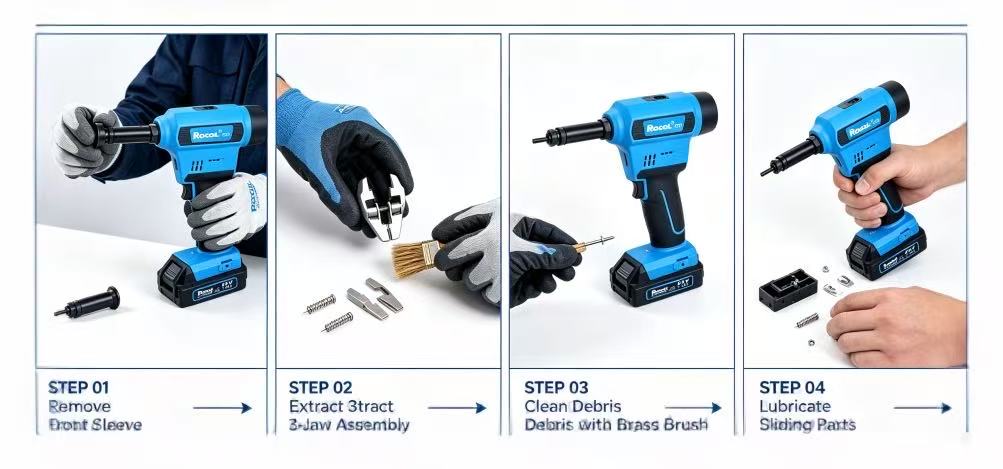
Selecting the right electric rivet gun comes down to matching your fastener requirements with the correct pulling force (N), stroke length (mm), and battery platform capabilities.
For Light to Medium Assembly: Choose compact, auto-reversing cordless tools with high-capacity battery packs.
For Heavy Structural Fabrication: Choose heavy-duty cordless platforms from Rocol Tools, featuring drop-forged steel gear housings and high tensile pull forces.
For High-Velocity Assembly & Process Verification: Invest in smart cordless tooling ecosystems from 4Woo, featuring automated pin retention, clean collector mechanics, and real-time LED quality monitoring.
By equipping your workforce with high-performance cordless electric riveters, you can eliminate restrictive air hoses, lower energy costs, and achieve consistent, zero-defect mechanical joints across every shift.


