English
Views: 0 Author: Site Editor Publish Time: 2026-06-09 Origin: Site


In modern manufacturing and structural fabrication, creating strong, reusable threads in thin-gauge materials is a persistent engineering challenge. Standard materials like sheet metal, plastics, carbon fiber, and tubular steel are often too thin to tap reliable threads directly. Traditional welding nuts require immense thermal energy, risk warping the parent material, destroy pre-coated surface finishes, and leave behind toxic slag that demands labor-intensive cleaning.
The engineering solution to this challenge is the structural rivet nut (often called a blind nut or nutsert). However, deploying these fasteners at scale across automotive, aerospace, marine, and electronic assembly industries requires highly precise tool engineering.
This comprehensive technical guide explores the mechanical principles of the metric M3 to M12 rivet nut range, classifies the core tool power infrastructures available through OEM and ODM manufacturing channels, details critical process control variables, and analyzes how industry pioneers like Rocol Tools and their intelligent 4Woo system are advancing industrial fleet operations.

Implementing a robust threaded insert protocol across a factory floor requires an understanding of how distinct metric sizes behave under mechanical deformation. The mechanical forces required to install an M3 aluminum insert differ fundamentally from those needed for an M12 structural stainless steel rivet nut.
M3, M4, and M5 rivet nuts are commonly used in precision electronics enclosures, control panels, automotive dashboards, and medical equipment. Because these fasteners possess thin walls and delicate internal threads, they require precise control over the stroke length and installation pull force. A tool that applies excessive pressure will instantly strip the internal metric threads or crush the delicate sheet metal substrate.
M6 and M8 sizes represent the most widely used fasteners in general industrial manufacturing, including automotive body panels, white goods appliance assembly, and heavy duty HVAC systems. These fasteners demand balanced tool parameters—providing sufficient force to fully collapse the rivet nut sleeve while maintaining high cycle speeds for high-volume production lines.
M10 and M12 structural rivet nuts are engineered for high-stress applications such as commercial truck chassis fabrication, agricultural machinery, construction equipment, and heavy steel enclosures. Deforming a steel or stainless steel M12 insert requires an immense linear pulling force (often exceeding 20 kilonewtons). Specialized tooling must deliver this massive tonnage smoothly to prevent thread galling or premature tool failure.
Here is the converted Markdown table based on your metric fastener force configurations diagram:
| Fastener Sizing Range | Applied Mechanical Force | Primary Tool Control Profile | Typical Application Focus |
| M3 - M5 Range | Low Force | High Precision (Stroke Control) | Delicate internal threads and thin-gauge substrates |
| M6 - M8 Range | Medium Force | Balanced Cycle Speed | General industrial manufacturing and high-volume lines |
| M10 - M12 Range | Ultra-High Tonnage | Dynamic Pull Force | High-stress structural joints and heavy heavy-duty alloys |
For a metric rivet nut to achieve its rated pull-out and spin-out torque resistance, the tool must execute a flawless compression sequence.
As the tool pulls the threaded mandrel back, the unthreaded sleeve of the rivet nut collapses axially and expands radially. This expansion must completely fill the pre-drilled or laser-cut hole cavity. If a tool under-sets the fastener due to low power or insufficient stroke, a microscopic gap will remain, causing the insert to spin out when an auxiliary bolt is torqued down during final assembly.
Conversely, over-setting occurs when the tool exerts force beyond the structural limits of the fastener. This distorts the counter-sunk flange, induces micro-fractures in surrounding panels, and stretches the internal metric threads, rendering the insert useless and requiring expensive rework.
Industrial facilities must select the right tool infrastructure based on volume, mobility, available utilities, and total cost of ownership (TCO). High-quality OEM and ODM factories offer configurations tailored to each operational paradigm.
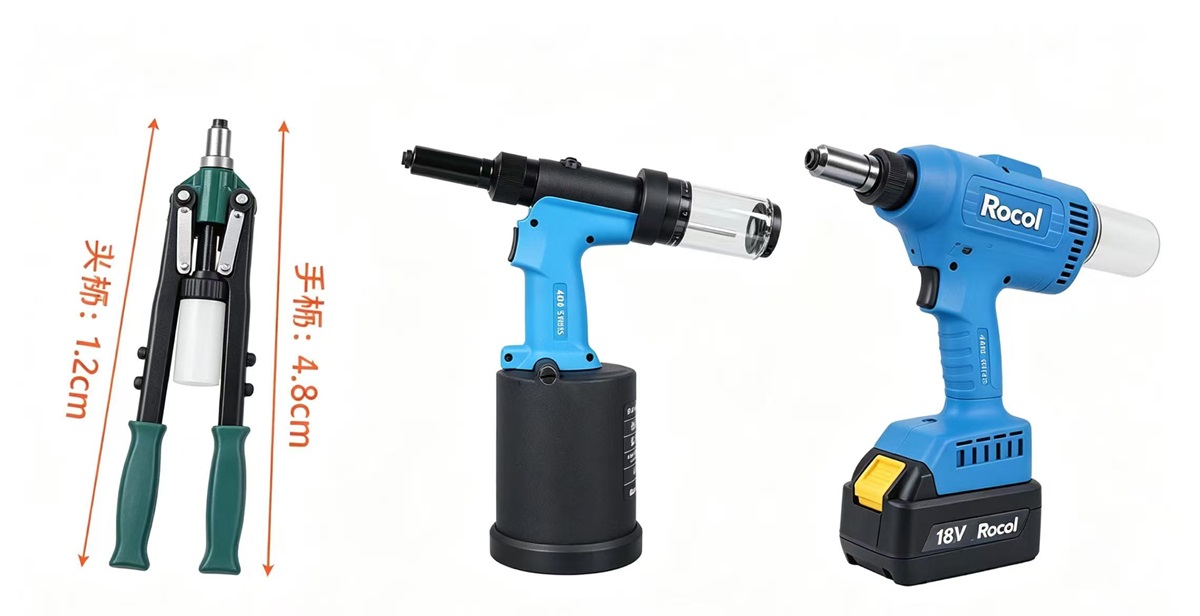
Manual tools rely completely on the mechanical advantage generated by the human operator. They are vital for prototype labs, field maintenance, field repair operations, and low-volume craft assembly shops.
Hand pliers utilize a compact handle profile designed for single-handed actuation. They offer excellent tactile feedback for small-diameter fasteners but cause quick operator fatigue when used continuously.
Lever and lattice manual tools use extended arms or complex mechanical linkages to multiply user input. This mechanical advantage allows field technicians to manually deform large M12 steel inserts, although the tool requires significant clearance space around the application area.
Powered by plant compressed air networks, pneumatic systems use air-driven hydraulic cylinders to provide rapid, high-tonnage pulling force.
Spin-spin tools use an air motor to spin the mandrel into the rivet nut, pull to deform it based on air stall-torque, and then spin backward to disengage. While fast, they are sensitive to air pressure fluctuations across the plant, which can lead to inconsistent installation settings.
These tools represent the premium configuration for stationary high-speed lines. The air pressure drives an internal hydraulic intensifier, producing a smooth linear pull. This process provides high consistency for medium-to-large structural fasteners but ties the operator to a rigid layout of overhead air drops and stiff hoses.
The rapid development of high-capacity lithium-ion cells and advanced brushless motors has enabled smart cordless tools to match the raw performance of industrial pneumatic equipment.
Modern cordless rivet nut tools use high-torque brushless DC (BLDC) motors paired with planetary gearboxes and heavy-duty ball screws. This architecture converts rotational electrical energy into highly regulated linear thrust, eliminating the maintenance, line leaks, and oil seal failures common with pneumatic systems.
At the cutting edge of industrial cordless innovation is Rocol Tools with their flagship 4Woo heavy-duty smart cordless riveting platform. Engineered specifically to bridge the gap between high-volume production speed and untethered mobility, the 4Woo series can install the full range of M3 through M12 structural inserts flawlessly.
Equipped with an onboard microprocessor and a digital control interface, the Rocol Tools 4Woo allows operators to toggle instantly between stroke-controlled or force-controlled installation modes. Unlike primitive battery tools that experience a drop in output torque as the battery discharges, the 4Woo actively regulates its internal voltage loop. This ensures identical pulling force from the first cycle to the last, providing complete operational freedom across large automotive assemblies, architectural structures, and industrial facilities.
In modern Tier-1 manufacturing and aerospace assembly, simple visual inspection cannot confirm the internal integrity of a blind fastening joint. Industry 4.0 standards mandate automated data verification for every assembly step.
Intelligent electric platforms like the 4Woo turn a manual, blind fastening operation into a transparent, data-verified assembly step by linking directly into the plant's Manufacturing Execution System (MES).
| Manufacturing Metric | Traditional Pneumatic Fleet | Rocol Tools 4Woo Smart Platform |
| Primary Power Source | Unregulated plant compressed air | Industrial High-Voltage Li-Ion Battery |
| Control Parameter Mode | Fixed mechanical stroke adjustment | Digital setting via force or stroke profiling |
| Data Logging Capabilities | Completely analog (None) | Integrated Bluetooth/Wi-Fi data stream |
| Error Flagging Logic | Relies on post-assembly manual quality check | Real-time cycle curve verification on the line |
During a single installation cycle, embedded load cells and linear encoders inside the Rocol Tools 4Woo track the exact real-time execution curve of the pull force against stroke displacement thousands of times per second.
If an operator encounters a pre-drilled sheet metal hole that was punched too wide, or if a material sheet is missing from the stack-up, the tool instantly detects that the physical curve falls outside its programmed compliance window. The 4Woo illuminates a local warning indicator on its digital panel and sends an error log wirelessly to the factory network, allowing line supervisors to fix the issue before the product moves further down the line.
When global brands source fastening tools, working with a professional OEM/ODM factory enables deep technical customization to meet specific assembly challenges.
Specialized industrial environments often feature restricted access angles or unusual component geometries. OEM/ODM engineers can design custom extended nose assemblies, ultra-slim tool heads, or angled pull units to ensure operators can install M3-M12 fasteners in tight spaces.
ODM manufacturing allows industrial brands to customize the tool's embedded software interface, update firmware profiles for specific specialized fasteners, and integrate custom wireless communication protocols to match unique smart factory networks.
To maintain long tool service lifetimes and zero-defect product runs, manufacturing floors should implement strict operational and maintenance protocols.
Avoid Punch-Induced Micro-Cracks: For thick, structural steel plates, laser-cut or CNC-drilled holes are superior to raw mechanical punching. Punching can create microscopic fractures along the inner hole wall, which can expand into structural cracks under high radial installation pressures.
Deburring Protocol: Always ensure that burrs and metal shavings are cleared from between the material sheets before riveting. Trapped debris can prevent proper initial sheet alignment, resulting in loose joints over time.
Mandrel Cleaning and Lubrication: Because high-tensile steel threads experience extreme friction during M10-M12 installations, mandrels must be cleaned with a wire brush and coated with high-pressure lubricants regularly to prevent thread galling and premature snaps.
Jaw Assembly Audits: Weekly clean-outs of the internal jaw mechanisms remove fine metal powder and coating residues, preventing tool slippage and extending component life.
Selecting and configuring the right M3 to M12 riveting tool fleet directly impacts a manufacturing plant’s baseline efficiency, assembly safety, and operational costs. While manual options remain essential for mobile field repairs, and pneumatic tools continue to provide fast cycles on fixed assembly benches, the modern manufacturing sector is rapidly adopting the flexibility, energy efficiency, and total digital traceability of cordless solutions.
By partnering with an experienced manufacturer and standardizing on advanced, connected systems like the Rocol Tools 4Woo, modern fabrication facilities can eliminate the maintenance and energy costs of complex air-compressor networks, protect thin substrates from over-setting, and achieve data-driven quality control for every joint. Balancing mechanical force with intelligent digital process control keeps your assembly workflows highly accurate, fully compliant with international quality standards, and completely future-proof.