
English
Views: 0 Author: Site Editor Publish Time: 2026-06-06 Origin: Site


In the global industrial manufacturing landscape, the integrity of structural fastening can dictate the success or failure of multi-million dollar engineering projects. From commercial transport chassis and railway boxcars to aerospace components and heavy agricultural machinery, structural joints are subjected to relentless dynamic stress, high-frequency harmonic vibrations, and extreme environmental exposure.
As a leading industrial riveting solutions manufacturer, a company's mission extends far beyond producing handheld tools; it encompasses delivering absolute joint reliability, process repeatability, and data-driven quality control. For decades, legacy air-powered systems dominated high-volume production benches. However, the shift toward flexible manufacturing, strict regulatory compliance, and energy efficiency has forced a major transformation in fastening technology.
This comprehensive technical guide breaks down the advanced engineering principles behind industrial fastening, details the critical manufacturing protocols required to eliminate joint failure, analyzes the modern shift in factory power infrastructure, and explores how visionary brands like Rocol Tools and their intelligent 4Woo system are defining the future of connected assembly.

To manufacture or implement a premium industrial fastening strategy, engineers must look past the external appearance of a tool and analyze the precise fluid and electromechanical forces occurring during the installation cycle. Structural riveting is a highly engineered process of controlled material deformation.
A securely fastened industrial joint relies on the perfect execution of two mechanical elements: clamp force and shear resistance.
Clamp force is the compressive pressure that binds multiple material sheets together tightly. When an industrial riveter acts upon a fastener—such as a high-tensile structural blind rivet or an internally threaded rivet nut—it applies a linear pull that collapses the fastener's sleeve against the blind side of the rear panel. A superior tool design ensures that high residual clamp force remains locked within the joint, utilizing material friction to completely eliminate lateral shifting.
Shear resistance prevents forces acting perpendicular to the fastener's axis from slicing through the joint, while tensile resistance prevents the panels from pulling apart axially. In heavy equipment, like mining trucks or rail cars, fasteners must achieve maximum radial hole fill. The tool must expand the fastener body tightly against the inner walls of the pre-drilled cavity, ensuring no microscopic gaps exist to cause joint movement under high dynamic stress.
As an experienced industrial riveting solutions manufacturer, engineering teams continuously develop technologies to eradicate hidden defects that lead to catastrophic field failures.
When working with thin-gauge sheet metal or softer alloys like aluminum, excessive or unevenly applied force from a riveting gun can cause the metal around the hole to buckle or warp. Advanced riveting systems resolve this by utilizing regulated deceleration profiles at the end of the stroke, ensuring the material’s yield point is only breached within the fastener itself.
Thread galling is a destructive form of adhesive wear that occurs when stainless steel or titanium fasteners are friction-heated under high torque loads. During the installation of structural rivet nuts, if a tool spins onto or pulls the threaded mandrel unevenly, the internal threads can weld together instantly, ruining the workpiece. Precision manufacturing requires tools that maintain perfect coaxial alignment throughout the entire pull-and-spin cycle.
Selecting the foundational power source for an industrial assembly plant impacts long-term capital expenditures (CapEx), daily utility costs (OpEx), factory floor adaptability, and operator ergonomics.
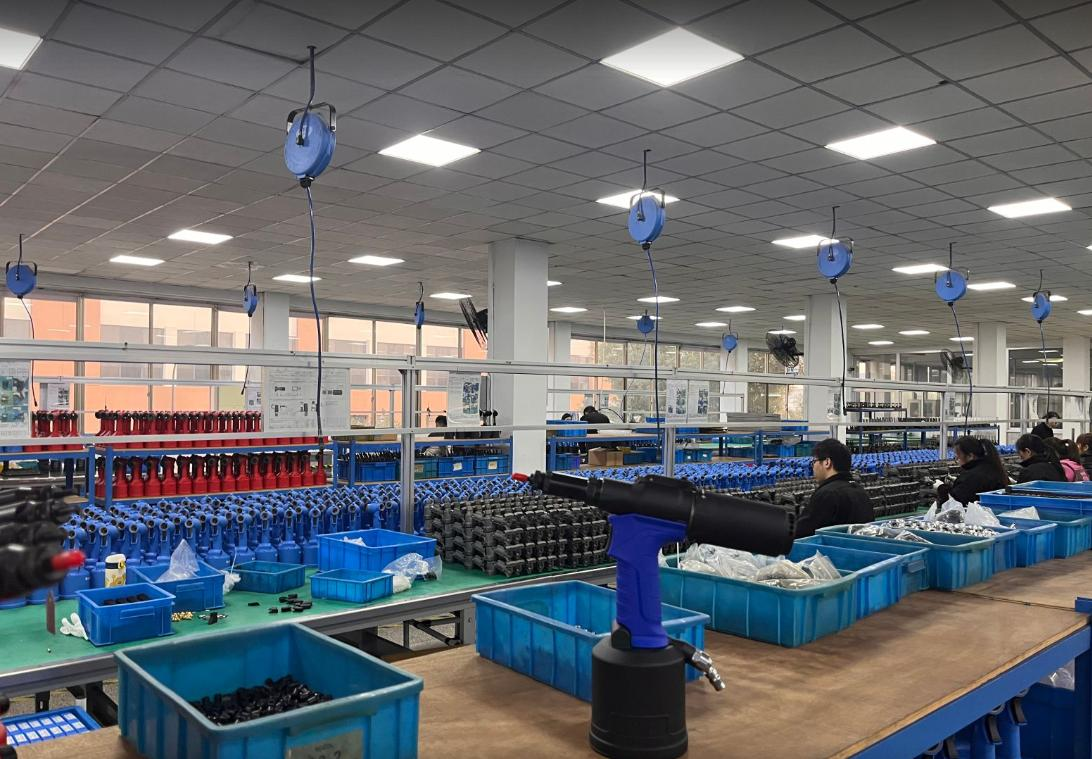
For generations, hydro-pneumatic (air-over-oil) tools have been the standard workhorse for heavy structural assembly because they deliver exceptional power-to-weight ratios.
Hydro-pneumatic guns use shop compressed air (typically regulated between 5.5 and 7 bar) to drive an internal large-diameter pneumatic piston. This piston forces hydraulic oil into a secondary high-pressure chamber, resulting in massive linear pulling force delivered to the tool's head assembly. Because the heavy mechanical elements are separated from the operator's hand, the handheld portion remains light.
Despite their historical reliability, hydro-pneumatic fleets present severe challenges for modern factories:
Line Pressure Drop-offs: When multiple tools cycle simultaneously on an air ring main, pressure drops can cause inconsistent rivet settings.
Extreme Energy Waste: Air compressors run continuously, losing huge amounts of electrical energy to thermal dissipation and microscopic line leaks.
High Maintenance Costs: Compressed air carries moisture that degrades internal seals, requiring frequent teardowns to prevent hydraulic fluid from leaking onto clean workpieces.
To achieve the agility demanded by modern production layouts, manufacturers are increasingly phasing out pneumatic lines in favor of smart, battery-powered cordless systems that deliver equivalent mechanical force.
Modern cordless riveting tools replace traditional pneumatic pistons and hydraulic fluid chambers with a high-torque brushless DC (BLDC) motor coupled to an industrial-grade planetary gearbox and precision ball screw. This drivetrain converts rotational electrical energy into smooth, linear pulling force, completely eliminating air hoses, oil seals, and central compressor dependencies.
At the cutting edge of this industrial cordless transition stands Rocol Tools with their flagship 4Woo heavy-duty smart cordless riveting platform. Engineered specifically to match the high-tonnage output of heavy pneumatic systems, the 4Woo effortlessly sets structural blind rivets and heavy-duty rivet nuts up to 6.4mm (1/4 inch) and larger in steel and stainless steel alloys.
Powered by high-capacity, industrial-grade lithium-ion cells, the electronic drivetrain of the Rocol Tools 4Woo features an active power-management loop. Traditional battery tools suffer from a drop in pulling force as the battery discharges; the 4Woo, however, continuously regulates internal voltage to ensure identical high-tonnage pulling force from the first installation cycle to the last. This gives manufacturing managers the exact consistency of a tethered air tool paired with the complete mobility of a cordless device.
In Tier-1 automotive manufacturing, defense contracting, and aerospace fabrication, simple visual inspections are no longer adequate to verify structural compliance. Modern quality standards require an unbroken digital record of every single fastening operation.
Intelligent cordless platforms function as active data-collection nodes within a factory’s Manufacturing Execution System (MES), replacing analog guess-work with verifiable statistics.
| Manufacturing Parameter | Legacy Hydro-Pneumatic Fleet | Rocol Tools 4Woo Smart System |
| Primary Power Delivery | Compressed air (Unregulated shop PSI) | High-Voltage Lithium-Ion Battery & BLDC Motor |
| Force Control Mode | Fixed mechanical stroke | Digitally regulated via real-time sensors |
| Data Tracking Capabilities | Completely analog (None) | Wireless data stream via Wi-Fi/Bluetooth |
| Error Flagging Logic | Relies on manual quality inspection | Instantaneous Pass/Fail notification on the tool |
The Rocol Tools 4Woo monitors both the exact pulling force (measured in kilonewtons) and the precise stroke displacement (measured in millimeters) thousands of times throughout a single rivet setting cycle. The tool compares this real-time mechanical profile against a pre-programmed, optimized installation curve window.
If an operator encounters an oversized hole (causing the fastener to collapse too quickly) or an omitted plate layer (preventing the proper clamp force from being achieved), the 4Woo instantly identifies the anomaly. The tool flags a "Fail" error code on its integrated digital control panel, illuminates a visual warning indicator, and transmits the error log wirelessly to the central factory network, allowing line supervisors to stop the defective assembly before it progresses down the assembly line.
To maximize fleet uptime and guarantee the longevity of your structural joints, assembly facilities should implement strict operational and preventative maintenance guidelines.
Drilling over Punching: In thick structural plates, drilled, laser-cut, or CNC-milled holes are far superior to raw punched holes. Punching creates micro-cracking along the inner wall of the hole, which can expand into structural fractures when subjected to high radial pressures during rivet expansion.
Deburring Protocol: Ensure all metal shavings and jagged burrs are completely cleared from the sheet interfaces before riveting. Trapped debris will eventually flatten or shake out under field vibrations, resulting in lost residual clamp force and loose joints.
Jaw Assembly Debris Cleaning: Due to the immense forces required to break high-tensile steel mandrels, metal scales and anti-corrosion oils naturally accumulate inside the tool's nosepiece. Jaws should be removed, cleaned with a wire brush, and inspected for tooth flattening weekly to prevent mandrel slippage.
Mandrel and Jaw Lubrication: Apply dedicated high-pressure lubricants to the internal jaw mechanisms regularly to minimize friction-induced heat during high-speed, continuous-duty production shifts.
Choosing a premier industrial riveting solutions manufacturer is a foundational decision that dictates a facility's baseline productivity, product reliability, and operational cost structure. While legacy hydro-pneumatic tools remain a fast choice for fixed-bench environments, the manufacturing sector is steadily standardizing on the agility, energy efficiency, and digital traceability of cordless solutions.
By integrating next-generation, high-performance systems like the Rocol Tools 4Woo, modern fabrication plants can completely eliminate the maintenance burdens of complex air-compressor networks, protect delicate substrates from structural crushing, and secure absolute data-driven quality control for every joint. Finding the ideal balance between heavy-duty mechanical force and intelligent digital process control ensures that your assembly workflows remain highly efficient, compliant with international standards, and completely future-proof.


