
English
Views: 0 Author: Site Editor Publish Time: 2026-08-11 Origin: Site


In high-volume manufacturing, automotive repair, structural sheet metal assembly, and aerospace engineering, choosing the right fastening equipment directly impacts productivity, labor ergonomics, and operating margins. Fasteners such as blind rivets, structural rivets, and rivet nuts form the mechanical backbone of countless modern structures. However, driving these fasteners efficiently requires selecting the ideal power tool.
For decades, the pneumatic (air-powered) rivet gun has remained the undisputed king of factory assembly lines. Lightweight, blazingly fast, and virtually indestructible, pneumatic tools set the benchmark for high-speed production. Yet, over the last decade, rapid developments in lithium-ion battery technology, brushless motors, and smart electronics have elevated cordless rivet guns into formidable contenders.
This comprehensive guide breaks down the critical mechanics, performance metrics, operational tradeoffs, and real-world applications of cordless rivet guns versus pneumatic rivet guns. Whether you are managing an automated industrial assembly facility or conducting on-site field maintenance, this guide will help you determine which fastening tool best aligns with your operational goals.

Pneumatic rivet guns utilize compressed air to drive an air-hydraulic piston mechanism. When the operator depresses the trigger, high-pressure air enters the tool cylinder, pushing a piston back to exert thousands of pounds of pulling force on the rivet mandrel. Once the predetermined tension limit is reached, the rivet expands, clamp load is achieved, and the mandrel snaps off clean.
[Li-Ion Battery] ➔ [Brushless DC Motor] ➔ [Planetary Gearbox / Ball Screw] ➔ [Linear Jaw Retraction] ➔ [Mandrel Release]
Air Motor & Piston: Converts pneumatic pressure (typically 80–100 PSI or 5.5–7.0 bar) into instantaneous linear force.
Hydraulic Fluid Chamber: Amplifies air pressure to achieve the massive pulling tension required for heavy-duty steel and stainless steel fasteners.
Jaw Unit and Nosepiece: Holds the mandrel securely during the pulling stroke.
Mandrel Vacuum Collection System: Sucks spent mandrels into a rear collection bottle to keep workspaces clean and free of trip hazards.

Pneumatic rivet tools cycle almost instantaneously. Because air pressure provides immediate kinetic response without motor spin-up time, an experienced operator can set dozens of rivets per minute without experiencing power lag or thermal throttling.
Because pneumatic tools do not carry internal electric motors, gearboxes, or heavy battery packs, their physical weight is significantly lower than cordless counterparts. A heavy-duty industrial pneumatic riveter typically weighs between 2.5 to 4.5 lbs (1.1 to 2.0 kg), drastically reducing operator fatigue during long shifts.
Air tools do not overheat under heavy, repetitive use. As long as the central air compressor delivers a steady, moisture-free airflow, a high-quality pneumatic tool—such as those manufactured by industrial leaders like Rocol Tools—can operate round-the-clock on high-volume production lines without thermal downtime.
With fewer moving electronic components, air tools are extremely durable. Routine maintenance involves simple fluid top-offs, jaw cleaning, O-ring replacements, and inline lubrication.
The most prominent drawback of a pneumatic riveter is its mandatory connection to an air hose. The thick, rigid air line creates resistance, restricts operator movement, and poses tripping risks in dynamic job environments.
Running compressed air infrastructure is notoriously energy-inefficient. Air compressors require substantial electrical power, and pipeline leaks can significantly inflate facility energy overhead.
Pneumatic tools release exhaust air upon trigger release, producing noise levels that frequently exceed 80–85 dBA. In confined spaces, this exhaust can also stir up shop dust or atomized oil mist if lubricators are not calibrated correctly.
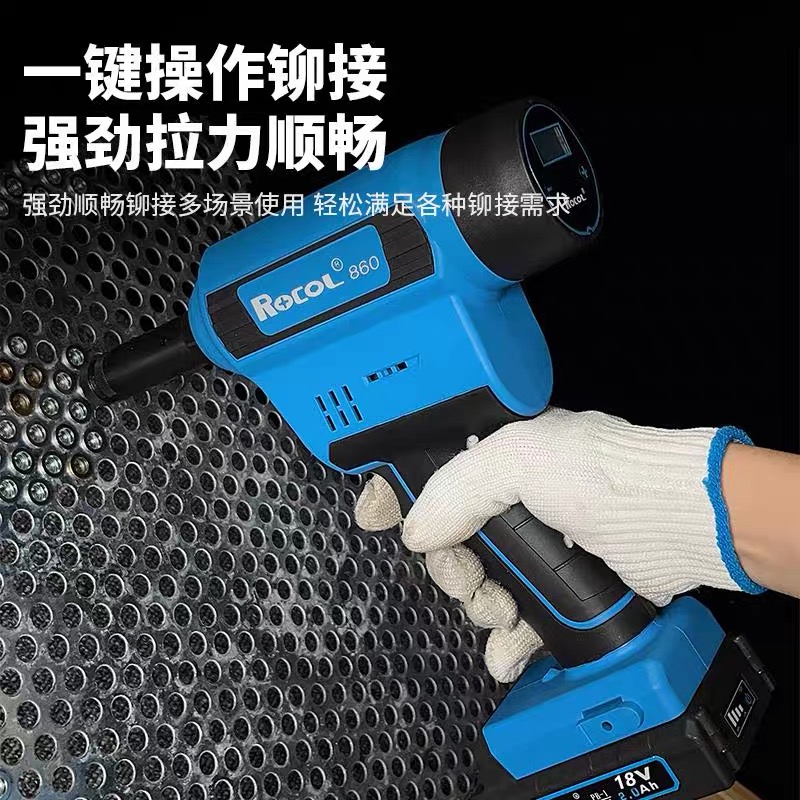
Cordless rivet guns rely on high-capacity lithium-ion battery packs to power a compact, high-torque brushless DC motor. The motor turns a planetary gear assembly, converting rotational motion into linear pulling force via a ball-screw or planetary-screw mechanism.
[Li-Ion Battery] ➔ [Brushless DC Motor] ➔ [Planetary Gearbox / Ball Screw] ➔ [Linear Jaw Retraction] ➔ [Mandrel Release]
Brushless DC Motor: Eliminates carbon brush wear, maximizes thermal efficiency, and delivers high torque output in a compact footprint.
Microprocessor Control Board: Regulates stroke length, monitors current draw to prevent overload, and controls automatic reverse cycles.
Planetary Gearbox & Ball Screw Drive: Converts high-RPM motor rotation into smooth, high-tonnage pulling force.
Battery Pack: Modern 18V/20V or 20V/24V lithium-ion platforms engineered with thermal management sensors and smart cell-balancing.

Without an air hose tethering the tool to a wall compressor, cordless riveters allow operators to move freely across large job sites, climb scaffolding, or work inside cramped vehicle interiors.
Deploying cordless riveting systems eliminates the need to buy, maintain, or move heavy air compressors, air dryers, and moisture separators. This makes battery-powered tools extremely cost-effective for field repair technicians and smaller fabricators.
Cordless tools operate almost silently when idle and generate significantly lower decibel levels during operation compared to air tools. There is no air exhaust, eliminating oil mist hazards and ambient dust disturbance.
Modern battery riveters often feature digital interfaces, LED illuminators, programmable stroke limits, and stroke counters. Advanced equipment platforms like 4Woo integrate sensor feedback that warns the user if a rivet was incompletely set, enhancing quality control in critical structural applications.
Including the motor, planetary gearbox, and 4.0Ah or 5.0Ah lithium-ion battery, a commercial cordless riveter weighs between 4.5 to 7.0 lbs (2.0 to 3.2 kg). This additional mass can cause hand and wrist fatigue over prolonged overhead shifts.
Under continuous heavy usage—especially when pulling heavy structural stainless steel rivets—battery charges deplete and motors generate heat. Without spare batteries or thermal management, productivity can stall while cells cool down and recharge.
The initial investment for a cordless rivet gun, including high-capacity batteries and multi-bay chargers, is typically higher than that of an equivalent pneumatic tool body.
To highlight the core differences between pneumatic and cordless technologies, the table below compares key performance parameters:
| Feature / Metric | Pneumatic Rivet Gun | Cordless Rivet Gun |
| Power Source | Compressed Air (5.5 – 7.0 Bar) | Rechargeable Li-Ion Battery (18V - 20V) |
| Mobility | Low (Tethered to air line) | Unlimited (Complete wireless freedom) |
| Tool Weight | Lightweight (2.5 – 4.5 lbs) | Heavier (4.5 – 7.0 lbs with battery) |
| Cycle Speed | Ultra-Fast (< 1 second per cycle) | Fast (1.0 – 2.5 seconds per cycle) |
| Duty Cycle | Unlimited 24/7 continuous duty | Dependent on battery swapping & thermal control |
| Maintenance | Minimal (Oil, O-rings, jaw cleaning) | Mechanical gear greasing, battery care |
| Infrastructure | High (Requires air lines & compressors) | Low (Requires standard power outlets for chargers) |
| Noise Level | Moderate to High (80 – 90+ dB) | Low to Moderate (65 – 75 dB) |
| Ergonomics | Balanced & lightweight; pulling torque limited by air pressure | Slightly tail-heavy; consistent pull force regardless of location |

Pneumatic Riveters: Air pressure creates consistent linear pulling force. For heavy-duty industrial fasteners (e.g., $1/4\text{ inch}$ or $6.4\text{ mm}$ structural blind rivets), industrial air tools easily generate pulling forces ranging from 18,000 N to over 30,000 N without motor stress.
Cordless Riveters: High-end brushless cordless tools achieve pulling forces up to 20,000 N to 25,000 N, sufficient for setting structural steel and aluminum blind rivets. However, continuous maximum-load pulls increase battery drain and thermal output.
In fixed workstation environments where tools are overhead or counterbalanced on spring balancers, pneumatic tools are superior due to their lower physical weight.
On field sites, climbing ladders, or crawling into structural enclosures, cordless tools eliminate the dangerous strain of dragging heavy rubber air hoses around obstacles.
When calculating TCO, consider both immediate and long-term costs:
Pneumatic Infrastructure: Purchasing a compressor system, filter-regulator-lubricator (FRL) units, drop lines, and power usage.
Cordless Ecosystem: Tool skin costs, battery degradation replacements over 3–5 year lifespans, and charging stations.
Different industrial sectors require distinct tool configurations. Below is an analysis of where each technology excels:
| Workspace Type | Recommended System | Key Advantages |
| Stationary Industrial Line | Pneumatic Rivet Gun System | • High speed • Light weight • 24/7 continuous operation |
| Field Operations & Worksite | Cordless Rivet Gun System | • No hoses • Site mobility • Fast setup |

Recommended System: Pneumatic Rivet Guns
Primary Factor: In automotive sub-assembly, appliance manufacturing, and HVAC ducting plants, operators set thousands of fasteners per shift at fixed workstations. Speed, tool weight, and constant power are paramount, making air tools the industry standard.
Recommended System: Hybrid Approach
Primary Factor: Workers moving inside long cargo trailers, buses, or railcars benefit from cordless tools because air hoses get tangled around internal framing. Stationary external paneling work, however, favors pneumatic rigs.
Recommended System: Cordless Rivet Guns
Primary Factor: Field service technicians cannot depend on job site air infrastructure. Carrying a cordless tool and two spare batteries onto a roof or into an elevator shaft is far safer and more efficient than hauling a portable air compressor.
Recommended System: High-Precision Air and Smart Cordless Systems
Primary Factor: Aircraft manufacturing demands tight clamping tolerances, precise pull tension, and non-marring jaw actions to prevent structural material damage.
When equipping your operation, selecting high-performance tooling manufacturers ensures operational reliability, tool endurance, and long-term serviceability.
| Brand / Company | Core Focus | Key Features & Advantages |
| Rocol Tools | Industrial Pneumatic & Air-Hydraulic | • Heavy-duty steel & alloy bodies • Fast cycle times for assembly lines • Low vibration & ergonomic designs |
| 4Woo Tools | Smart Cordless & Battery Innovation | • Brushless motor efficiency • Smart stroke control & count systems • On-site mobility & ergonomics |
In heavy industrial manufacturing, Rocol Tools has earned a reputation for engineering high-durability pneumatic air-hydraulic riveters and rivet nut tools. Built to handle punishing production environments, Rocol Tools focuses on maximizing cycle speed, structural rigidity, and operator comfort.
Precision Air-Hydraulic Engineering: Designed with high-tensile steel cylinder housings and precision-ground hydraulic valves that deliver smooth, chatter-free pulling forces up to $34\text{ kN}$.
Integrated Vacuum Mandrel Collection: Features built-in air-saver switches that suck spent mandrels directly into high-capacity collection bottles, maintaining a safe, clean shop floor.
Ergonomic Shock-Absorption: Built with anti-vibration rubberized handgrips and light-touch pneumatic triggers that minimize Repetitive Strain Injuries (RSI) across full work shifts.
Versatile Fastener Compatibility: Designed to seamlessly pull standard blind rivets, structural rivets, and heavy-duty blind rivet nuts across aluminum, steel, and stainless steel alloys.
For plant managers looking to maximize output on high-speed assembly lines, integrating Rocol Tools pneumatic equipment guarantees long tool service life and minimal line maintenance downtime.

For operations prioritizing wireless flexibility, smart electronic monitoring, and rapid jobsite deployment, 4Woo stands out as a leading developer of cordless blind riveting technology. By merging high-torque brushless motors with intelligent onboard electronics, 4Woo tools bridge the gap between battery portability and industrial-grade pulling power.
Brushless Drive Efficiency: Powered by energy-dense brushless motors that run up to $40\%$ cooler and provide extended runtime per battery charge cycle.
Smart Rivet Monitoring & Cycle Counting: Select 4Woo models feature digital displays with integrated stroke counters and rivet insertion sensors, ensuring every joint meets strict structural quality standards.
Tool-Free Nosepiece Quick Change: Engineered with quick-release nosepiece assemblies, allowing field operators to swap rivet diameter sizes in seconds without needing specialized hand wrenches.
Universal Li-Ion Battery Ecosystem: High-output battery platforms deliver consistent pulling force through the last percentage of charge, preventing weak fastener sets caused by voltage drop.
Whether outfitting field repair teams or equipping flexible industrial cells, 4Woo cordless riveting platforms deliver the strength, precision, and freedom modern technicians require.
Before purchasing a fleet of rivet tools or replacing legacy systems, evaluate the following selection checklist:
Will the operator remain at a single bench, or move around large workpieces?
Decision: Fixed benchwork favors Pneumatic (Rocol Tools); multi-directional movement favors Cordless (4Woo).
How many rivets are set per hour, per shift?
Decision: Over $1,000+$ rivets per shift strongly favors pneumatic air tools for their infinite duty cycle and fast refresh rate.
What size and metal grade are your rivets?
Decision: Small aluminum blind rivets ($1/8\text{ inch}$ or $3.2\text{ mm}$) run easily on either system. Large stainless steel structural fasteners ($1/4\text{ inch}$ or $6.4\text{ mm}$) require high pulling force—verify tool tensile force ratings regardless of power source.
Does your facility already have a clean, dry compressed air distribution system with drop lines?
Decision: If air lines are already in place, pneumatic tools offer a lower upfront cost per tool skin. If air lines are absent, installing them costs significantly more than buying cordless tools and charging stations.
Proper maintenance extends tool lifespan, maintains clamping force quality, and prevents operational downtime.
Daily Oiling: Add 2–3 drops of pneumatic tool oil into the air inlet daily if an inline lubricator is not present.
Clean Pulling Jaws: Remove the nose housing weekly to clean metal shavings and dust out of the jaw teeth using a wire brush.
Drain Air Compressors: Regularly drain water traps and air receiver tanks to prevent moisture from rusting the tool’s internal pneumatic cylinder.
Keep Screw Mechanism Lubricated: Apply recommended synthetic grease to the internal ball screw and lead mechanism according to manufacturer service intervals.
Inspect Battery Terminals: Keep electrical contacts clean and dry; store lithium-ion batteries in temperature-controlled spaces to prevent cell degradation.
Check Mandrel Collection: Empty the rear collection collector frequently; allowing jammed mandrels to back up into the drive system can damage internal gears.

When deciding between a cordless rivet gun and a pneumatic rivet gun, there is no single "winner"—only the right tool for your specific application:
Choose a Pneumatic Rivet Gun if you operate in a high-volume factory setting, require continuous 24/7 duty cycles, demand the lightest physical tool weight, and already have an established compressed air setup. Industrial air tools, like those engineered by Rocol Tools, deliver maximum speed, longevity, and cost-efficiency under heavy production demands.
Choose a Cordless Rivet Gun if you need total jobsite mobility, perform maintenance work on large structures, work outdoors or in remote areas, or wish to eliminate air compressor infrastructure and hose trip hazards. Innovations like 4Woo cordless systems offer the power, smart cycle features, and freedom needed to handle demanding field operations cleanly and efficiently.
By matching your facility's production speed, physical layout, and fastener specifications to the proper tool architecture, you can streamline assembly workflows, protect operator safety, and ensure consistent structural fastening quality on every job.


