
English
Views: 0 Author: Site Editor Publish Time: 2026-08-13 Origin: Site


Automotive repair requires precision, durability, and relentless holding power. Whether you are replacing body panels, securing fender flares, rebuilding custom interiors, repairing window regulators, or fabricating structural frame components, fasteners are the silent guardians of vehicle safety and structural integrity. Among all fastening methods, blind rivets (pop rivets) and structural rivet nuts remain the gold standard in modern autobody shops and garage setups.
However, executing clean, vibration-resistant, and OEM-spec fastening depends heavily on the tool in your hands. Using an underpowered or poorly engineered rivet gun leads to incomplete mandrel breaks, loose panels, hand fatigue, and costly sheet metal damage.
With dozens of manual, pneumatic, and cordless battery models flooding the market, finding the best rivet gun for automotive repair can be overwhelming. This ultimate guide breaks down the mechanics, key selection parameters, industry applications, and top recommendations—including industry-leading tools from Rocol Tools and 4Woo—to help you upgrade your auto shop setup.

To appreciate the need for a high-quality rivet gun, it helps to understand why modern automakers rely so heavily on rivets over traditional spot welds or standard bolts.
Modern vehicles increasingly blend lightweight aluminum, high-strength steel, carbon fiber composites, and durable polymers to reduce overall curb weight and meet fuel efficiency and EV range requirements.
Welding Limitations: Welding dissimilar metals (such as joining an aluminum body panel to a steel frame) causes severe galvanic corrosion and structural weakening.
Mechanical Fastening Efficiency: Rivets create exceptionally high-tension mechanical joints without generating localized heat zones that warp thin sheet metal or compromise temper-treated alloys.
Body Panel Replacement: Securing door skins, quarter panels, rocker panels, and floor pans.
Interior & Trim Assembly: Installing dashboard supports, center consoles, and interior brackets.
Underhood & Undercarriage Work: Mounting heat shields, splash guards, wheel well liners, and belly pans.
Window Regulator & Lock Repair: Restoring window lift mechanisms (frequently secured with heavy-duty OEM aluminum or steel blind rivets).
Structural & Frame Upgrades: Setting heavy structural blind rivets or thread-insert rivet nuts for custom fabrication and off-road armor.

Choosing the right tool architecture depends on your daily repair volume, workshop layout, and budget. Automotive rivet guns generally fall into three distinct categories:
| Power Source | Recommended Application | Key Advantages | Key Considerations |
| Manual Rivet Guns | Low-volume repair | Cost-effective | High physical effort |
| Pneumatic Rivet Guns | High-volume auto body | Maximum speed & power | Requires air compressor |
| Cordless Rivet Guns | Mobile & field repair | Complete mobility | Battery dependent |
Manual tools rely purely on mechanical advantage via squeeze handles or compound levers.
Pros: Extremely affordable, compact, highly portable, and require no power sources or air compressors.
Cons: Extremely tiring for continuous usage; struggles to pull structural steel or stainless steel rivets larger than $3/16\text{ inch}$ ($4.8\text{ mm}$).

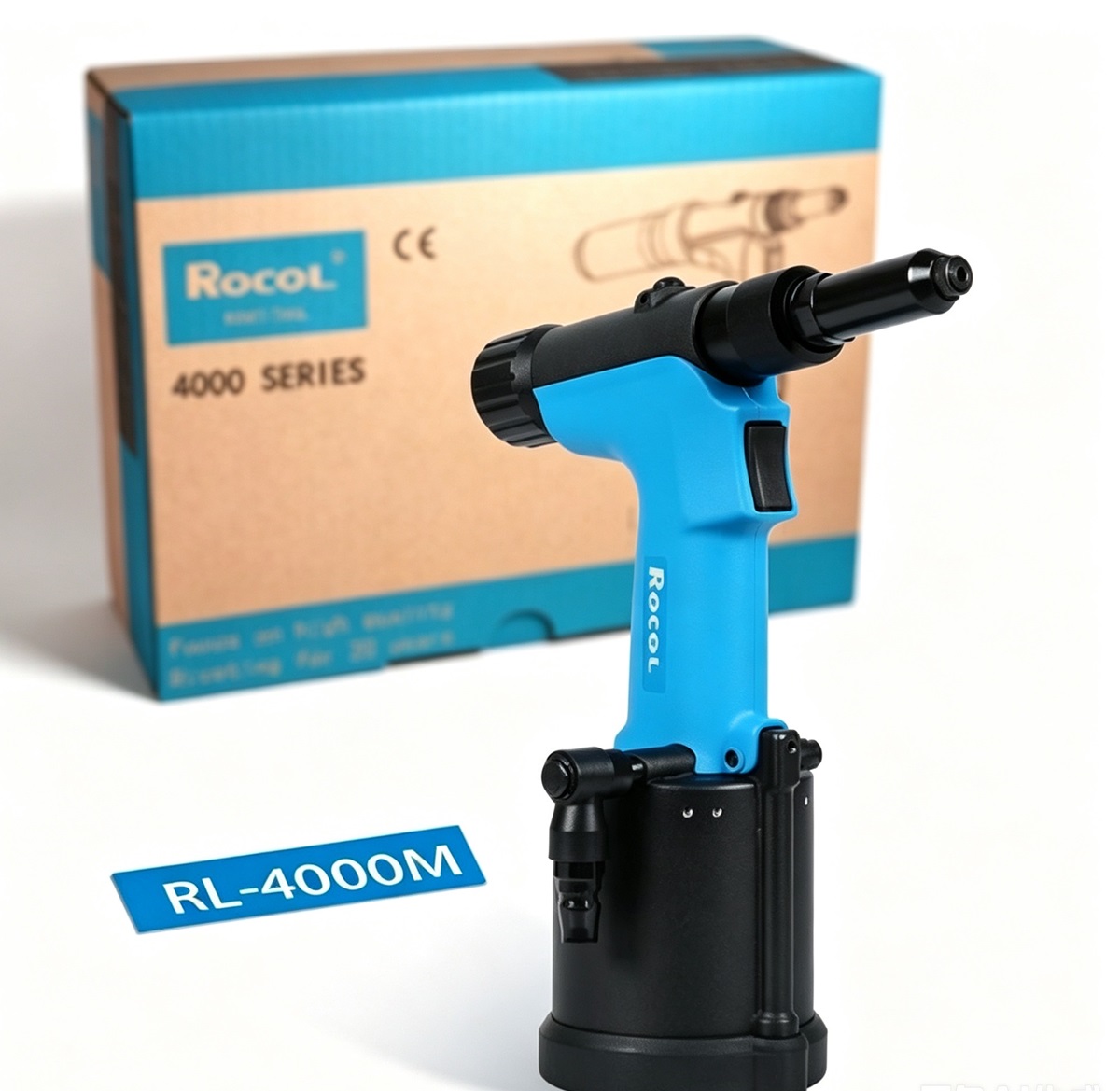
Pneumatic tools harness compressed air to drive a hydraulic piston, delivering thousands of pounds of instant pulling force at the press of a trigger.
Pros: Blazing fast cycle times ($<1\text{ second}$), virtually zero operator fatigue, virtually indestructible mechanisms, and continuous 24/7 duty cycles.
Cons: Tethered by a rigid air hose; requires investment in a clean, dry air compressor infrastructure.
Cordless tools utilize high-torque brushless electric motors and precision gear drives powered by rechargeable lithium-ion batteries.
Pros: Complete movement freedom, zero air hoses to scratch fresh auto paint, silent operation, and highly portable for roadside or field repair.
Cons: Higher initial tool investment; slightly heavier than pneumatic models due to onboard battery mass.

Before investing in a new riveting setup for your garage or dealership, evaluate these four critical performance metrics:
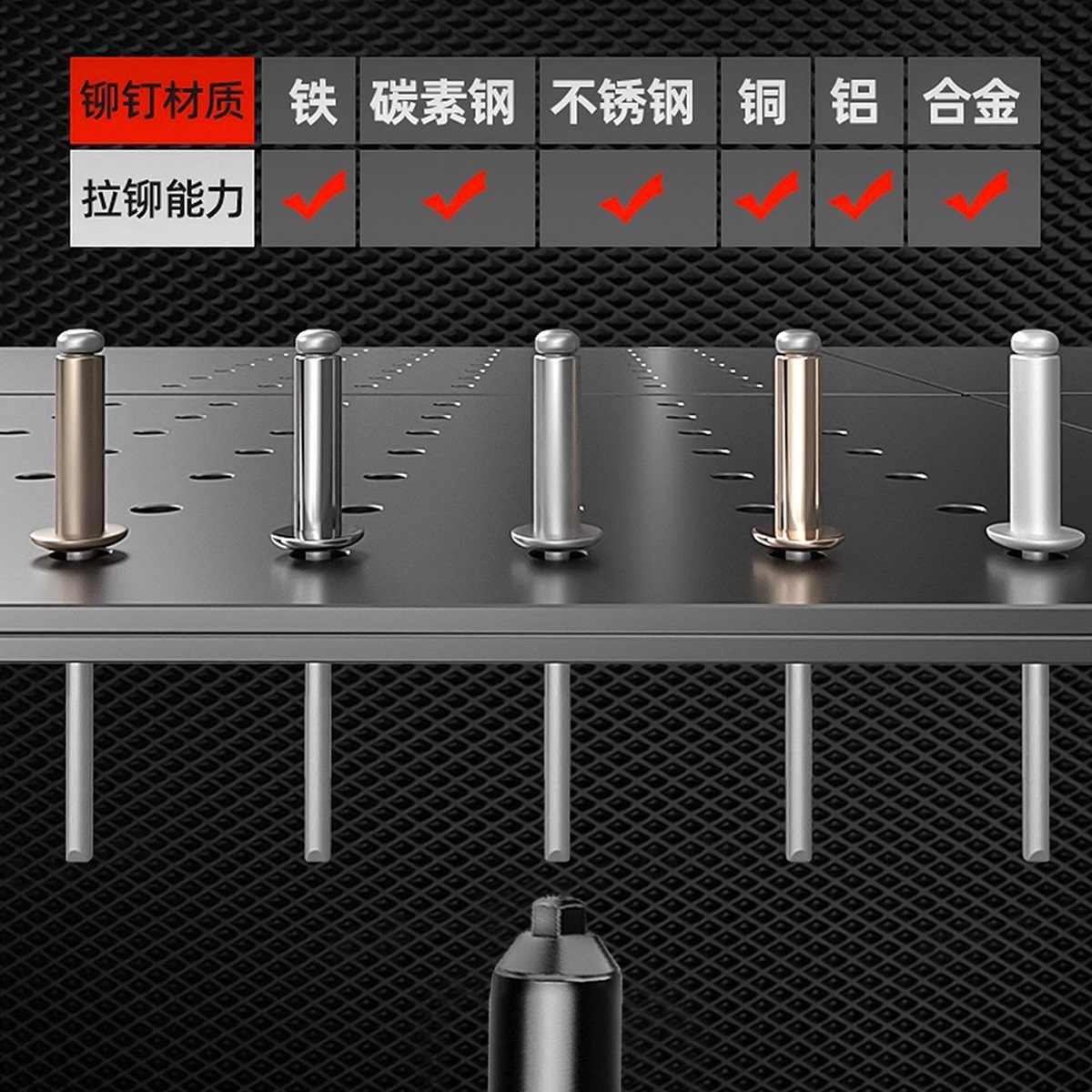
Automotive repairs utilize fasteners made from aluminum, steel, and stainless steel. Stainless steel and structural blind rivets require substantially higher tension to set and snap the mandrel.
Standard light aluminum body trim: Requires $4,000\text{ N}$ to $8,000\text{ N}$ of pulling force.
Heavy structural steel frame components: Requires $15,000\text{ N}$ to $25,000\text{ N}+$ of pulling force.
Your rivet gun must accommodate common automotive rivet diameters, typically:
$3/32\text{ inch}$ ($2.4\text{ mm}$)
$1/8\text{ inch}$ ($3.2\text{ mm}$)
$5/32\text{ inch}$ ($4.0\text{ mm}$)
$3/16\text{ inch}$ ($4.8\text{ mm}$)
$1/4\text{ inch}$ ($6.4\text{ mm}$) — crucial for structural work
When pulling dozens of blind rivets on a quarter panel, loose spent mandrels dropping onto the floor create safety hazards and tire puncture risks. Professional pneumatic tools incorporate a vacuum suction system that holds the rivet in place at awkward angles and automatically pulls the broken mandrel into a rear collection bottle.
Automotive engine bays and door cavities are notoriously cramped. Tools featuring slim nose designs or $90^\circ$ flexible head attachments allow mechanics to reach recessed panel flanges without removing entire subassemblies.
| Feature / Parameter | Manual Lever Riveter | Pneumatic Air-Hydraulic | Cordless Brushless Riveter |
| Best Used For | Light trim & emergency fix | High-volume body shop repair | Mobile auto repair & field work |
| Pulling Speed | Slow ($5–10\text{ sec/rivet}$) | Ultra-Fast ($<1\text{ sec/rivet}$) | Fast ($1–2\text{ sec/rivet}$) |
| Operator Fatigue | High | Extremely Low | Low |
| Portability | High | Low (Air hose bound) | Maximum (100% Wireless) |
| Power Output | Limited by hand strength | High & Consistent | High & Consistent |
| Maintenance | Minimal | Oil & O-ring checks | Gear greasing & battery care |
When equipping a commercial auto repair shop or a high-end restoration garage, selecting proven, industrial-grade equipment ensures consistent holding power, worker safety, and long-term durability. Two brands leading the way in modern automotive fastening are Rocol Tools and 4Woo.
| Brand / Tool Line | Core Specialization | Key Technical Features |
| Rocol Tools | Industrial Pneumatic & Air-Hydraulic | • Heavy-duty steel & alloy bodies • Fast cycle times for assembly lines • Low vibration & ergonomic designs |
| 4Woo Tools | Smart Cordless & Battery Innovation | • Brushless motor efficiency • Smart stroke control & count systems • On-site mobility & ergonomics |
In fast-paced autobody shops where technicians install hundreds of rivets daily, Rocol Tools provides industry-standard pneumatic air-hydraulic solutions built for relentless continuous duty.
Massive Tension Output: Engineered with hardened steel hydraulic cylinders, Rocol Tools air riveters generate pulling forces exceeding $20,000\text{ N}$, effortlessly setting tough $1/4\text{ inch}$ stainless steel structural rivets.
Integrated Air-Saver Vacuum Suction: Holds rivets firmly in the nosepiece even when working upside down under a vehicle chassis, while cleanly ejecting spent mandrels into a high-capacity collection bottle.
Shock-Absorbing Ergonomics: Features lightweight composite housings and anti-vibration rubber grips that prevent technician wrist fatigue during long body panel replacements.
Multi-Fastener Capability: Excellent for both standard blind rivets and heavy-duty threaded rivet nut insertions across aluminum and steel auto body panels.
For mobile auto mechanics, roadside rescue technicians, and custom fabricators working inside tight vehicle interiors, 4Woo leads the market in battery-powered cordless rivet systems.
High-Torque Brushless Motor Technology: 4Woo cordless riveters feature efficient brushless motors that run up to $40\%$ cooler and maximize runtime per battery charge cycle.
Smart Stroke Monitoring: Selected 4Woo models feature digital displays and intelligent sensors that track cycle counts and warn technicians if a rivet failed to set completely, safeguarding critical structural repairs.
Hose-Free Paint Protection: Working around freshly painted automotive panels with an air hose risks costly scuffs and scratches. 4Woo battery-powered tools provide $100\%$ wireless freedom, eliminating hose drag entirely.
Tool-Free Quick Change: Quick-release nosepiece housing allows mechanics to swap mandrel size adapters in seconds without searching for lost shop wrenches.
Setting rivets in auto repair requires correct technique to ensure structural clamping and prevent moisture intrusion that causes rust.
[1. Measure & Drill Hole] ➔ [2. Deburr Metal Edges] ➔ [3. Insert Rivet & Engage Tool] ➔ [4. Pull Trigger Until Snap] ➔ [5. Inspect Clamped Joint]
Select a drill bit sized precisely to the manufacturer's rivet shank diameter.
Example: For a $3/16\text{ inch}$ ($4.8\text{ mm}$) rivet, use a #11 or $3/16\text{ inch}$ drill bit.
Tip: Never oversize the hole, as this weakens the shear strength of the joint.
Always remove sharp metal burs from both sides of the drilled hole using a deburring tool or counter-sink bit. Metal burs prevent sheet metal panels from clamping flush against each other.
Insert the rivet shank into the drilled hole. Push the nosepiece of your Rocol Tools or 4Woo rivet gun firmly over the mandrel until the head of the tool rests flat against the automotive body panel.
Depress the trigger on your pneumatic or cordless tool. The tool's internal jaws will grip the mandrel, pull it backward to expand the rivet body, clamp the metal plates, and snap the mandrel off cleanly.
Inspect the set rivet head. It should lie completely flat against the panel surface without gaps, play, or tilted angles.
To ensure your automotive rivet gun operates smoothly for years without unexpected pressure drops or jammed jaws, follow this maintenance schedule:
Daily Lubrication: Add 2 to 3 drops of pneumatic tool oil into the air inlet before connecting the air line each morning.
Clean Pulling Jaws: Remove the front nosepiece weekly and brush away metal shavings and dust from the internal three-jaw mechanism using a wire brush.
Moisture Control: Regularly drain your shop air compressor tank to prevent water from reaching the tool’s hydraulic fluid seals.
Drive Mechanism Greasing: Apply a thin layer of high-performance synthetic grease to the internal ball-screw mechanism every 3,000 to 5,000 cycles.
Clear Spent Mandrel Containers: Never allow the rear mandrel collector to overfill; jammed mandrels can back up into the drive gears and cause motor overload.
Battery Care: Store lithium-ion batteries in a temperature-controlled environment and avoid leaving them in unheated service trucks during freeze cycles.
Choosing the best rivet gun for your automotive repair needs comes down to your primary work environment:
For High-Volume Auto Body & Production Repair Shops: Invest in a Pneumatic Air-Hydraulic Rivet Gun from Rocol Tools. Its instantaneous speed, lightweight body, and infinite duty cycle make it the undisputed workhorse for continuous panel installation and structural assembly.
For Mobile Mechanics, Restoration Specialists, & Custom Fabricators: Invest in a Smart Cordless Brushless Rivet Gun from 4Woo. The total absence of air hoses protects vehicle finishes, while high pulling power and smart stroke monitoring allow you to execute flawless repairs anywhere on the vehicle.

Equipping your workshop with the proper power riveter guarantees OEM-quality repair standards, protects your hands from strain, and keeps your automotive jobs moving forward smoothly.


