
English
Views: 0 Author: Site Editor Publish Time: 2026-08-03 Origin: Site


When working in sheet metal fabrication, automotive repair, aerospace assembly, or industrial manufacturing, blind fasteners are essential components. Two of the most commonly used blind joining solutions are standard blind rivets (often called pop rivets) and rivet nuts (commonly referred to as rivnuts, threaded inserts, or blind threaded inserts).
A frequent question raised by fabricators, engineers, and plant managers alike is: "Can you use a standard rivet gun for rivnuts?"
The short answer is no—you cannot use a standard blind rivet gun to install a rivnut. While both fasteners share the principle of "blind" installation (requiring physical access to only one side of the workpiece), the mechanical mechanism required to set them is fundamentally different. Attempting to set a rivnut with a standard pop rivet gun will result in crushed threads, incomplete shank collapse, or a completely ruined fastener.
In this comprehensive guide, we will unpack the structural and mechanical differences between blind rivets and rivnuts, explain why standard tooling fails, detail the specific machinery required for threaded inserts, and highlight industry reference standards from leading performance brands like Rocol Tools and 4Woo.
To understand why standard rivet guns are incompatible with rivnuts, it helps to examine the mechanical operation of each fastener and its dedicated installation tool.
Key Takeaway: Standard pop rivet guns rely on gripping and pulling a smooth, solid wire stem until it snaps. Rivnut setters require a threaded mandrel that screws into female internal threads, applies a controlled linear pull, and then unscrews cleanly.
A standard blind rivet consists of two distinct components: a hollow tubular sleeve (body) and a solid mandrel pin running through its center.

The rivet sleeve is inserted into a pre-drilled hole.
The hardened wedge jaws inside a standard rivet gun grip the smooth, solid mandrel stem.
The tool applies linear pulling force, drawing the mandrel head into the sleeve to expand the blind side.
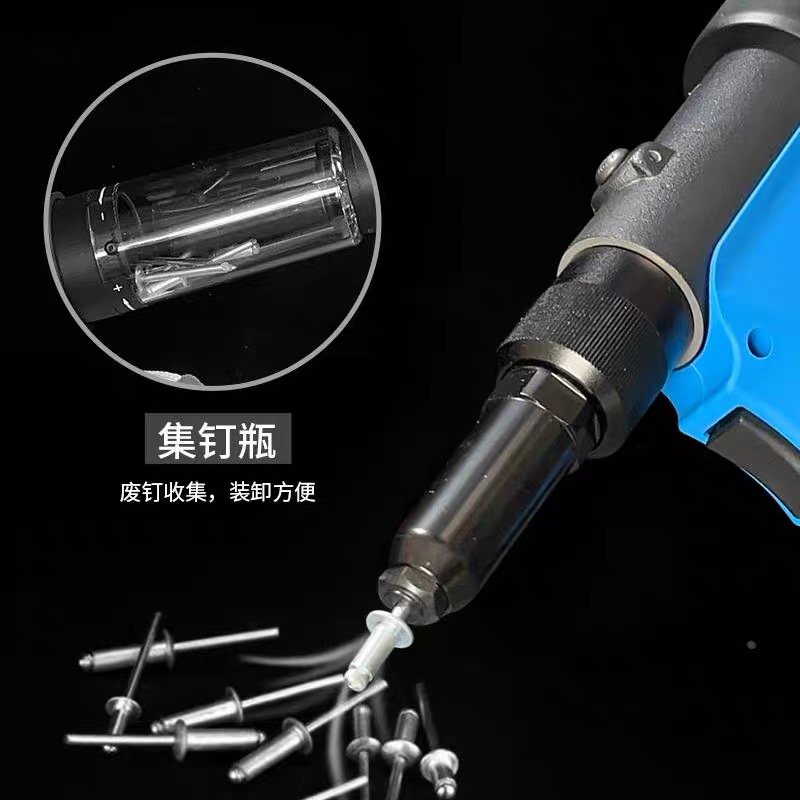
Once the pre-engineered tension limit is reached, the mandrel snaps off at a designated break-point groove and is ejected into a collection vessel.
A rivnut is designed to create permanent, load-bearing internal threads in thin-gauge metals, tubing, or composite structures where tapping a thread is impossible.
A rivnut features internal female threads at its base and a ductile, unthreaded wall near its head.
The installation tool utilizes a threaded drive mandrel matching the thread size (e.g., M4, M6, M10, or 1/4-20).
The tool threads into the rivnut's internal threads.
The tool applies axial pulling force, collapsing the unthreaded shank on the blind side to form a robust bulb flange against the metal sheet.
Once set, the tool reverses direction (spin-out) to unscrew the threaded mandrel, leaving intact internal threads ready to accept a machine bolt.
| Engineering Feature | Standard Blind Rivet | Rivet Nut (Rivnut / Threaded Insert) |
| Fastener Function | Permanent, non-removable mechanical joint | Creates reusable internal female threads |
| Mandrel Type | Integrated smooth wire pin (disposable) | Reusable threaded tool mandrel |
| Tool Jaw Mechanism | Hardened, serrated wedge jaws for smooth pins | High-torque threaded drive shaft |
| Final Tool Action | Snaps mandrel pin at break-neck groove | Spins out / unthreads from set rivnut |
| Disassembly Capability | Must be drilled out or sheared | Bolt can be repeatedly screwed and unscrewed |
If an operator attempts to force a standard pop rivet gun to install a rivnut (for instance, by inserting a smooth pin or bolt through the insert and pulling it with standard rivet jaws), three catastrophic failures occur:
Standard rivet gun jaws feature hardened, serrated teeth designed to bite aggressively into smooth wire. Applying this gripping force directly or indirectly against a rivnut's internal female threads will crush, strip, or deform the precise thread geometry.

Standard blind rivet tools lack the stroke control and axial alignment required for threaded inserts. The rivnut shank will collapse unevenly or under-deform, leading to spin-out failure—where the rivnut rotates freely inside its mounting hole when a bolt is torqued into it.
Because standard tools lack an automated spin-out mechanism, any makeshift pin pulled into a rivnut will become permanently jammed inside the fastener body without a clean way to reverse it out.
Installing rivnuts reliably in commercial and industrial settings requires dedicated threaded insert tools. The primary tool categories include:
Best for: Prototype shops, low-volume repairs, and field maintenance.
Mechanism: Manual leverage drives a threaded mandrel to collapse small-to-medium inserts (M3 to M6).
Best for: High-volume assembly lines, automotive manufacturing, and HVAC fabrication.
Mechanism: Uses compressed air and hydraulic fluid to drive automated spin-in, pulling, and rapid spin-out cycles.
Best for: On-site construction, architectural cladding, and flexible off-line assembly.
Mechanism: Brushless motors drive precision lead screws for controlled stroke and force output.
When selecting industrial riveting equipment, plant managers and manufacturing engineers rely on equipment built to withstand continuous multi-shift production demands. Two benchmark brands delivering high performance across global supply chains are Rocol Tools and 4Woo.
| Brand | Core Technology | Material / Architecture | Target Application / Feature |
| ROCOL TOOLS | Heavy Fluid Power | Drop-Forged Steel | Large Rivnuts / Steel |
| 4WOO | High-Speed Pneumatics | Smart Sensor Logic | Zero-Defect |
For heavy equipment fabrication, commercial transit chassis, structural steel racking, and large-diameter inserts ($M8$ to $M12+$), Rocol Tools serves as a premier reference standard for heavy fluid-power engineering.
Setting large-diameter carbon steel or stainless steel rivnuts requires immense axial pulling force. Rocol Tools engineers its hydropneumatic platforms with drop-forged alloy steel bodies and hardened tool-steel threaded mandrels. This robust construction prevents tool frame flexing and mandrel elongation under severe tensile loads ($20,000\text{ N}$ to over $35,000\text{ N}$).

Continuous multi-shift operations can cause hydraulic fluid inside substandard tools to overheat, leading to force degradation and loose insert seating. Rocol Tools incorporates advanced heat-dissipation channels and high-viscosity oil circulation loops, maintaining consistent pulling force across 24/7 industrial operating environments.
In high-velocity manufacturing lines—such as electronics enclosures, HVAC air handling units, and EV battery tray assemblies—4Woo leads the industry in intelligent pneumatic and vacuum-assisted tools.
A signature feature of the 4Woo rivnut tool ecosystem is its rapid automatic mandrel drive. When an operator pushes a rivnut against the tool tip, the high-torque pneumatic motor automatically engages, threading the insert on in fractions of a second. Upon trigger pull and shank collapse, the motor instantly reverses to back out cleanly, completing total installation cycles in as little as $1.0\text{ to }1.5\text{ seconds}$.
4Woo embeds microprocessors and stroke transducers into its smart tool platforms. The internal sensor logic monitors stroke displacement and hydraulic pressure curves in real time:
Visual LED Feedback: Instantly alerts the operator if a rivnut fails to set properly due to hole mis-alignment or sheet thickness variation.
Integrated Venturi Vacuum Extraction: On blind rivet models, 4Woo utilizes venturi vacuum systems to securely retain fasteners at any angle and instantly extract spent mandrels into rear collectors, keeping work cells free of metal debris.
Selecting the correct rivnut machinery requires calculating the required linear pulling force based on fastener metallurgy and thread diameter.
The pulling force ($F$) required to collapse the ductile shank wall of a threaded insert is calculated using the cross-sectional area of the collapsing wall ($A$) and the material's yield strength ($\sigma_y$):
Aluminum Inserts ($M3$–$M6$): Require $4,000\text{ N}$ to $8,000\text{ N}$ of linear force.
Steel Inserts ($M6$–$M8$): Require $10,000\text{ N}$ to $18,000\text{ N}$ of linear force.
Stainless Steel Inserts ($M8$–$M12$): Require $20,000\text{ N}$ to $35,000+\text{ N}$ of linear force.
Procurement directors must look beyond initial acquisition costs to calculate the Total Cost of Ownership (TCO) across millions of cycles:
| Operational Metric | Heavy Structural Assemblies | High-Speed Precision Lines |
| Recommended Tooling | Heavy Hydraulic Tools (e.g., Rocol Tools) | Smart Pneumatic / Vacuum Tools (e.g., 4Woo) |
| Fastener Material | Stainless Steel / Heavy Carbon Steel ($M8$–$M12$) | Aluminum / Thin Steel Inserts ($M3$–$M8$) |
| Key Advantage | High pulling force, drop-forged durability | Rapid cycle speeds, smart sensor verification |
| Target Sector | Commercial Vehicles, Solar Racking, Structural Steel | HVAC, EV Battery Cover Trays, Electronics |
To maintain peak Overall Equipment Effectiveness (OEE) and eliminate unscheduled shop floor downtime, maintenance personnel should adhere to a strict preventative protocol:
Mandrel Thread Inspection: Inspect the threaded mandrel daily for thread wear, burrs, or metal galling. Replace worn mandrels immediately to avoid damaging the internal threads of the rivnuts.
Mandrel Lubrication: Apply a light drop of high-pressure synthetic lubricant to the mandrel threads every shift to ensure smooth spin-in and spin-out performance.
Air Regulator Calibration: Ensure incoming compressed air regulators maintain pressure between $5.5\text{ bar}$ and $7.0\text{ bar}$ ($80\text{ to }100\text{ PSI}$).
Hydraulic Oil Check: Inspect hydraulic cylinders and internal O-ring seals for fluid leakage, topping off high-viscosity oil as recommended by manufacturers like Rocol Tools.
To summarize: You cannot use a standard blind rivet gun for rivnuts. Standard pop rivet guns lack the threaded drive shaft, stroke control, and automated spin-out mechanism necessary to install threaded inserts without destroying internal thread geometry.
Achieving strong, spin-proof threaded connections in sheet metal requires dedicated rivnut installation equipment:
For heavy structural steel framing, commercial chassis, and large-diameter steel inserts ($M8$–$M12$), rely on the rugged fluid power and drop-forged endurance of Rocol Tools.
For high-velocity assembly lines, cleanroom waste management, and digital process verification, invest in the smart pneumatic platforms of 4Woo.

By pairing engineered fasteners with dedicated installation tooling, manufacturing leaders ensure joint reliability, eliminate costly rework, and maximize production throughput.


