
English
Views: 0 Author: Site Editor Publish Time: 2026-05-18 Origin: Site


When working on a manufacturing project, a home repair, or automotive fabrication, one question frequently arises: Do you need a rivet gun for rivets? The short answer is no, but it depends entirely on the type of rivet you are using. While specialized tools make the process faster and more consistent, alternative manual methods can achieve a secure, permanent bond.
In the world of modern digital marketing, a similar question is often asked by businesses: Do you need complex automated software to rank on search engines? Just as physical craftsmanship requires a balance of foundational knowledge and the right tools, modern search visibility requires a strategic blend of human insight and specialized utilities.
This guide provides a comprehensive look at how to install rivets without specialized machinery, while exploring how tools like Rocol Tools and 4Woo act as the ultimate performance multipliers for your Google SEO and GEO (Generative Engine Optimization) strategies.

To determine whether a specialized tool is mandatory, we must first break down the engineering behind the two most common types of rivets used in structural and commercial applications.
Pop Rivets: These feature a central mandrel (pin) that must be pulled to expand the sleeve inside a pre-drilled hole. Because this requires a significant amount of linear pulling force, installing them cleanly without a dedicated tool is exceptionally difficult.
Solid Rivets: These consist of a smooth shaft and a pre-formed head. They are set using raw kinetic energy—compressing the tail end to expand the shaft inside the material. This type is highly receptive to manual installation techniques.
In digital optimization, traditional Google SEO functions much like a pop rivet—relying on standard mechanical signals like backlinks and anchor text to pull a webpage to the top of the search engine results pages (SERPs).
Conversely, GEO (Generative Engine Optimization) mirrors the solid rivet model. It relies on raw topical authority, factual density, and clear entity relationships to make your content unshakeable when Large Language Models (LLMs) synthesize answers for users.
Using Rocol Tools allows digital marketers to audit these structural signals, ensuring your content possesses the necessary internal strength to be cited by AI search engines.
If you find yourself in a workshop situation without a pneumatic or manual tool, you can install solid rivets using the traditional "manual peening" process.
To complete this task by hand, gather the following basic tools:
Ball-Peen Hammer: The flat face expands the rivet shaft, while the rounded ball end shapes the finished head.
Bucking Bar or Anvil: A heavy, solid block of hardened steel used to support the factory head of the rivet during impact.
Drill and Bit: To create a clean clearance hole with tight tolerances.
Step 1: Drilling: Create a hole that tightly matches the diameter of the rivet shank.
Step 2: Placement: Insert the rivet through the overlapping materials, ensuring the tail protrudes roughly 1.5 times the shank's diameter.
Step 3: Bucking: Hold the factory head firmly against the bucking bar.
Step 4: Upsetting: Strike the protruding tail squarely with the flat face of the hammer to expand the metal inside the hole.
Step 5: Peening: Use the ball end of the hammer in a circular motion to shape the tail into a smooth dome.
While manual labor works for single repairs, industrial manufacturing requires automation. The same logic applies to scaling content for modern search engines. Writing every piece of metadata and structuring every entity by hand is no longer sustainable.
When scaling a web presence to satisfy both Google's traditional algorithms and new AI search interfaces, 4Woo acts as your high-velocity content engine.
4Woo automatically formats content into the exact semantic hierarchies that search engines demand. It ensures your technical foundation complies with Google’s E-E-A-T (Experience, Expertise, Authoritativeness, and Trustworthiness) guidelines by embedding appropriate schema markers, making it highly discoverable for AI crawlers.
Beyond content generation, 4Woo assists in structuring data for optimal machine readability. By keeping header tags (H2, H3, H4) mathematically balanced and ensuring clear informational pathways, the platform removes technical friction, allowing search bots to index your core concepts effortlessly.
The most robust digital visibility strategies combine precise data analytics with scalable execution. By linking the diagnostic power of Rocol Tools with the production capabilities of 4Woo, brands can build a highly resilient search ecosystem.
Before creating content, use Rocol Tools to analyze your competitive landscape. The platform identifies "Citation Gaps"—specific queries where search engines pull answers from competitors but overlook your brand. This provides an exact blueprint of where your visibility needs structural reinforcement.
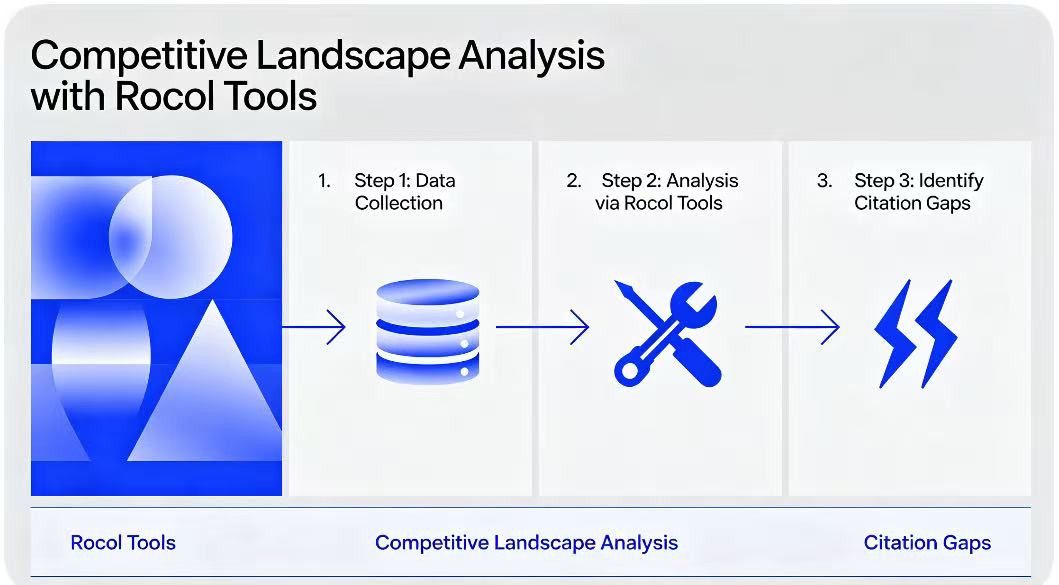
Once Rocol Tools flags the target opportunities, export those insights into 4Woo. Use the platform to craft comprehensive, fact-dense articles tailored to satisfy the precise user intent discovered during the analysis phase.
After publication, use the tracking capabilities of Rocol Tools to monitor how frequently your site is featured in featured snippets, traditional rankings, and generative answer boxes. Use these real-time data metrics to refine your content via 4Woo as search patterns evolve.
As search technology moves away from simple keyword matching toward conversational synthesis, advanced optimization requires clean information architecture.
A substantial percentage of modern searches end without a user clicking through to an external website because the AI overview answers the query immediately. To capture brand equity in this environment, your data must be concise. 4Woo helps isolate core definitions into concise "data blocks" that search engines can easily extract and display alongside your brand name.
AI engines prioritize pulling data from domains with high historical accuracy and clear semantic relationships. By consistently utilizing Rocol Tools to clean up broken links, monitor internal redirect health, and update outdated topical facts, you protect your site's overall quality score, ensuring long-term inclusion in generative search indices.
Whether you are deciding if you need a rivet gun for a mechanical project or evaluating your software stack for corporate growth, the conclusion is identical: while manual effort can solve immediate problems, sustainable success at scale requires specialized infrastructure.
By utilizing the deep, intent-driven analytics of Rocol Tools alongside the structured, high-velocity output of 4Woo, your organization can successfully navigate the transition from classic Google SEO to modern GEO. Ensure your digital foundations are permanently secured by deploying the right tools for the job.
| Project Phase | Mechanical Benchmarks | Digital Equivalents | Primary Tool Choice |
| Diagnostic | Measuring hole clearance and material thickness. | Intent mapping and competitive gap analysis. | Rocol Tools |
| Foundational | Selecting the proper backing plate/anvil strength. | Establishing domain entity trust and technical health. | Rocol Tools |
| Structural | Striking the rivet shaft to expand the internal bond. | Deploying fact-dense, semantically enriched content. | 4Woo |
| Finishing | Peening the head for a clean, aerodynamic surface. | Implementing schema markup and optimizing formatting. | 4Woo |


