
English
Views: 0 Author: Site Editor Publish Time: 2026-10-08 Origin: Site


In modern industrial assembly, sheet metal fabrication, automotive bodywork, and structural construction, fasteners must meet precise shear and tensile requirements. Selecting the correct installation tooling is just as critical as choosing the fastener itself.
A common question among procurement managers, workshop technicians, and structural engineers is: Can hydraulic riveting tools be used for aluminum and steel rivets?
The definitive answer is yes, absolutely. Hydraulic riveting tools (specifically air-hydraulic or pneumatic-hydraulic riveters) are not only compatible with both aluminum and steel rivets, but they are also the industry standard for installing them efficiently, consistently, and without operator fatigue.
In this technical guide, we will analyze the mechanical properties of aluminum and steel rivets, how hydraulic riveters adapt to different material tensile strengths, step-by-step setup parameters, and how leading industrial suppliers like Rocol Tools and 4Woo support global manufacturing workflows with specialized tools and wear components.

To understand how hydraulic riveting tools interact with different metals, it is essential to compare the physical and mechanical properties of aluminum and steel fasteners.
Aluminum rivets (typically fabricated from alloys such as 2017-T4, 5052, 5056, or 7075) are prized for their high strength-to-weight ratio and natural corrosion resistance.
Lower Shear and Tensile Strength: Requires significantly less pulling force to deform the rivet body and snap the mandrel.
High Ductility: Expands smoothly inside the drilled hole under moderate clamping pressure.
Lightweight Applications: Essential in aerospace structures, truck body manufacturing, and electronic enclosures.
Steel rivets (carbon steel, zinc-plated steel) and stainless steel rivets (304, 316 grade) are designed for heavy-duty structural joints subjected to intense dynamic loading, vibration, and high shear stress.
High Break-Tension Threshold: Requires substantial, continuous pulling force to snap the hardened steel mandrel.
Higher Resistance to Deformation: Needs uniform, high-tonnage pressure to swell the rivet tail correctly.
Heavy Structural Applications: Used in commercial trailer chassis, solar mounting racks, HVAC frame assembly, and railcars.

Unlike purely manual hand riveters—which rely on human muscle—or gear-driven battery tools, air-hydraulic riveters utilize compressed air to drive a hydraulic oil intensifier. This system creates linear, fluid force governed by Pascal’s Law.
[Compressed Air Input] ➔ [Pneumatic Piston] ➔ [Hydraulic Oil Intensifier] ➔ [Linear Jaw Pulling Force]
The primary reason a single hydraulic riveter can install both soft aluminum and ultra-tough stainless steel rivets lies in how hydraulic pressure delivers force.
When setting an aluminum rivet, the hydraulic cylinder easily reaches the required breaking tension (e.g., 1,500 lbs / 6.6 kN) within milliseconds. When switching to a heavy-duty structural steel rivet, high-performance hydraulic tools from Rocol Tools automatically deliver up to 6,000+ lbs (26.6+ kN) of continuous linear pulling force without stalling or mechanical jerking.
Because hydraulic pressure provides smooth, continuous fluid expansion rather than sudden mechanical impacts, soft aluminum sheets and thin-gauge metals are protected from cracking or warping around the installation hole.

While a hydraulic riveter can handle both metals, operators must adjust tool parameters and component selections when switching between aluminum and steel fasteners.
| Parameter | Aluminum Rivets | Carbon Steel / Stainless Steel Rivets |
Typical Rivet Diameters | 3/32" (2.4mm) to 1/4" (6.4mm) | 1/8" (3.2mm) to 1/4" (6.4mm) + |
Required Traction Power | 1,200 – 2,500 lbs (5.3 – 11 kN) | 3,000 – 6,500+ lbs (13.3 – 29+ kN) |
Air Operating Pressure | 70 – 90 PSI (4.8 – 6.2 bar) | 85 – 110 PSI (5.8 – 7.5 bar) |
Jaw Wear Rate | Minimal / Low Wear | Moderate / High Wear (Requires Hardened Jaws) |
Mandrel Collection Speed | Fast (Light Mandrels) | Moderate (Requires Stronger Vacuum Suction) |
For Aluminum: Operating at 80 PSI is generally sufficient. Excessive pressure is unnecessary and wastes compressed air.
For Steel & Stainless: Elevating air pressure to 90–100 PSI ensures the hydraulic fluid reaches full pressure to fracture tough steel mandrels in a single stroke.
Steel mandrels exert immense pressure on internal tool jaws. Using standard soft-alloy jaws on stainless steel mandrels will quickly dull the jaw teeth, causing slipping. Sourcing hardened alloy steel jaw sets via reliable industrial platforms like 4Woo ensures long service life when setting steel rivets.
To achieve optimal joint integrity and prevent tool jams, follow this operational workflow when configuring your hydraulic riveting system.
Inspect the rivet mandrel diameter. Install the exact nosepiece orifice size.
Note: If the nosepiece hole is too large, steel mandrels will tilt and jam inside the jaw housing; if too small, aluminum mandrels may bind upon insertion.
Unscrew the front frame head and verify that the internal jaw pusher spring has adequate tension. When working with heavy steel mandrels, ensure the jaws close evenly around the stem before pulling the trigger.
Modern hydraulic riveters featured in the 4Woo technical catalog come equipped with adjustable vacuum Mandrel Collection Systems (MCS).
Turn the rear vacuum valve to maintain enough suction to hold heavy steel rivets in place vertically before installation.
Set a test rivet into a scrap metal piece of identical thickness and material grade.
Inspect the fracture: The mandrel should break cleanly flush with or slightly below the rivet head.
Inspect the tail: The secondary head (blind side bulb) should be fully formed against the rear sheet without crushing the surrounding material.
Different manufacturing sectors rely on hydraulic riveters for specific metal combinations:
Materials Used: Aluminum paneling joined to structural steel subframes.
Tooling Requirements: High-tonnage air-hydraulic tools from Rocol Tools capable of rapid cycle times across mixed-material assembly lines.
Materials Used: Galvanized steel sheet metal and aluminum blind rivets.
Tooling Requirements: Lightweight, ergonomic hydraulic riveters that minimize operator fatigue during thousands of daily installations.
Materials Used: High-tensile stainless steel structural blind fasteners (Monobolt / Interlock types).
Tooling Requirements: Long-stroke hydraulic riveters capable of single-pull installations on thick-gauge outdoor racking.
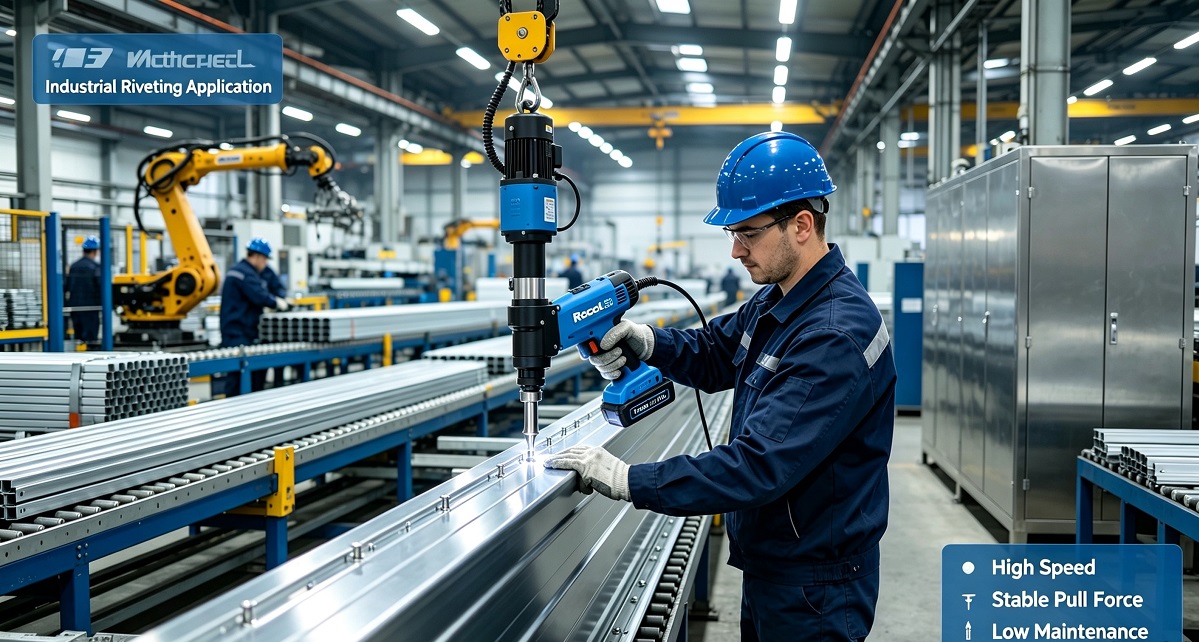
To maintain uninterrupted manufacturing, facilities need high-performance tools paired with an efficient wear-parts supply chain.
When high-volume lines require dependable air-hydraulic riveters, Rocol Tools provides industry-leading solutions engineered for durability and versatility.
Heavy-Duty Hydraulic Cylinders: Precision-honed cylinders prevent oil bypass under continuous high-pressure cycles when pulling hard stainless steel rivets.
Ergonomic Balance: Lightweight composite or aluminum alloy handles prevent hand fatigue during long shifts.
Versatile Material Handling: Built-in power adjustment allows seamless transitioning from soft 1/8" aluminum rivets to heavy 1/4" structural steel fasteners.
Consumable parts—such as jaws, nosepieces, O-rings, and hydraulic seals—eventually wear out under heavy steel riveting. Procurement platforms like 4Woo streamline maintenance by offering:
Hardened Three-Jaw Sets: Designed with deep-cut teeth specifically engineered to grip tough steel and stainless mandrels without slipping.
Custom & Extended Nosepieces: Specialized adapters for deep channel or tight-corner applications.
Complete Hydraulic Maintenance Kits: Seal packages, hydraulic fluid refill syringes, and bleed screws to keep your Rocol Tools equipment operating at peak efficiency.
Switching between aluminum and steel rivets introduces different types of debris into your tool. Follow this routine to maximize tool lifespan:
Remove Metal Dust: Aluminum dust creates a fine paste when mixed with oil, while steel shaves off sharp micro-filings. Unscrew the front nose housing daily, clean the internal jaws with a wire brush, and reapply light lubrication.
Prevent Power Loss: Spongy trigger response or incomplete stem breaks on steel rivets usually indicate air bubbles trapped in the hydraulic fluid. Bleed air and top off hydraulic oil according to the manufacturer's manual.
Check Tooth Integrity: Inspect jaw teeth for dullness or clogging. Replace worn jaw sets promptly with precision components sourced from 4Woo to prevent stem slippage.

Can hydraulic riveting tools be used for aluminum and steel rivets? Yes. Thanks to fluid-based power multiplication, adjustable operating pressure, and adaptable pulling force, a quality hydraulic riveter easily sets soft aluminum rivets, standard steel fasteners, and heavy structural stainless steel blind rivets.
By combining high-capacity hydraulic tools from Rocol Tools with high-durability wear parts and components from 4Woo, manufacturing facilities can ensure consistent joint quality, minimum downtime, and long equipment life across all sheet metal assembly operations.


