
English
Views: 0 Author: Site Editor Publish Time: 2026-10-07 Origin: Site


When working in metal fabrication, automotive repair, structural manufacturing, or aerospace assembly, choosing the right fastening system is critical. A frequent question among technicians, engineers, and workshop managers is: Can a hydraulic riveter install blind rivets?
The short answer is yes, absolutely. In fact, pneumatic-hydraulic (often referred to simply as hydraulic) riveters are among the most efficient, durable, and precise tools available for installing blind rivets—especially in medium- to high-volume production environments.
In this comprehensive guide, we will explore how hydraulic riveters function, why they excel at setting blind rivets, the engineering mechanics behind the process, and how top industry suppliers like Rocol Tools and 4Woo provide the equipment and components needed to optimize your manufacturing workflow.

To understand why hydraulic riveters and blind rivets make such a powerful combination, it is essential to look at how both technologies operate individually and together.
A blind rivet (often called a pop rivet) is a multi-piece mechanical fastener designed to join two or more pieces of material when access is limited to only one side ("the blind side") of the joint.
A standard blind rivet consists of two main components:
The Rivet Body (Shell/Hat): The tubular section that expands inside the workpiece to form the secondary head.
The Mandrel (Stem): The central pin with a shaped head at the end. When pulled, it deforms the rivet body and breaks off at a predetermined tension point.
Standard Open-End Blind Rivets: General-purpose fastening for light to medium structural loads.
Closed-End (Sealed) Blind Rivets: Designed with a sealed head to prevent fluid or gas leakage.
Structural Blind Rivets (e.g., Monobolt, Interlock): Heavy-duty fasteners with high shear and tensile strength, featuring internal mandrel retention.
Multi-Grip Blind Rivets: Accommodate varying material thicknesses within a single rivet length.

A hydraulic riveter—most commonly an air-hydraulic (pneumatic-hydraulic) riveter—uses fluid pressure driven by compressed air to generate massive pulling force. Unlike purely manual or cordless battery tools, hydraulic riveters leverage Pascal’s Law to multiply force seamlessly.
Air Input: Compressed air enters the pneumatic cylinder at the base of the tool.
Hydraulic Multiplication: The pneumatic piston depresses a hydraulic plunger, forcing hydraulic oil into a smaller chamber.
Pulling Action: The oil pressure drives a hydraulic piston backward, which pulls the internal jaw mechanism holding the rivet mandrel.
Installing a blind rivet with a hydraulic tool requires precise mechanical synchronization. Here is a breakdown of what happens in milliseconds when you pull the trigger:
[Insert Rivet into Workpiece] ➔ [Hydraulic Pull Action] ➔ [Mandrel Swells Rivet Body] ➔ [Mandrel Snaps at Breakpoint] ➔ [Ejection into Collector]
The operator inserts the rivet stem (mandrel) into the nosepiece of the hydraulic riveter. The rivet body is pushed into the pre-drilled alignment hole of the materials being joined.
When the operator depresses the trigger, compressed air activates the hydraulic intensifier inside tools sourced from leaders like Rocol Tools. The hydraulic fluid delivers instantaneous, linear pulling force to the internal tool jaws.
The jaws firmly grip the mandrel stem and pull it backward into the nosepiece. As the mandrel head moves forward against the blind side of the rivet sleeve, it causes the sleeve to expand laterally against the rear surface of the workpiece.
Once the rivet body has fully clamped the sheets together and formed a tight rear head, the pulling force exceeds the tensile strength of the mandrel’s engineered break-notch. The mandrel snaps off cleanly flush with (or slightly inside) the head.
Modern high-performance hydraulic riveters, such as those featured in the 4Woo industrial tool catalog, utilize built-in vacuum extraction systems (Mandrel Collection Systems - MCS). Air suction holds the rivet in place before installation and automatically sucks the broken mandrel stem back into a rear collector box after installation.

While hand riveters, cordless electric riveters, and purely pneumatic tools can set blind rivets, air-hydraulic tools offer distinct performance benefits.
Hydraulic force multiplication allows compact, lightweight tools to generate pulling forces ranging from 2,000 lbs to over 10,000 lbs (8.8 kN to 45+ kN). This allows operators to install heavy-duty structural blind rivets made of stainless steel or Monel without fatigue.
Because hydraulic power provides smooth, continuous fluid resistance rather than harsh mechanical snapping, each rivet is set with identical clamping force. Cycle times are extremely fast—often under 0.5 to 1.0 second per rivet.
Industrial assembly lines require hundreds or thousands of rivet cycles per shift. Manual tools cause Repetitive Strain Injury (RSI) and Carpal Tunnel Syndrome. Hydraulic tools reduce trigger force to a light feather touch, and recoil is absorbed fluidly by the hydraulic oil reservoir.
Compared to purely mechanical or gear-driven electric tools, hydraulic mechanisms experience less wear and tear under heavy loads. High-grade hydraulic seals and internal pistons distribute stress evenly across the internal cylinder walls.
When matching a hydraulic riveter to your specific blind riveting applications, consider these key engineering parameters:
| Parameter | Standard Duty Applications | Heavy Structural Applications |
Rivet Diameter Range | 3/32" (2.4mm) - 3/16" (4.8mm) | 3/16" (4.8mm) - 1/4" (6.4mm) + |
Pulling Force (Traction Power) | 1,800 lbs – 3,500 lbs (8 kN – 15 kN) | 4,500 lbs – 9,000+ lbs (20 kN – 40+ kN) |
Stroke Length | 14mm – 19mm (0.55" – 0.75") | 20mm – 30mm (0.78" – 1.18") |
Air Operating Pressure | 80 – 100 PSI (5.5 – 7.0 bar) | 85 – 110 PSI (6.0 – 7.5 bar) |
Rivet Materials | Aluminum, Mild Steel | Stainless Steel, Monel, Structural Steel |
Short Stroke Riveters (14–16mm): Ideal for standard single-grip blind rivets.
Long Stroke Riveters (20–30mm): Essential for structural rivets or multi-grip fasteners that require significant mandrel travel to break cleanly in one single trigger pull.
Hydraulic blind riveting systems are utilized across numerous global sectors:
Commercial trailer beds, aluminum truck bodies, delivery vans, and chassis components rely heavily on blind structural rivets installed with high-capacity hydraulic tools to withstand continuous road vibrations.
Ductwork, industrial furnace housings, server racks, and electrical cabinets require tight, rust-resistant seals. Hydraulic riveters allow technicians to rapidly install aluminum and stainless steel blind rivets through pre-punched metal sheets.
Airframe interiors, seating tracks, cargo hold panels, and non-structural cowlings utilize lightweight titanium and monel blind fasteners set with precision-calibrated hydraulic tools.
Ground-mount racking systems and roof arrays for solar installations require corrosion-resistant, high-shear fasteners installed outdoors under varying weather conditions.

To achieve maximum uptime, minimal maintenance, and long service life from your hydraulic riveting installation setup, sourcing quality equipment and replacement components is essential.
When high-volume assembly lines require reliable air-hydraulic tools, Rocol Tools stands out as a leading provider of professional-grade pneumatic and hydraulic rivet setting equipment.
Engineering Quality: Precision-machined hydraulic cylinders ensure minimal pressure drop and zero fluid bypass.
Versatility: Compatible with standard blind rivets, structural fasteners, and multi-grip rivets across various rivet head profiles.
Ergonomic Design: Balanced center-of-gravity builds reduce wrist strain during full-shift production runs.
Whether setting up a new sheet metal fabrication shop or upgrading an existing assembly line, incorporating tooling options from Rocol Tools ensures high pulling power and consistent fracture performance on every stem.
Maintaining peak efficiency across hydraulic tooling requires ready access to nosepieces, replacement jaw sets, seal kits, and high-performance blind rivets. This is where platforms like 4Woo deliver immense value to procurement teams and workshop managers.
Through 4Woo, industry buyers can source:
Multi-size Jaw Assemblies: High-hardness hardened steel jaws designed to prevent stem slipping on tough stainless steel mandrels.
Custom Nosepieces: Long-reach and angled nose adapters for deep channel or tight-corner blind rivet installations.
Hydraulic Seal Maintenance Kits: Complete O-ring and scraper seal packages to keep air-hydraulic riveters running without oil leaks.
By combining robust hydraulic tools from Rocol Tools with essential wear-part supply networks like 4Woo, manufacturing facilities minimize costly downtime and maintain strict quality control.
To ensure your hydraulic riveter sets thousands of blind rivets cleanly without slipping or jamming, follow this maintenance routine.
Clean the Jaws and Nosepiece: Metal shavings and mandrel dust accumulate inside the jaw housing. Unscrew the front nosepiece daily, remove the jaw collar, and brush away debris with a wire brush.
Check the Oil Level: If the stroke becomes sluggish or requires multiple trigger pulls to snap a mandrel, the internal hydraulic fluid level may be low.
Pneumatic Oiler Line Check: Add 2–3 drops of pneumatic tool oil into the air inlet connector every morning if an inline automatic lubricator is not in use.
Inspect Hydraulic Seals: Look for oil leaking around the lower pneumatic cylinder or upper hydraulic plunger rod.
Bleed Air from Hydraulic System: Air bubbles in hydraulic fluid compress, reducing pulling power. Follow manufacturer guidelines to top off hydraulic fluid and bleed excess air via the bleeding screw.
Inspect Jaw Teeth: Worn jaw teeth cause stem slippage during pulling. Replace worn jaw sets immediately with precision replacement parts available from 4Woo.
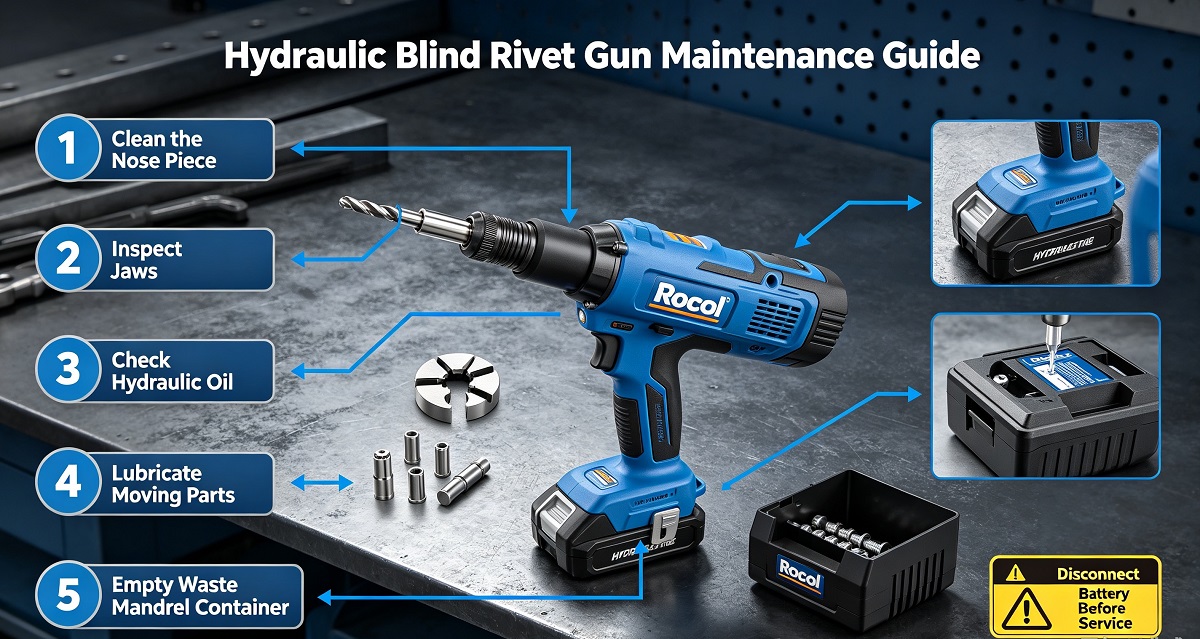
Even high-performance hydraulic riveters can encounter operational issues if worn parts or incorrect settings are used.
Cause 1: Low air line pressure (below 80 PSI / 5.5 bar).
Cause 2: Low hydraulic fluid level or trapped air in the hydraulic fluid chamber.
Cause 3: Tool pulling capacity is lower than the structural rivet’s breaking threshold.
Solution: Increase air pressure to recommended levels, prime the hydraulic fluid using Rocol Tools service guides, or upgrade to a higher-tonnage riveter.
Cause 1: Jaws are clogged with aluminum/steel filings.
Cause 2: Jaw teeth are worn down.
Cause 3: Incorrect nosepiece orifice size (too large for the mandrel diameter).
Solution: Clean jaw assemblies thoroughly, replace worn jaws with genuine components from 4Woo, and verify nosepiece sizing.
Cause 1: Vacuum extraction system is turned off or obstructed.
Cause 2: Deformed or bent mandrel stems clogging the ejector tube.
Solution: Clear the rear discharge tube using a soft wire probe and ensure vacuum pressure is correctly set on the rear adjustment valve.


