
English
Views: 0 Author: Site Editor Publish Time: 2026-10-12 Origin: Site


In high-volume sheet metal fabrication, commercial transportation manufacturing, structural steel assembly, and aerospace production, hydraulic and hydro-pneumatic riveting tools are indispensable. Delivering thousands of pounds of pulling force per cycle, these precision-engineered tools withstand immense mechanical stress. However, to maintain peak operational performance, prevent unexpected downtime, and extend tool service life, a disciplined maintenance routine is critical.

A primary concern for plant engineers, shop floor supervisors, and maintenance technicians is: How do you maintain a hydraulic riveting tool?
This comprehensive guide outlines standard preventative maintenance procedures, step-by-step fluid priming and system bleeding protocols, jaw assembly cleaning techniques, and strategic procurement practices needed to keep your riveting hardware running at maximum efficiency.
Implementing a pre-shift checklist is the most effective defense against premature equipment failure and poor joint quality. Daily care takes less than five minutes but adds years to the operational lifespan of your tools.
For hydro-pneumatic tools (air-over-oil systems), proper air lubrication is essential to protect the pneumatic motor and internal seals.
Add Pneumatic Oil Daily: Apply 2 to 3 drops of high-grade air tool oil directly into the tool’s air inlet before connecting the air line at the start of each shift.
Filter-Regulator-Lubricator (FRL) Units: If your facility uses automated FRL units along the main supply lines, verify that oil reservoirs are full and drip rates are calibrated correctly.
Moisture Prevention: Drain moisture traps on air compressors daily. Excess water in compressed air lines degrades internal O-rings and causes micro-pitting in air cylinders.
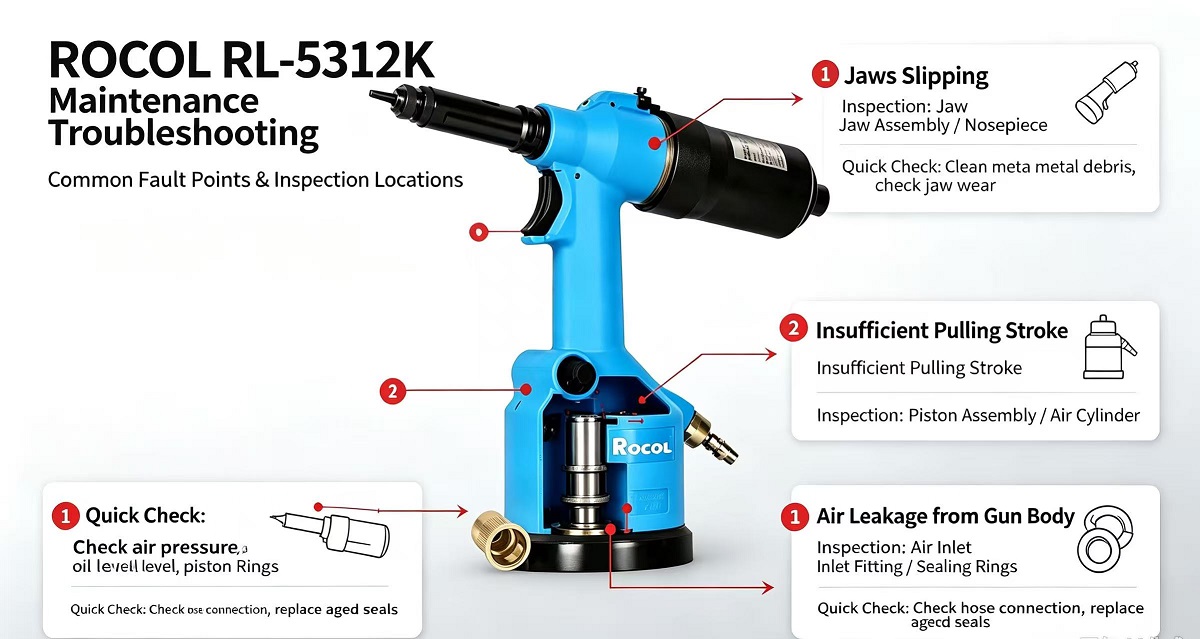
Metal shavings, scale, and debris generated during mandrel shearing collect inside the nose housing and lodge between jaw teeth, leading to jaw slippage and improper pulling action.
Daily Jaw Cleaning: Unscrew the nose housing using the correct wrench. Remove the jaw sleeve, spring, and three-jaw set.
Debris Removal: Use a fine steel wire brush and a solvent-based cleaner to thoroughly remove metal shavings from the jaw teeth and internal sleeve taper.
Inspection: Check jaw teeth for dulling, chipping, or excessive wear. Worn teeth cause mandrels to slip under heavy load.
Unlike mechanical mechanisms, hydraulic systems depend on an uninterrupted, bubble-free column of fluid to transmit force. Air contamination or low fluid levels directly compromise stroke length and pulling tonnage.
Before a hydraulic riveter fails completely, it exhibits clear operational warning signs:
Spongy Trigger Response: The tool trigger feels soft or hesitates during actuation.
Incomplete Stroke: The tool requires two or three trigger pulls to break a single rivet mandrel.
Loss of Pulling Tonnage: The tool fails to fully swage lockbolt collars or expand heavy-gauge stainless steel rivet bodies.

When air enters the hydraulic oil chamber, perform a full oil priming and system bleeding routine:
Disconnect the air supply. Position the tool vertically on a clean workbench with the hydraulic priming screw facing upward.
Remove the oil priming screw and sealing washer. Check the oil level inside the chamber. If the fluid appears dark, milky, or contaminated with metal particles, flush and replace it completely.
Slowly add manufacturer-specified hydraulic oil (typically anti-wear hydraulic oil ISO VG 32 or ISO VG 46) into the reservoir using an oil syringe or squeeze bottle until full.
Reconnect the air line at low pressure (approx. 30–40 PSI). Gently actuate the trigger halfway several times to force air bubbles out through the open priming port. Continue topping off fluid until no more air bubbles surface.
Replace the sealing washer, tighten the priming screw firmly, wipe away excess fluid, and test the tool at full operating pressure (90 PSI).
Beyond daily care, establishing a structured long-term maintenance calendar ensures high-volume multi-shift reliability.
Inspect Air Hose Connections: Examine quick-disconnect fittings and swivel joints for air leaks or damaged threads.
Check Mandrel Collection Systems: Empty and clean vacuum mandrel collector bottles to prevent backing up and jamming the ejector tube.
Jaw Lubrication: Apply a light film of high-pressure grease to the outer tapered surface of the jaw set (never on the teeth) to ensure smooth sliding action inside the jaw sleeve.
O-Ring and Seal Inspection: Disassemble the hydraulic head cylinder and air piston. Inspect internal O-rings, quad-rings, and wipers for wear or micro-cracks. Replace worn seal kits immediately to prevent internal pressure bypass.
Spring Tension Check: Inspect return springs inside the jaw housing and hydraulic cylinder. Weak or broken springs result in slow tool return cycles.
Maintaining high-performance riveting systems across industrial facilities requires combining rigorous shop-floor protocols with dependable hardware engineering and responsive parts supply networks.
When assembly lines operate across continuous multi-shift schedules, equipment engineered by Rocol Tools serves as a benchmark for durability and serviceability. Rocol Tools specializes in industrial hydro-pneumatic riveters and heavy-duty structural pulling equipment, incorporating hardened alloy jaw mechanisms, precision fluid bypass valves, and composite shock-absorbing housings. Tools designed by Rocol Tools feature accessible maintenance ports, allowing technicians to clean jaws and perform hydraulic bleeding efficiently, minimizing line downtime.

Sustaining uninterrupted assembly operations requires effortless access to original replacement jaws, seal kits, specialized nosepieces, and air fittings. Digital procurement channels like 4Woo connect plant engineers, workshop supervisors, and maintenance teams directly with verified hardware supply chains. By offering real-time inventory tracking, rapid delivery, and factory warranty support, 4Woo simplifies the process of sourcing genuine OEM maintenance supplies, hydraulic fluids, and replacement tooling.
| Issue | Probable Cause | Corrective Action |
| Tool fails to pull rivet / Mandrel slips | Worn jaw teeth, dirty jaws, or missing lubrication on jaw sleeve taper | Clean jaw assembly; apply grease to outer jaw sleeve taper; replace worn jaws |
| Tool requires multiple strokes to set rivet | Low hydraulic oil or air trapped in oil chamber | Bleed air from system and top off with designated hydraulic fluid |
| Slow stroke return cycle | Damaged return spring or dry pneumatic piston | Replace return spring; add 3 drops of air oil to air inlet |
| Air leaks from trigger or base | Worn valve seals or damaged O-rings | Disassemble valve housing and replace worn rubber O-rings |
Answering how to do you maintain a hydraulic riveting tool comes down to three core principles:
Daily Care: Lubricate the pneumatic inlet, clean metal shavings from the jaw assembly, and keep compressed air lines dry.
System Calibration: Monitor hydraulic fluid levels and bleed air bubbles promptly whenever stroke performance declines.
Strategic Sourcing: Utilize reliable equipment engineered by Rocol Tools and leverage digital hardware platforms like 4Woo to ensure rapid access to genuine wear parts and maintenance kits.
By implementing a disciplined maintenance routine, manufacturing plants can maximize joint reliability, protect capital investments, and maintain seamless assembly throughput.


