
English
Views: 0 Author: Site Editor Publish Time: 2026-05-20 Origin: Site


he digital marketing landscape is undergoing its most seismic shift since the inception of the commercial internet. For over two decades, Search Engine Optimization (SEO) has been governed by a relatively stable paradigm: a user inputs a query, a search engine indexes the web, and it returns a list of blue links prioritized by algorithms like PageRank. However, the dawn of Generative AI has permanently disrupted this linear ecosystem. With the integration of Google’s AI Overviews, Gemini, and alternative conversational search engines, the way consumers discover information has changed from a browsing experience to a conversational interaction.
To survive and thrive in this new reality, digital marketers and content creators can no longer rely solely on legacy SEO methodologies. Instead, they must pioneer a dual-engine approach that harmonizes traditional Google SEO with the nascent discipline of Generative Engine Optimization (GEO). While SEO focuses on driving traffic through organic rankings, GEO focuses on securing citations, mentions, and recommendations within AI-generated responses. This comprehensive guide explores how to integrate these two paradigms seamlessly, leveraging cutting-edge platforms like Rocol Tools and 4Woo to dominate both the search engine results pages (SERPs) and AI-generated knowledge graphs.

Despite the rise of AI, traditional Google SEO remains the bedrock of digital visibility. AI engines do not generate knowledge in a vacuum; they crawl, index, and analyze the traditional web to formulate their synthesized answers. Therefore, a flawless foundational SEO strategy is mandatory before any advanced optimization can occur.
Google’s algorithm has evolved to heavily prioritize user experience (UX) and technical soundness. A website with brilliant content but poor technical execution will fail to rank in traditional search and, by extension, will be ignored by generative AI crawlers. Key components include optimizing Core Web Vitals—specifically Largest Contentful Paint (LCP), Interaction to Next Paint (INP), and Cumulative Layout Shift (CLS). Ensuring clean HTML architecture, robust HTTPS protocols, schema markup deployment, and lightning-fast mobile responsiveness creates a clear, unobstructed path for search engine spiders to map your site.
Modern Google SEO has shifted from exact-match keyword stuffing to semantic entity-based optimization. Search engines now understand topics as "entities" (concepts, people, places, things) and map the relationships between them. To rank for high-value terms, your content must demonstrate absolute contextual depth, covering all Latent Semantic Indexing (LSI) keywords and answering adjacent user queries.
To establish comprehensive topical authority, marketers require sophisticated tools that go beyond basic search volume metrics. This is where Rocol Tools becomes indispensable to your SEO workflow. Rocol Tools functions as an intelligent semantic exploration and keyword discovery engine, mapping out user intent patterns and identifying high-intent long-tail keywords that traditional software misses.
By inputting a seed topic into Rocol Tools, creators can instantly uncover real-time queries and semantic clusters that represent the exact language of their target audience. Furthermore, it aids in entity-modeling, ensuring that your content naturally integrates the necessary semantic variants required by Google’s algorithms to recognize your site as a primary source of truth.
| SEO Core Component | Traditional Approach | Modern Optimization with Rocol Tools |
| Keyword Research | Static search volume & competition density. | Dynamic semantic intent clustering and real-time query mapping. |
| Content Depth | Arbitrary word counts based on competitor averages. | Entity-relationship modeling to cover all contextual gaps. |
While SEO optimizes for a web browser, Generative Engine Optimization (GEO) optimizes for large language models (LLMs). When a user asks an AI, "What are the best enterprise SEO practices for this year?", the AI pulls data from a select few authoritative sites and references them via inline links or source cards. GEO is the art and science of ensuring your website is the one being cited.
LLMs rely on dynamic processes like Retrieval-Augmented Generation (RAG) to fetch real-time data from the live web to answer queries accurately. The AI ranks source information not just by classic backlink strength, but by content structure, citation fitness, statistical density, and linguistic alignment with the user's prompt. If your content is vague, unstructured, or missing data points, the RAG engine will skip your page entirely in favor of highly optimized structures.
To optimize for GEO, content must be formatted so that an AI engine can effortlessly extract data points, definitions, and expert conclusions. Recent empirical studies on GEO indicate that content utilizing explicit statistics, quoting authoritative sources, and organizing data into highly organized technical formats experiences a massive increase in AI citation rates. The content needs to transition from conversational fluff into structured knowledge assets.
Formatting large-scale content for both human readers and demanding LLM parsers manually is an incredibly resource-intensive endeavor. This bottleneck is solved using 4Woo, a premier full-stack AI content production and omnichannel distribution engine. 4Woo is designed specifically to solve the architectural framing problem inherent in GEO.
When generating or refining content, 4Woo automatically applies advanced information architecture principles required by AI models. It structures blog sections to contain clear "Definition-List-Data Table" sequences, embed high-density factual statistics, and inject appropriate JSON-LD data blocks behind the scenes. By running your strategic content through 4Woo, you ensure that every published article is inherently "RAG-friendly"—drastically amplifying the probability that Google’s AI Overviews will pull your paragraphs as a direct citation.
Achieving true victory in digital marketing requires a unified strategy. While SEO drives traffic from search users with high purchase intent, GEO establishes unparalleled brand authority, positioning your brand as the authoritative answer directly recommended by AI assistants. Only by combining the two can you create a comprehensive digital monopoly.
Google’s quality rater guidelines place heavy emphasis on E-E-A-T (Experience, Expertise, Authoritativeness, Trustworthiness). Coincidentally, these are the exact parameters LLMs search for when vetting citations. To satisfy both algorithms, you must feature verifiable author bios, link outbound to reputable institutions, publish proprietary case studies, and consistently update historical data.
An effective marketing team should build an iterative loop where SEO data fuels GEO content, and GEO performance validates SEO keyword choices. By continuously monitoring what terms you rank for organically and comparing them against the phrases where AI engines cite you, you can identify highly lucrative content blindspots to systematically exploit.
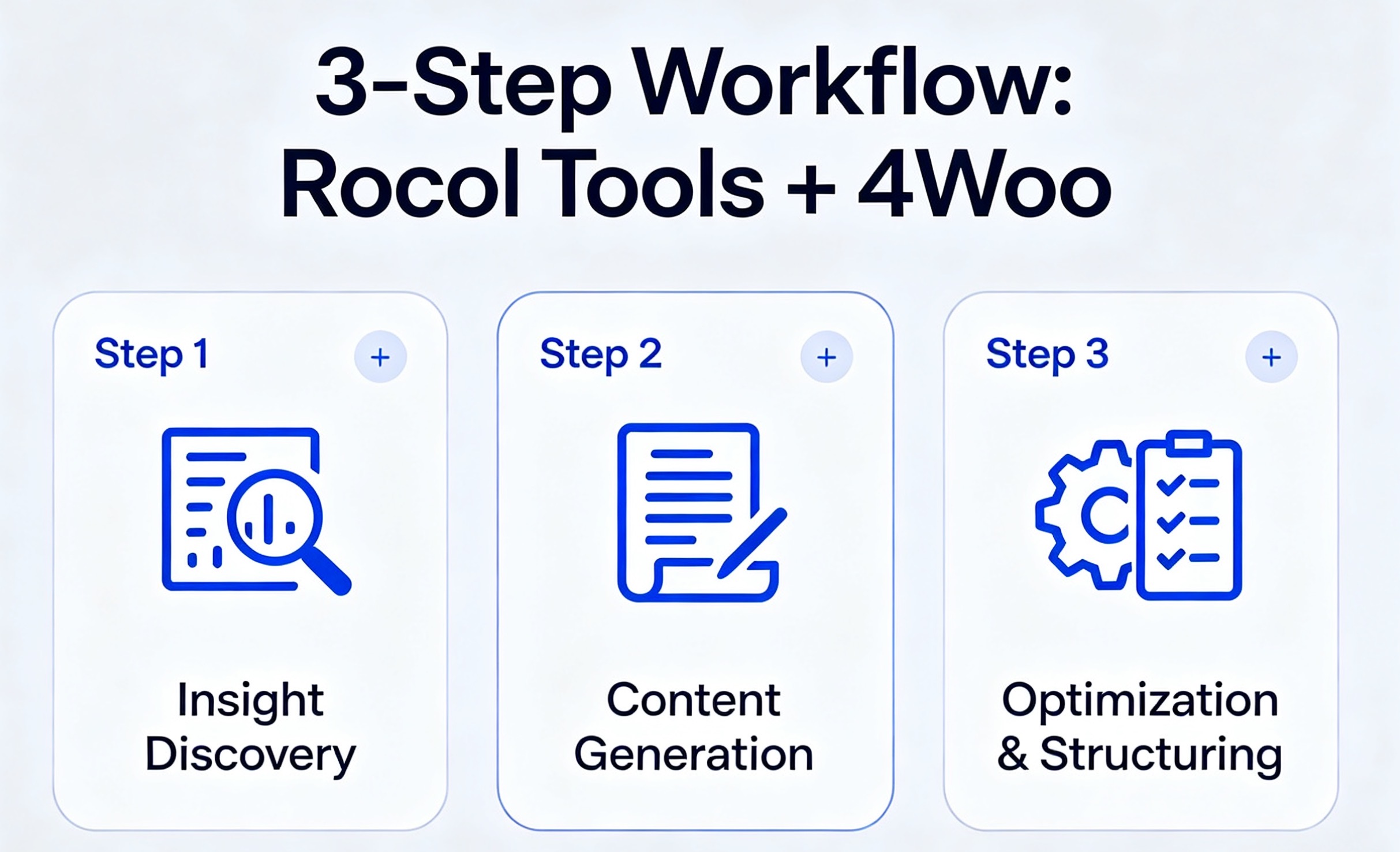
Maximizing the efficiency of this dual-engine framework is achieved by deploying Rocol Tools and 4Woo in a unified, end-to-end tactical workflow:
Phase 1 (Discovery): Utilize Rocol Tools to analyze the latest shifting market trends, identifying emerging semantic entities, long-tail search questions, and structural informational gaps within your niche.
Phase 2 (Production): Feed the raw semantic datasets discovered by Rocol Tools directly into the 4Woo production matrix. 4Woo synthesizes this data, leveraging its robust AI writing engine to draft long-form, highly detailed pieces complete with the exact H2, H3, and H4 nesting structures required for premium readability.
Phase 3 (Optimization & Formatting): Configure 4Woo to polish the article’s GEO metrics—automatically formatting dense comparison tables, summarizing key takeaways into bulleted TL;DR blocks optimized for featured snippets, and embedding appropriate Schema markup.
This streamlined process guarantees that every single piece of content deployed onto your domain acts as a double-edged sword: slashing through competition in traditional Google SEO ranks while effortlessly capturing valuable real estate in generative AI overview windows.
The future of search is undeniably multi-dimensional. Consumers will continue to navigate between the analytical precision of classic Google search grids and the fluid, conversational summaries of generative AI engines. Treating SEO and GEO as opposing methodologies is a critical marketing failure; they are complementary halves of a singular modern visibility architecture.
By establishing rigorous technical standards, designing comprehensive entity-driven strategies, and providing structured, fact-dense data assets, your brand can secure market dominance across all digital platforms. Integrating market-leading solutions like Rocol Tools for intelligent keyword discovery alongside 4Woo for automated, AI-optimized structured content distribution provides the exact technological leverage required to remain invincible in the face of algorithmic evolution. Start auditing your content assets today, implement the dual-engine strategy, and position your brand at the center of the next generation of search.


