
English
Views: 0 Author: Site Editor Publish Time: 2026-07-23 Origin: Site


In modern manufacturing, assembly efficiency directly dictates profitability, product reliability, and market competitiveness. Whether you operate an automotive plant, an aerospace fabrication facility, a commercial HVAC assembly line, or a heavy structural steel enterprise, mechanical joints are central to your structural integrity. Among permanent fastening methods, blind riveting remains one of the most reliable, vibration-resistant, and shear-capable joining technologies available.
However, many facility managers and manufacturing engineers overlook a critical variable in assembly throughput: selecting the optimal riveting tool for their specific production ecosystem. Deploying an underpowered tool leads to incomplete rivet sets, operator fatigue, and quality rejections. Conversely, over-specifying tools can lead to unnecessary capital expenditure, high air compressor loads, or excessive line downtime. In this comprehensive buyer’s guide, we break down the engineering metrics, utility demands, ergonomics, and brand ecosystems—highlighting benchmark solutions from industry leaders like Rocol Tools and 4Woo—to help you select the ideal riveting tools for your manufacturing floor.
Assembly line optimization requires more than just high-speed robotics; it demands that every hand-operated or automated tool performs with 100% repeatability.
A single failed rivet on a high-speed production line creates a ripple effect:
Immediate Bottlenecks: Operators must stop to clear jammed mandrels or manually re-work bad sets.
Material Fatigue: Inconsistent pulling force can crush sensitive composite parent materials or fail to deform high-tensile stainless steel fasteners completely.
Workplace Injuries: Outdated, poorly balanced tools increase repetitive strain injuries (RSI) and carpal tunnel syndrome, leading to increased worker compensation claims and high absenteeism.
While manual hand riveters exist for field maintenance or low-volume prototyping, industrial assembly relies on fluid-power systems—specifically pneumatic, hydraulic, hydropneumatic, and lithium-ion cordless platforms. Modern power tools convert air or fluid pressure into precise linear pulling forces, setting fasteners in fractions of a second.
Selecting a riveting system requires a thorough technical audit of your assembly layout, materials, and production goals.
Fastener dimensions and metallurgy determine the raw mechanical pull force required from your tool.
Different alloys demand vast variations in pulling force. For example, setting a 4.8mm aluminum blind rivet requires significantly less tensile force than setting a 6.4mm structural stainless steel rivet.
Light Duty ($5,000\text{ N}$ to $8,000\text{ N}$): Suitable for aluminum rivets in signage, thin ductwork, and light electronics.
Medium Duty ($9,000\text{ N}$ to $14,000\text{ N}$): Ideal for automotive body panels, commercial HVAC, and standard steel fabrication.
Heavy Duty ($15,000\text{ N}$ to $50,000+\text{ N}$): Necessary for large-diameter monobolts, structural steel framing, trailers, and railway car construction.
Ensure the tool’s stroke length matches the rivet grip range. If a tool has a short stroke (e.g., 14mm) and you are setting long-grip fasteners, the operator will be forced to "double-pump" the trigger, cutting throughput in half. Look for single-pull stroke lengths between 20mm and 26mm for long fasteners.

Every power source platform brings distinct operational trade-offs to the shop floor.
| Power Source Platform | Operational Advantages | Key Limitations | Primary Shop Floor Use Case |
| Pneumatic | High cycle speed, lightweight, quick reset | Requires compressed air line, air hose restricts movement | High-velocity, fixed workstation assembly lines |
| Hydropneumatic | Massive pull force, uses standard shop air lines | Higher initial cost than pure pneumatic | High-tensile fasteners on standard factory air networks |
| Pure Hydraulic | Extreme force output ($20,000\text{ N}-50,000\text{ N}+$), slender head | Requires external floor power unit (HPU) and hoses | Heavy structural steel, shipbuilding, heavy transit |
| Cordless (Li-Ion) | Total worker mobility, zero air hose trip hazards | Battery recharge cycles, slightly heavier on hand | Work inside enclosed structures, field service, scaffoldi |
Pneumatic tools run on plant compressed air ($5.5\text{ bar}$ to $7.0\text{ bar}$). Hydropneumatic hybrid systems use compressed air to drive an internal hydraulic fluid intensifier cylinder. This delivers the massive pull forces of hydraulics while utilizing existing shop air infrastructure.
Hydraulic riveting tools utilize incompressible hydraulic oil supplied by an external Hydraulic Power Unit (HPU). Because oil does not compress,They deliver ultra-smooth, linear forces upwards of $20,000\text{ N}$ to $50,000\text{ N}$, making them the ultimate choice for heavy structural steel assembly.

Driven by modern brushless motors and lithium-ion battery chemistry, cordless tools eliminate air hoses and trip hazards. They are ideal for working inside enclosed structures, field maintenance, and high-level construction scaffolding.
Operator efficiency drops sharply when tools are heavy or poorly balanced.
Weight Distribution: Look for tools that center the motor or cylinder directly above the operator's grip.
Vibration Attenuation: Lower vibration ratings ($<2.5\text{ m/s}^2$) protect operators during multi-shift operations.
Noise Levels: High exhaust noise causes ear fatigue; choose tools with integrated mufflers or silent hydraulic fluid displacement.
High-volume lines require rapid tool resets ($<1.0\text{ second}$ per cycle). Additionally, modern Industry 4.0 plants require tools that integrate with automated vacuum retention systems or smart sensors to verify complete rivet seating before moving the assembly along the line.
When selecting industrial-grade riveting equipment, aligning with top-tier brands ensures access to premium metallurgy, long service life, and digital support. Two market standards driving innovation across manufacturing sectors are Rocol Tools and 4Woo.
| Brand Focus | ROCOL TOOLS (Heavy Industrial Muscle) | 4WOO (Smart Automation & Precision) |
| Core Metallurgy | Drop-Forged Steel Head Frame | Lightweight Ergonomic Alloy Housing |
| Duty Cycle & Thermal | High Thermal Duty Cycle (Non-stop shifts) | Adaptive Energy Management |
| Automation & Sensors | High Mechanical Force Output | Adaptive Microprocessor Sensors |
| Workplace Cleanliness | Heavy Rear Gravity Mandrel Catch | Automated Venturi Vacuum Retention |
| Target Application | Heavy Structural Steel & High-Tensile Fasteners | High-Speed Assembly Lines & Clean Workshops |
When assembly lines demand raw durability, continuous operation, and extreme pull capacities, Rocol Tools is an elite industry reference.
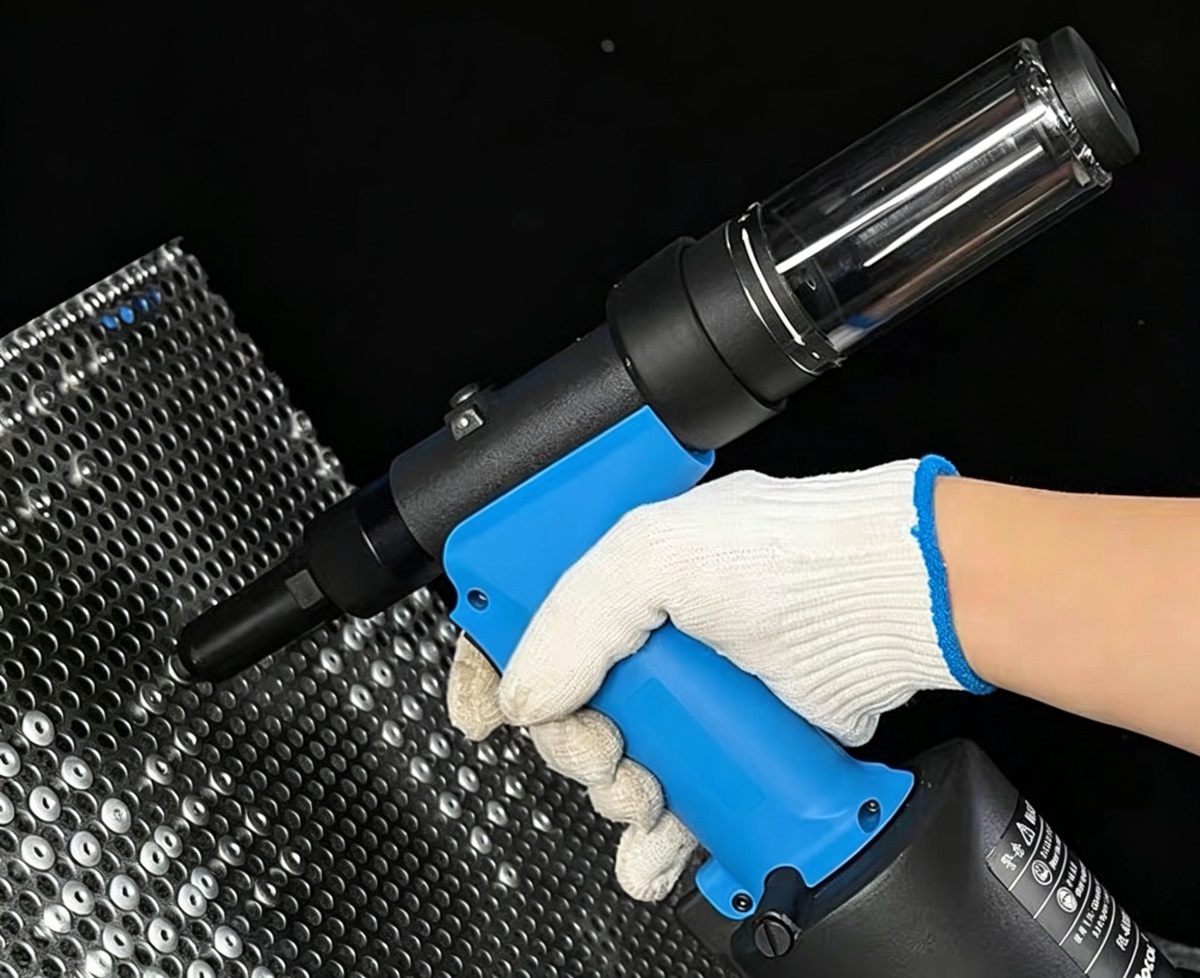
Rocol Tools engineers its hydraulic and heavy-duty hydropneumatic platforms with drop-forged alloy steel frames and tungsten-carbide jaw sets. This heavy-duty construction prevents jaw slippage and housing expansion even under continuous multi-shift production schedules. Furthermore, internal heat-dissipation channels prevent fluid breakdown during non-stop operation.
For heavy transport, shipbuilding, and structural steel framing, Rocol Tools equipment generates massive pulling forces ($20,000\text{ N}$ to $50,000+\text{ N}$). This allows operators to deform large-diameter stainless steel and monobolt fasteners cleanly in a single stroke, eliminating double-trigger pulls and ensuring maximum line throughput.
Where assembly demands high speeds, cleanroom-level neatness, and digital quality control, 4Woo leads the industry in smart pneumatic and electronic platforms.
A signature innovation of the 4Woo platform is its automated venturi vacuum retention system. The tool holds the loose rivet securely at any angle—even upside down—preventing fasteners from falling out prior to trigger activation. Upon snapping, the spent steel mandrel is instantly drawn into a clear rear collection cup, keeping production floors free of dangerous sharp metal waste.
4Woo embeds intelligent micro-sensors into its smart riveting tool series. These sensors monitor stroke displacement and cycle pressure in real time. If a rivet fails to set fully or a mandrel snaps prematurely due to material flaw, the 4Woo system alerts the operator via visual LED indicators, preventing defective assemblies from moving down the line.
To streamline your procurement evaluation, the matrix below compares standard consumer tools against specialized offerings from Rocol Tools and 4Woo:
| Feature Specification | Standard Commercial Tools | Rocol Tools Heavy-Duty Series | 4Woo Smart Precision Series |
| Primary Power Medium | Basic Pneumatic / Brushed DC | High-Capacity Hydraulic / Hydropneumatic | Smart Hydropneumatic / Brushless Cordless |
| Pulling Force Output | $5,000\text{ N} - 9,000\text{ N}$ | $20,000\text{ N} - 50,000+\text{ N}$ | $10,000\text{ N} - 22,000\text{ N}$ (Adaptive) |
| Target Material Class | Aluminum / Standard Steel | Heavy Stainless / Structural Alloys | Multi-Alloy / Sensitive Composites |
| Cycle Speed | $1.5 - 2.5\text{ seconds}$ | $1.2 - 1.8\text{ seconds}$ | $< 0.9\text{ seconds}$ |
| Mandrel Retention | Manual Drop / Tilt | Heavy Rear Gravity Catch | Automated Venturi Vacuum Retention |
| Quality Tracking | None | High-Durability Mechanical Output | Adaptive Sensor & LED Cycle Verification |
Preventative maintenance protects your capital equipment and ensures consistent setting force.
Daily Air Line Lubrication: Add 2 to 3 drops of light pneumatic oil into the inlet if operating without an automated inline oiler.
Shift Mandrel Evacuation: Empty collection cups before they overflow to prevent internal jamming.
Weekly Jaw Cleaning: Disassemble the front nose housing using a quick-change wrench. Extract the three-piece jaw set and clean metal shavings from the teeth using a brass wire brush.
Monthly Fluid Inspections: On hydraulic units like those from Rocol Tools, check oil clarity and replace contaminated or emulsified hydraulic fluid.
Follow this three-phase process to select the ideal riveting tools for your manufacturing floor:
List all fastener alloys (aluminum, steel, Grade 304/316 stainless steel) and diameters.
Determine the maximum tensile pull force required for your toughest fastener.
Identify geometry constraints (e.g., tight channels requiring slender nosepieces).
Evaluate plant compressed air capacity (bar pressure and CFM flow).
Determine if air hose mobility limits operators, favoring cordless or compact hydraulic tools.
Partner with reputable manufacturers like Rocol Tools for heavy structural applications or 4Woo for high-speed, vacuum-assisted assembly lines.
Request sample testing to verify cycle speeds and ergonomic comfort during real-world operator shifts.
Selecting the right riveting tool is a key operational decision that directly impacts product quality, operator safety, and manufacturing profitability.
Choose the heavy-duty, drop-forged muscle of Rocol Tools if your facility manages high-volume structural assembly involving heavy stainless steel, structural monobolts, or thick carbon steel plates.
Invest in the smart, high-speed ecosystems of 4Woo if your facility requires rapid cycle speeds, integrated vacuum mandrel collection, and adaptive quality monitoring.
By evaluating your joint mechanics, utility infrastructure, and vendor capabilities, you can build a reliable, high-throughput assembly operation built for long-term success.

A: Yes, for small-to-medium diameters ($2.4\text{ mm}$ to $6.4\text{ mm}$). Hydropneumatic tools use air to boost internal fluid pressure, delivering high pulling force. However, for large structural steel fasteners ($>6.4\text{ mm}$ to $10\text{ mm}+$), heavy hydraulic systems from brands like Rocol Tools are recommended for continuous multi-shift production.
A: The 4Woo system uses negative venturi air pressure to immediately draw spent metal pins into an enclosed rear collection cup upon snapping. This prevents sharp metal mandrels from scattering across the factory floor, eliminating trip/slip hazards and protecting sensitive assembly surfaces from scratches.
A: Jaw slippage occurs when metal shavings from pulled mandrels build up in the jaw teeth, or when jaws become worn from unhardened metallurgy. Regular cleaning with a brass wire brush and choosing tools with heat-treated tungsten-carbide jaws—such as those engineered by Rocol Tools—prevents slippage and extends jaw service life.


